Things to Do on the Big Island: 15 Best Picks Worth Your Time
18 min readYndira W. Tonin
The best things to do on the Big Island are the ones you cannot do anywhere else in Hawaii, stand beside an active volcano, stargaze from nearly 14,000 feet, and snorkel with manta rays in the dark. It is the wild, oversized, slightly otherworldly island, and it rewards the curious and the willing to drive.
Here is the thing to understand first, the Big Island is genuinely big. It is larger than all the other Hawaiian islands combined, and it packs in something like eight of the world's climate zones, snow on the summits, rainforest in Hilo, desert lava fields, and sunny Kona beaches, sometimes in the same afternoon.
That means you do not "see" the Big Island in a day. You pick a few experiences, accept some real driving, and let the island show you things that do not exist anywhere else on earth. This guide is sorted by experience so you can build the trip around what you came for.
Table of Contents
01
How to plan the Big Island
Two facts run your whole trip, the island is huge, and it has two very different sides.
Plan on five to seven days. Three or four can cover the Kona coast and Volcanoes National Park if you hustle, but a week lets you reach both coasts, the Kohala resorts, and the Hamakua waterfalls without living in the car.
The drives are real. Kona to Volcanoes National Park is about 2.5 hours. Kona to Hilo is roughly 2 hours over Saddle Road. The island looks compact on a map and then quietly eats a morning getting you from one good thing to the next.
Because of that, many people split their stay between two bases, the sunny, dry Kona/Kohala side for beaches, and the green, rainy Hilo side for waterfalls and quick access to the volcano. You do not have to, but it saves a lot of backtracking.
You will absolutely need a rental car. There is no useful transit and the highlights are scattered across a county the size of Connecticut. Book it early, and check the rental terms for Saddle Road and the Mauna Kea access road, which some companies still treat as forbidden territory. The cool ranch town of Waimea is the nearest base for the climb.
Finally, pack for range. You can start the day on a 80-degree beach and end it shivering at a freezing summit, so bring real layers even though every instinct on a Hawaii trip says shorts. Our best time to visit Hawaii guide covers the seasons, and the best island comparison shows where the Big Island fits.
02
Stand at an active volcano
This is the headliner, and it is the one experience that genuinely exists nowhere else in the United States.
Hawaii Volcanoes National Park is built around Kilauea, one of the most active volcanoes on earth, and a UNESCO World Heritage Site that runs from the coast to nearly 14,000 feet. Walking through steam vents and across old crater floors is remarkable on its own.
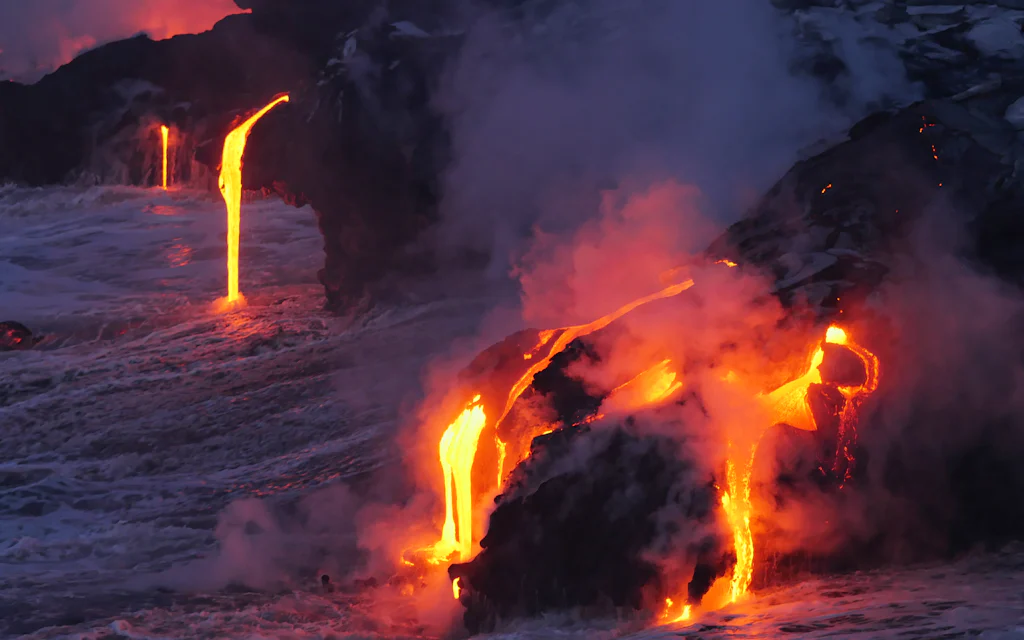
If Kilauea is erupting during your visit, the sight of molten rock glowing against the night sky is the kind of thing you will describe for the rest of your life. Eruptions come and go, so check current conditions with the National Park Service before and during your trip.
Do not miss the Kilauea Iki Trail, a roughly four mile loop that drops through rainforest and across a crater floor that was a lava lake within living memory. It is the best hike in the park and one of the best in Hawaii.
Add the Thurston Lava Tube, the Chain of Craters Road down to the coast, and, if it is glowing, a return trip after dark, the lava show is entirely different at night. Give the park a full day, bring a headlamp and a jacket, and fill the tank first. Gas is scarce up there.
Two more notes that save the visit. Your entry pass is good for several days, so the smart move is to come in the afternoon, drive out for dinner, and return after dark for the glow, two completely different parks for one fee.
And genuinely dress for it. The park climbs thousands of feet from the coast, and the crater rim is cool, breezy, and often misting even when Kona is roasting. People show up in beach clothes and spend the evening shivering instead of staring at lava.

Photo by Marc Szeglat on Unsplash
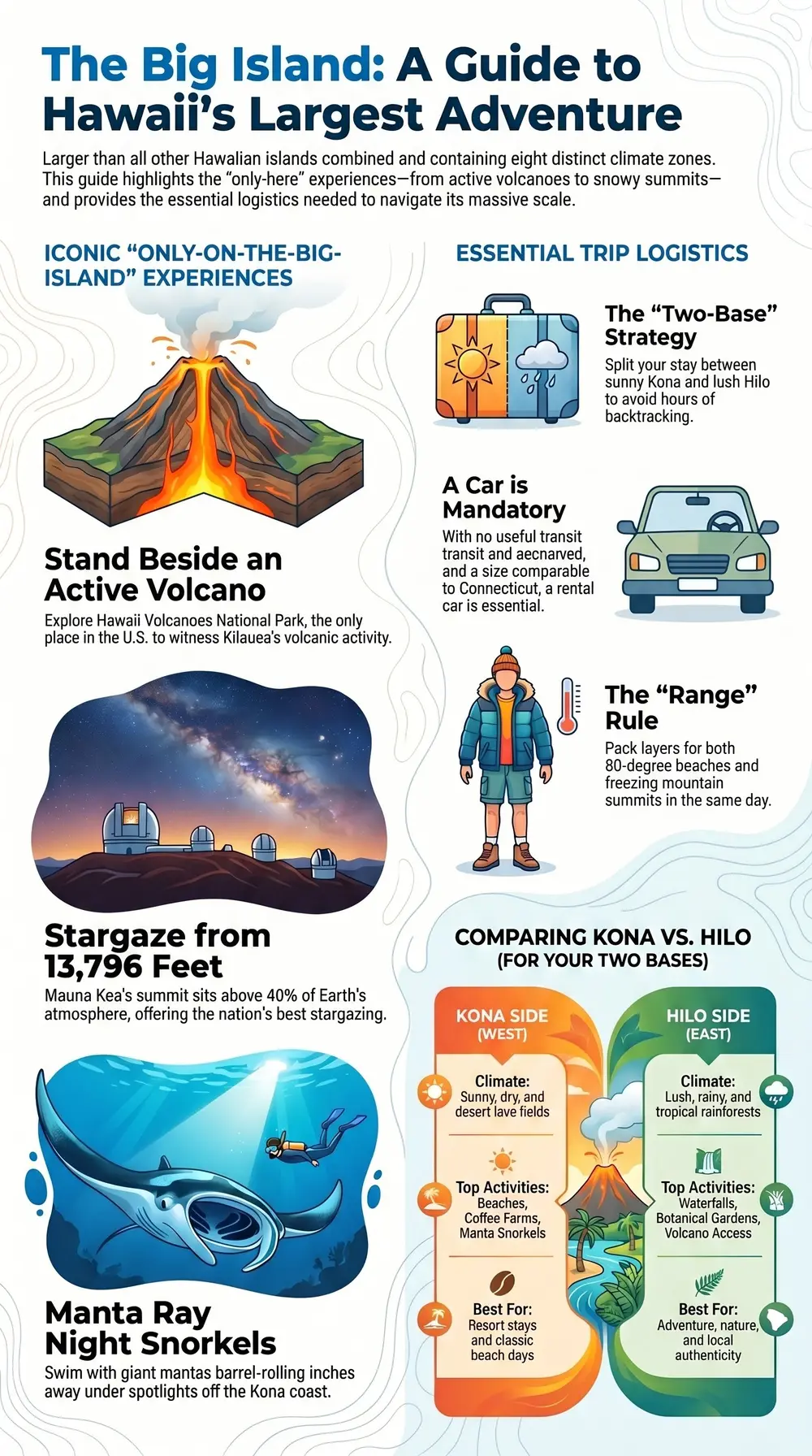
The Big Island at a glance, the only here experiences and the Kona vs Hilo two base plan.
03
Stargaze atop Mauna Kea
At 13,796 feet, Mauna Kea's summit sits above 40 percent of the planet's atmosphere, which is why the world's great observatories cluster up there, and why it is the best stargazing in the country.
A Mauna Kea summit and stars tour is the easy way to do it. It handles the altitude, the cold, and the driving, taking you up for sunset above the clouds, then back down to the visitor station for telescope viewing under a sky absolutely thick with stars.
★4.8(1,592)
Big Island: Mauna Kea Summit and Stars Small-Group Adventure Tour
8 hours
Free cancellation
from
$330
Going on your own is possible but serious. You need a high clearance four wheel drive (and a rental company that allows the road), you must stop to acclimatize at the visitor station, and the summit is genuinely freezing and thin on oxygen.
A couple of honest notes. Altitude sickness is real up there, so skip the summit if you are pregnant, have heart or breathing issues, or have been diving in the last day. And it can be cloudy or closed, the mountain has the final say, as it does with everything on this island.
Even if you skip the summit, the visitor station at 9,200 feet has free stargazing programs on clear nights, and the drive up Saddle Road through the lava plains between the two great volcanoes is a strange, lunar pleasure in itself.
And the payoff up top is hard to oversell. The air is so clear and dark that even with the naked eye you will see more stars than you knew were there, with the Milky Way smeared across the sky like spilled sugar.
Bring a red flashlight if you have one (it preserves your night vision), dress like it is the middle of winter, and give your eyes a solid twenty minutes to adjust before you decide the sky is not impressive. It is. You are just still city blind.

Photo by Tell Death I am Busy on Unsplash
04
Snorkel and meet a manta ray
The Big Island's water is as good as its land, and one experience tops the list, the manta ray night snorkel off the Kona coast.
After dark, boats anchor and shine lights into the water to draw plankton, and the mantas, some with wingspans over a dozen feet, arrive to feed, barrel rolling inches beneath you. It is surreal, a little intimidating, and routinely ranked among the best marine encounters on the planet.
By day, Kealakekua Bay is the marquee snorkel, a protected marine sanctuary with coral, dolphins, and water so clear it looks filtered. You reach the best of it by kayak or boat tour from the Kona side.
Two Step at Honaunau, right next to the Place of Refuge, is the easy shore entry alternative, walk in off the lava ledge and the reef starts immediately.
Whatever you do in the water, the usual rules hold, go in the morning for the calmest conditions, wear reef safe sunscreen, and give the turtles and mantas their space. They are the locals. You are the guest.
A few logistics worth knowing. The manta night snorkel books out, so reserve a week or two ahead, and pick an operator that caps group size and follows the wildlife guidelines, the experience is far better with fewer lights and fewer flailing limbs around you.
Kealakekua and Two Step are best in the calm morning hours, before the wind and the day trippers arrive. And if you are nervous about a night swim, most manta trips offer the same encounter from the boat with a flotation device, so you can keep your face in the water and your nerves on the surface.
05
See the colored sand beaches
The Big Island does beaches differently. The volcano gives it sand in colors you will not see anywhere else, plus the bonus that some beaches are barely a few decades old.
Punaluu Black Sand Beach is the famous one, jet black sand from cooled lava, palm trees, and green sea turtles that haul out to bask in the afternoon. Keep your distance from the honu. It is the law and the right thing.
Papakolea (Green Sand Beach) is the genuinely rare one, its olive green sand tinted by a mineral called olivine. Reaching it is a hot, windy, three mile each way hike (or a bumpy local shuttle), and it is worth it for the novelty alone.
For classic golden sand and easy swimming, the Kohala Coast delivers, Hapuna Beach is a wide, gorgeous, lifeguarded stretch, and Makalawena rewards a short walk with near empty sand, see our best beaches on the Big Island guide for the full lineup.
The same rule applies as on every island, check the surf, swim where there are lifeguards when you can, and respect the ocean. Some of these beaches are remote, with no services and no one watching but the turtles.
A practical tip for the green sand hike, bring far more water than feels reasonable, wear real shoes, and start early. There is no shade, no services, and the afternoon sun on that exposed trail has turned plenty of confident hikers into puddles.
The black sand and Kohala beaches, by contrast, are easy roadside stops, so if you only have energy for one adventure, spend it on the green sand and keep the rest casual.

Photo by Josh Withers on Unsplash
06
Chase waterfalls and valleys
The wet Hilo side of the island is a different world, green, and laced with waterfalls you can reach with almost no effort. Hilo is also the home of the Merrie Monarch Festival, the world's premier hula competition, held here every spring.
Akaka Falls is the easy showstopper, a paved loop through jungle leads to a 442-foot cascade, with a second waterfall thrown in along the way. Twenty minutes of walking for one of the best falls in the state.
Rainbow Falls, right in Hilo, is a roadside stunner that throws actual rainbows in the morning mist when the light cooperates.
Waipio Valley on the Hamakua coast is the dramatic one, a deep, sacred, impossibly green valley behind a black sand beach. The lookout is gorgeous and easy. The road down is brutally steep and now restricted, so admire it from the top unless you are on a sanctioned tour, our Waipio Valley lookout guide has the current 2026 access rules. For a north coast valley you can still hike into, see Pololu Valley at the other end of the Kohala mountains.
The Hilo side rains often, which is exactly why it is so green. Pack a light jacket, accept the occasional shower, and you get the waterfalls and the rainforest as your reward.
Hilo town itself is worth an hour while you are over there. It has a walkable old downtown, one of the best farmers markets in the state, and a couple of small museums for when the rain truly settles in, our things to do in Hilo guide breaks down the whole east side.
It is the un touristy, real Hawaii counterweight to the glossy resort coast, and a surprising number of visitors leave wishing they had given the wet side more of their week.

Photo by Micah Alameda on Unsplash
07
Drink the Kona coffee
The Big Island is the only place in the United States that grows coffee commercially at scale, and the Kona belt on the island's western slopes produces some of the most famous beans in the world.
Touring a Kona coffee farm is a genuinely good half day, you walk the orchard, learn why the volcanic soil and the elevation matter, and taste the difference between the real thing and the "Kona blend" that is mostly not Kona.
Many farms sit right above Kailua-Kona, so you can pair a morning tasting with an afternoon at the beach. The small, family run estates are the ones worth seeking out.
And it is not just coffee. The same slopes grow cacao, so you can tour a chocolate farm too, and the upcountry town of Holualoa is a walkable cluster of art galleries and coffee shops that makes for a lovely, low key break from the sun.
Buy the beans straight from the farm. It is fresher, it supports the growers directly, and it is the one souvenir that does not end up in a drawer.
If coffee is not your thing, the same drive still pays off. The Captain Cook and Kealakekua area is layered with history, from the Captain Cook Monument to Pu'uhonua o Honaunau, the restored "Place of Refuge" where, in old Hawaii, lawbreakers who reached it earned a second chance.
It is a quiet, genuinely moving stop that most beach bound visitors drive right past, and it pairs naturally with a Kealakekua snorkel and a farm tour into one easy west side day.
08
A perfect Big Island plan
If you want a shape to start from, here is how a week tends to flow when you split it between the two sides.
Days 1 to 3, Kona/Kohala side: beach mornings on the Kohala Coast, a Kona coffee farm, snorkeling Kealakekua Bay, and the manta ray night snorkel for the night everyone ends up talking about.
Day 4, transit and Mauna Kea: drive Saddle Road across the island, acclimatize, and take a sunset and stars trip up Mauna Kea.
Days 5 to 7, Hilo/Volcano side: a full day in Hawaii Volcanoes National Park (and back after dark if it is glowing), the Hilo waterfalls, the Waipio Valley lookout, and Akaka Falls.
That rhythm, one big thing a day, real drives between regions, and a beach or a waterfall to land on, fits the island far better than trying to loop it from a single base.
Two or three days is enough for a focused taste of the volcano and the Kona coast. But the Big Island rewards the full week more than any other island, precisely because everything is so spread out.
However you split it, leave some slack in the schedule. The island's weather and its distances both have a way of rearranging plans without asking.
The travelers who roll with it, a surprise clear summit one night, an extra hour at a beach the next, always seem to come home with the best stories. The ones who over plan come home tired and behind.
09
What to skip (or do differently)
The honest list, because somebody should say it.
Do not try to circle the island in a day. It is a 200-plus-mile loop with mountains in the middle. You will spend the whole day driving and see none of it properly.
Do not base in one spot and day trip everything. The Kona to Hilo haul is brutal as a round trip. Split your stay, or at least cluster your days by side.
Do not drive to the Mauna Kea summit in a regular car, after diving, or without acclimatizing. It is high, cold, and unforgiving, and most rental contracts forbid the road anyway.
Do not expect lava on demand. Eruptions are not scheduled. If Kilauea is quiet during your visit, the park is still extraordinary, adjust your expectations, not your trip.
Do not skip the Hilo side because it rains. The rain is the whole reason it is so green and so full of waterfalls. Pack a jacket and go.
Do not under budget the volcano. People give the park a rushed couple of hours and regret it. It is the reason many visitors come to the island at all, and it deserves a full, unhurried day, ideally bookended by a daylight visit and a return after dark.
10
When to go and where to stay
The sweet spot seasons are April to early June and September to early November, warm, drier, fewer crowds, lower rates. The Big Island is less seasonal than the others, but the Kona side stays reliably sunny year round while Hilo is wetter in every month.
For where to sleep, the Kohala Coast has the island's marquee resorts and the most dependable sunshine, set against dramatic old lava fields. Kailua-Kona is the lively, walkable, better value base on the same dry side.
Hilo is the rainy, affordable, authentically local town near the waterfalls and the easiest jump to the volcano. And Volcano Village, right by the park, is the move if you want to do the lava show at night without a long drive home. You can compare Big Island hotels on Expedia (also on Booking.com) from Kohala and Kona to Hilo and Volcano.
Split between a dry side and a wet side base if you can. It is the single best way to tame the island's size.
On a budget, lean toward Hilo or Kailua-Kona over the Kohala resorts, the rooms cost less, the local food is better, and you are closer to the volcano and the waterfalls anyway. The Kohala splurge is about the beaches and the polish, not the access.
A note from us, since we are an Oahu outfit, if your trip also touches Oahu, that is where we set up our beach picnics, you can see what we do here. On the Big Island, chase the lava and the coffee. We will hold down the other island.
FAQ: visiting the Big Island
How many days do you need on the Big Island?
Five to seven. Three or four covers the Kona coast and Volcanoes National Park in a hurry. A week lets you see both sides, the Kohala beaches, and the Hilo waterfalls without living in the car. It is the most spread out island, so give it time.
What is the number one thing to do on the Big Island?
Visit Hawaii Volcanoes National Park, standing beside an active volcano is the experience you cannot get anywhere else. The manta ray night snorkel and Mauna Kea stargazing are close behind.
Can you see lava on the Big Island?
Sometimes. Kilauea is one of the most active volcanoes on earth, but eruptions come and go, so check the National Park Service for current activity. Even with no active lava, the park's craters, lava tubes, and steam vents are worth a full day.
Do you need a car on the Big Island?
Yes, without question. The island is enormous, the highlights are scattered across both coasts, and there is no useful public transit. Rent a car, and check whether the contract allows Saddle Road and the Mauna Kea access road.
Is the Big Island good for a first trip to Hawaii?
It is fantastic for adventurous, nature first travelers, but it is the most spread out and least beach resort y of the main islands. First timers who mostly want easy beaches and logistics often prefer Oahu or Maui. Our best island to visit guide compares them.
When is the best time to visit the Big Island?
April to early June and September to early November for the best mix of weather, crowds, and price. The Kona side is sunny year round. The Hilo side is wetter in every season, which is why it is so green.
What local foods should you try on the Big Island?
Start with loco moco, which was invented here. The rice, burger, egg, and gravy plate was born in Hilo, and the island also gave us Kona coffee, Punalu'u sweet bread, and some of the freshest poke and fish anywhere. Eat at farmers markets and roadside stands over resort restaurants, that is where the island actually eats.
Disclosure: Some links on this page are affiliate links. If you book or buy through them we may earn a small commission, at no extra cost to you. As an Amazon Associate, we earn from qualifying purchases.

