Things to Do in Hilo: The Rainy, Lush Side of the Big Island (2026)
25 min readYndira W. Tonin
The best things to do in Hilo are chasing waterfalls, wandering Japanese gardens, and snorkeling with sea turtles - all in the rainy, ridiculously green town that most Big Island visitors treat as a quick stop and shouldn't. Hilo is the island's other half: wet where Kona is dry, local where Kona is resort, and the closest base by far to the volcano.
This guide covers the in town highlights, the day trips worth the drive, where to eat, and how to handle the rain (you will get rained on, and it's fine). It's written for the traveler deciding whether Hilo deserves more than a drive through - as of 2026 it absolutely does, with one important closure to plan around. Everything here is sorted by what it actually delivers, not just what's nearby.
Table of Contents
- What's in this guide: Hilo's character
- Chase the waterfalls: Rainbow Falls and Boiling Pots
- Akaka Falls State Park and the Hamakua Coast drive
- Stroll Liliuokalani Gardens (and Coconut Island's closure)
- Browse the Hilo Farmers Market
- Explore historic downtown Hilo
- Kaumana Caves and the Imiloa Astronomy Center
- Carlsmith Beach Park and Hilo's turtle beaches
- Meet the animals at the Panaewa Rainforest Zoo
- Tour a farm: chocolate, vanilla, and macadamia
- Day trip to Hawaii Volcanoes National Park
- Day trip up Mauna Kea
- Where to eat in Hilo
- How many days in Hilo, and when to go
- Where to stay in Hilo
- FAQ: Things to do in Hilo
What's in this guide: Hilo's character
Hilo is the wettest city in the United States, and that single fact explains everything you'll love and everything you'll grumble about. The roughly 128 inches of rain a year are why waterfalls run five minutes from downtown, why the gardens are lush enough to feel prehistoric, and why a hotel room here costs a fraction of a Kona resort. You trade reliable sunshine for genuine, green, unpolished Hawaii.
Hilo at a glance
The honest framing is Hilo versus Kona, because most people pick one to base on. Kona, on the dry west side, is the snorkeling and resort half. Hilo, on the rainy east, is the waterfalls and rainforest half - and it's the obvious base if Hawaii Volcanoes National Park is high on your list, since the park entrance is 45 minutes up the hill instead of two hours across the island. Plenty of people split their stay; if you can only pick one and you want nature over a tan, base in Hilo and read our things to do in Kona guide for the days you drive west.
Hilo vs Kona: which side are you?
Hilo (east side)Our pick
Rainy, lush, local
- Waterfalls, gardens, rainforest, black sand
- Real working town, low-key and affordable
- Closest base for Volcanoes National Park
- Expect rain - that's the deal you make
Kona (west side)
Dry, sunny, resort
- Snorkeling, coffee farms, white-sand beaches
- Resorts, luaus, and reliable sunshine
- A two-hour drive from the volcano
- Pay more for the guaranteed tan
The other thing to know up front: Hilo is spread out and the bus is sparse, so this is a town you need a rental car for. Almost everything below costs nothing or close to it, the distances are short, and the rain is warm. Most of the best things to do in Hilo Hawaii are outdoors and weather dependent, so the winning strategy is simply to front load the day - waterfalls and beaches in the morning, indoor stops for the afternoon shower. Bring a light shell, accept that you'll be a little damp, and the town opens right up.
01
Chase the waterfalls: Rainbow Falls and Boiling Pots
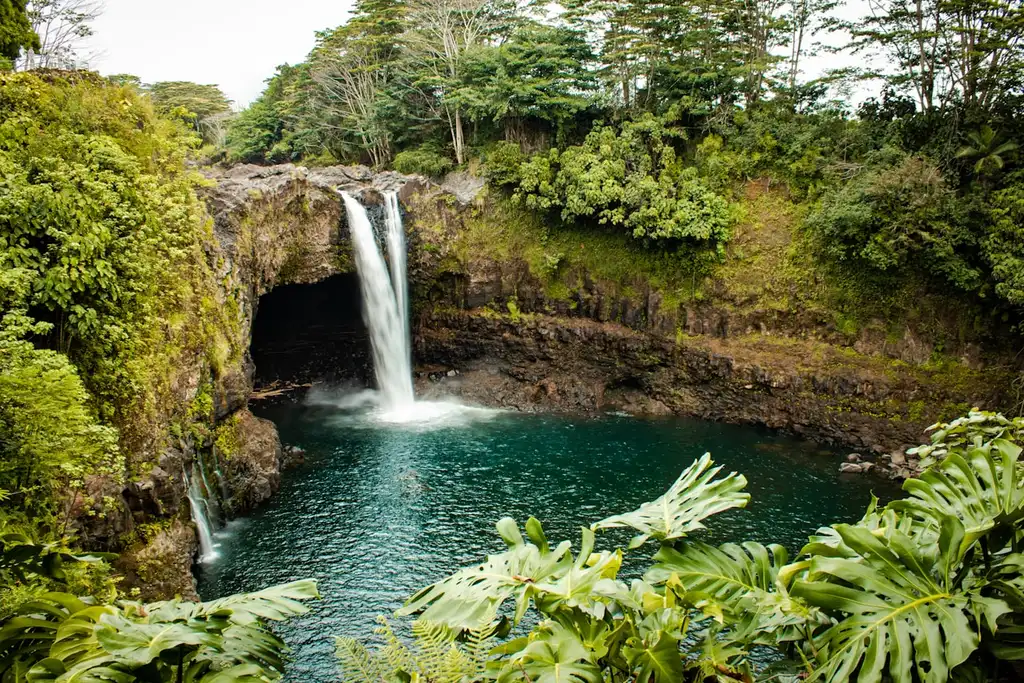
Start with the waterfalls, because Hilo's are the most accessible in Hawaii - no hike, barely a walk. Rainbow Falls (Waianuenue) is the headliner, an 80-foot curtain pouring over a lava cave into a wide pool, and it's a five minute drive from downtown with a parking lot right at the viewpoint. The name is literal: on a clear, sunny morning around 9 to 10am, the sun hits the mist and throws a rainbow across the falls. The cave behind the curtain is said in Hawaiian legend to be the home of Hina, the goddess mother of the demigod Maui, which is the kind of detail that makes the stop more than a photo. Get there early, before the tour vans and before the clouds, and you might have the railing to yourself.
The Hilo-area waterfalls
Rainbow FallsFree
An 80-foot fall over a lava cave, 5 minutes from downtown. Go by 10am on a sunny morning for the rainbow in the mist.
Akaka Falls$5 parking
A 442-foot plunge up the Hamakua coast, reached by a short paved loop through jungle. The island's tallest easy waterfall.
Boiling PotsFree
A staircase of churning pools on the Wailuku River, just above Rainbow Falls. Look, don't swim - the current is deadly.
Pe'epe'e FallsFree
A wide multi-strand fall feeding the Boiling Pots, best after rain (which in Hilo is most days).
Just upstream sits Boiling Pots, a staircase of churning, bubbling pools on the same Wailuku River, fed by the wide strands of Pe'epe'e Falls. It's a short walk to the overlook and genuinely hard to look away from after rain, which in Hilo is most days. One firm warning, because this is where Hilo turns serious: people drown here. The pools look inviting and the current underneath is lethal, with no safe way out once it has you - this is a look, photograph, and stay behind the railing spot, full stop. For the full story on the falls, the rainbow timing, and parking, see our Rainbow Falls guide.
Quick facts: Cost: No charge · Time: 30-60 minutes for both · Best: Sunny morning by 10am · The move: Rainbow Falls first for the rainbow, then walk up to Boiling Pots.
02
Akaka Falls State Park and the Hamakua Coast drive
Fifteen miles north of town, Akaka Falls is the tallest waterfall you can see this easily on the Big Island - a single 442-foot ribbon dropping into a green gorge, reached by a short paved loop trail through a jungle of bamboo, ginger, and dangling vines. The whole loop takes about 30 minutes and passes a second waterfall, the 100-foot Kahuna Falls, on the way. Akaka Falls State Park charges nonresidents $5 each to enter plus $10 per vehicle to park, payable by card, and it's the rare Hawaii waterfall that rewards almost no effort. It pairs perfectly with the slow, scenic drive to reach it, and the little plantation town of Honomu at the turnoff is worth a stop for a malasada and a couple of galleries.

Photo: Andy Henderson on Unsplash
That drive is the Hamakua Coast, the old sugar coast north of Hilo, and it's a destination in itself: a green, cliff lined road dotted with waterfall pullouts, the four mile Onomea scenic drive, and small towns that time mostly forgot. Build in a stop at the Hawaii Tropical Botanical Garden on Onomea Bay if gardens are your thing - it's a steep, dense, dripping ravine of palms and orchids that earns its admission. For the Akaka logistics and how it ranks among the island's falls, our Akaka Falls guide has the details, and the Big Island waterfalls roundup covers the rest.
Quick facts: Cost: $5 entry per nonresident plus $10 per vehicle to park · Time: Half a day with the drive · The move: Combine Akaka with the Onomea scenic loop and the botanical garden.
03
Stroll Liliuokalani Gardens (and Coconut Island's closure)
On Hilo Bay sits one of the town's quiet surprises: Liliuokalani Gardens, the largest Edo style Japanese garden outside Japan. Built between 1917 and 1919 to honor the Japanese immigrants who came to work the sugar plantations, it's a free, walkable expanse of koi ponds, stone lanterns, arched red bridges, a teahouse, and pagodas, with Hilo Bay on one side and snow capped Mauna Kea behind it on a clear day. The whole bayfront it sits on is open green space for a reason - the 1946 and 1960 tsunamis wiped out the neighborhood that once stood here, and the town rebuilt it as parkland. It's the kind of place that turns a rainy afternoon into the quiet highlight of the trip - a genuine place to relax, with bay views and no admission, as long as you like.

Photo: valera visinky on Unsplash
Here's the catch, and it's the one piece of Hilo planning every other guide gets wrong: the footbridge to Coconut Island (Mokuola) collapsed in November 2025, and the island has been closed ever since. The county estimates a temporary bridge could take up to two years, with a permanent replacement years further out - so as of 2026, you can admire the little island from the garden's shore, but you cannot walk out to it. Don't build your afternoon around jumping off its tower the way older guides suggest; the gardens themselves are still wide open and worth an hour.
Quick facts: Cost: No charge · Time: 45-60 minutes · Note: Coconut Island is closed until the bridge is rebuilt · The move: Go at golden hour for the bay and the bridges.
04
Browse the Hilo Farmers Market
The Hilo Farmers Market is the best in the state, and it's a genuine market, not a craft fair with a produce table bolted on. Downtown at the corner of Mamo Street and Kamehameha Avenue, it runs daily but blooms on Wednesdays and Saturdays, when the full roster of farmers shows up with tropical fruit you've never heard of - rambutan, soursop, white pineapple, apple bananas, a dozen kinds of avocado. Bring cash and an empty stomach.
Beyond the fruit, it's a working lunch counter: plate lunch, fresh poke, laulau, malasadas, and cold coconuts macheted open while you wait. You can build a better, cheaper meal here than at most restaurants in town, then carry it two blocks to the bayfront. It's also the best single place to feel Hilo's pace - unhurried, local, and entirely unbothered by your itinerary. The market has anchored downtown since the 1980s and grew out of the same plantation era agriculture that shaped this whole side of the island, so browsing it is a small slice of Hawaiian culture as much as a grocery run.
If you're shopping for gifts, this beats any airport shop: lei, local honey, handmade crafts, Hilo grown coffee and vanilla, hand poured soaps, and macadamia everything. Come early on a Saturday for the full roster of farmers and the best pick of the produce, and bring a tote - you'll leave with more than you planned.
Quick facts: Cost: Free to browse, a few dollars to feast · Best: Wednesday or Saturday, 7am to early afternoon · The move: Come hungry, bring cash, eat your way down one aisle.
05
Explore historic downtown Hilo
Downtown Hilo is a few square blocks of early-1900s storefronts that survived two devastating tsunamis, and walking it is the best thing to do when the rain settles in for the afternoon. The Pacific Tsunami Museum, housed in an old bank building, tells the story of the 1946 and 1960 tsunamis that reshaped the bayfront and took many Hilo lives - it's a sober, important, genuinely moving stop, and it explains why the grassy bayfront park is grassy and not built on. Treat it with the seriousness it asks for.
The best free things in Hilo
Liliuokalani Gardens
The largest Edo-style Japanese garden outside Japan - koi ponds, red bridges, and pagodas on Hilo Bay.
Hilo Farmers Market
Tropical fruit you can't name, lei, and cheap plate lunch. Biggest on Wednesdays and Saturdays.
Richardson Ocean Park
A black-sand beach where green sea turtles haul out and the snorkeling is calm and close to shore.
Panaewa Rainforest Zoo
The only natural tropical rainforest zoo in the US, and admission is free. White Bengal tiger included.
Downtown Hilo
Historic storefronts, the Pacific Tsunami Museum, and Big Island Candies samples - a walkable, rainy-day afternoon.
The rest of downtown is lighter: the Lyman Museum and Mission House for island natural history and Hawaiian culture, the East Hawaii Cultural Center for local art, and blocks of galleries, bookshops, and vintage stores made for the kind of slow browsing the weather encourages. The architecture is half the show - tin roofed, plantation era storefronts in faded pastels, several on the National Register. Don't leave without stopping at Big Island Candies, the famous shortbread and chocolate maker just outside the core, where the free samples are generous and the factory window lets you watch it being dipped. It's touristy and completely worth it. Between the museums, the shops, and a long coffee, exploring downtown easily fills the wettest afternoon Hilo can throw at you, and the bayfront farmers market is a two-minute walk if you get hungry.
Quick facts: Cost: Free to wander; small museum fees · Time: 2-3 hours · The move: Save downtown for the afternoon rain, do the outdoors in the morning.
06
Kaumana Caves and the Imiloa Astronomy Center
When the rain really sets in, Hilo has two indoor ish stops worth the drive. Kaumana Caves is a lava tube formed by an 1881 Mauna Loa flow that very nearly reached the town, right off Kaumana Drive a few minutes from downtown. A mossy county stairway drops you into a fern draped collapse, and from there the tube runs in both directions - one side easier, one side a genuine, dark, dripping scramble. Bring a real flashlight (phone lights die fast), sturdy shoes, and zero claustrophobia. It costs nothing, it's raw, and it's completely unsupervised, which is half the appeal and exactly why you go slow and watch your head underground.
For a drier, more polished afternoon, the Imiloa Astronomy Center on the university campus is the best museum on this side of the island. It connects Hawaiian culture and voyaging traditions to the modern astronomy happening on Mauna Kea above, with a full planetarium, hands on exhibits, and a genuinely good cafe. It's especially smart to visit before you head up to Mauna Kea later in the trip, because it gives the mountain the cultural and scientific context the cold summit can't. Together the cave and the center are the perfect one two for a day the forecast ruins, one underground and free, one warm and worth the ticket. Time the Imiloa for a planetarium show and you've turned a washout into the most memorable afternoon of the trip.
Quick facts: Cost: Kaumana free; Imiloa about $19 · Time: An hour each · The move: Cave in the morning, Imiloa when the downpour starts.
07
Carlsmith Beach Park and Hilo's turtle beaches
Hilo's beaches aren't the wide golden kind - they're small, black sand, reef protected coves strung along the bay just east of town, and they're some of the most reliable turtle spots in all of Hawaii. They cost nothing, they're rarely crowded, and they share one rule: this is turtle and tide pool country, not a sunbathing strip where you swim laps. String two or three together for the calm coves, the tide pool views, and a relaxed, rain friendly afternoon.

Where to swim and see turtles
Carlsmith Beach ParkSnorkel
Calm, reef-protected coves (locals call it Four Mile) with the most reliable turtle snorkeling near town.
Richardson Ocean ParkTurtles
Black sand, tide pools, and basking honu. Small, popular, and the closest thing Hilo has to a postcard beach.
Onekahakaha Beach ParkFamilies
A shallow, walled-off pool that's the safest spot in town for little kids to paddle.
Honolii Beach ParkSurf
Hilo's surf beach, just north of town - a river-mouth break where you'll mostly be watching, not paddling out.
Carlsmith Beach Park
Carlsmith Beach Park, which locals call Four Mile, is the pick of the bunch - a series of calm, clear, reef walled pools where green sea turtles graze on the algae and the snorkeling is easy enough for kids. The water is cool and spring fed, the entry is gentle over a grassy lawn, and you'll almost always share the water with a honu or three. Get there early on a weekend; it's a local favorite and the small lot fills.
Richardson Ocean Park
Next door, Richardson Ocean Park is the postcard: black sand, tide pools, and turtles hauling out to bask on the shore. The little cove snorkels well when it's calm, and the rocks teem with sea life at low tide. Give any resting honu a wide berth - federal law asks for about ten feet, and they are protected. For little kids, Onekahakaha Beach Park just down the road has a shallow, walled pool that's the safest paddling in town, and to the north, Honolii Beach Park is Hilo's river mouth surf break, worth a stop just for watching the local surfers if you'd rather not paddle out yourself.
Quick facts: Cost: No charge · Time: A relaxed half day · The move: Carlsmith to snorkel, Richardson for the turtles and the photo.
08
Meet the animals at the Panaewa Rainforest Zoo
A few minutes south of town, the Panaewa Rainforest Zoo is the only natural tropical rainforest zoo in the United States - and admission is free. Set across 12 acres of actual rainforest that soaks up well over 100 inches of rain a year, it gets exactly the weather it needs to keep the place dripping and green, and it houses close to 200 animals, including a white Bengal tiger named Sriracha who is, predictably, the star of the show. It's small, it's mellow, and it's exactly the right size for kids before the attention spans run out, with a covered area to wait out a passing shower.
What makes it work is the setting: instead of concrete enclosures under the sun, you're walking shaded rainforest paths past lemurs, exotic birds, a pygmy hippo, spider monkeys, and native Hawaiian species like the nene goose, with a petting zoo and a feeding most weekend afternoons. There's a small playground and a botanical garden of palms and bamboo woven through it, so it doubles as a quiet green walk even if you're not there for the animals. It's not a world beating zoo by size, but free admission plus a genuine rainforest setting make it one of the best value family activities on the island. Bring mosquito repellent - the same rain that keeps it this lush keeps it buggy.
Quick facts: Cost: No charge · Time: 1-2 hours · The move: Go on a weekend afternoon for the tiger feeding, and pack bug spray.
09
Tour a farm: chocolate, vanilla, and macadamia
Hilo's rain and rich volcanic soil grow things almost nowhere else in the country can, and a farm tour is the most underrated half day on this side. Hilo sits in one of the only US regions that grows cacao, so a bean to bar chocolate tour ends, correctly, in a tasting flight. Up the Hamakua coast near Honokaa, the Hawaiian Vanilla Company runs the country's first commercial vanilla farm experience, complete with a vanilla forward lunch that wins people over who didn't think they cared about vanilla.
Farm tours around Hilo
Chocolate
Hilo sits in one of the only US regions that grows cacao. Bean-to-bar tours end, correctly, in tasting.
Vanilla
The Hawaiian Vanilla Company near Honokaa runs the country's first commercial vanilla farm tour and lunch.
Tea
Small Hamakua tea farms grow and hand-process leaf at elevation - a quiet, rare tasting.
Macadamia nut
Mauna Loa's visitor center off the highway is free, self-guided, and ends in a lot of free samples.
For the easy, free version, the Mauna Loa Macadamia Nut visitor center off Highway 11 is self guided, walks you past the orchard and the processing line, and ends, naturally, in a lot of free samples and a gift shop. There are tea farms at elevation on the Hamakua side too, hand processing leaf in tiny batches, plus the Hilo coffee that grows on this rainy side alongside the more famous Kona beans. If you'd rather have it all guided in one trip, an award winning coffee, chocolate, and farm tour packages the tastings without the planning. However you do it, a farm tour is the rare activity that's actually better in the rain - the canopy keeps you dry and the whole place is built for the wet.
Quick facts: Cost: Free (macnut) to about $90 (vanilla lunch) · Time: 1-2 hours · The move: Pick one - chocolate for the tasting, vanilla for the lunch, macnut for the free samples.
10
Day trip to Hawaii Volcanoes National Park
The single best reason to base in Hilo is sitting 45 minutes up the hill: Hawaii Volcanoes National Park, the home of Kilauea and the easiest active volcano to visit on Earth. From Hilo you can be at the Kilauea caldera overlooks, walking through the Thurston lava tube, hiking across a crater floor, or peering into steam vents, all in a single unhurried day. It's the kind of place that resets your sense of scale, and from this side of the island it's a day trip instead of an expedition.

Photo: Marc Szeglat on Unsplash
The lava question is the one everyone asks, and the honest 2026 answer is: it depends on the day. Kilauea has been in an on and off summit eruption inside Halemaumau crater, fountaining lava during episodes that last hours and then going quiet for days or weeks between them - so a glowing lava night is possible but never guaranteed. Check the USGS status before you drive up, go after dark if an episode is active, and either way the park delivers. The most efficient way to see the park plus the waterfalls and black sand beaches in one go is a guided Big Island waterfalls, black sand, and volcanoes tour out of the Hilo side.
For everything inside the gates - the drives, the hikes, the safety, and the current lava picture - read our full Hawaii Volcanoes National Park guide before you go.
Quick facts: Cost: $30 per vehicle, good for 7 days · Time: A full day · The move: Check the USGS Kilauea update that morning; if lava's flowing, stay for dark.
11
Day trip up Mauna Kea
The other giant day trip from Hilo goes up, not over. Mauna Kea is the tallest mountain on Earth measured from its base, and at 13,800 feet its summit holds some of the world's most important observatories - and some of the clearest, darkest skies you'll ever stand under. From Hilo it's about an hour to the visitor station at 9,200 feet, which is as high as a regular rental car should go, and where the sunset and the stargazing are spectacular without the altitude risk.
Day trips from Hilo
Hawaii Volcanoes National Park45 min
45 minutes up the hill to craters, lava tubes, and steam vents - and, when an episode is erupting, glowing lava at night.
Mauna Kea1 hr
The visitor station at 9,200 feet for sunset and some of the clearest stargazing on Earth. The summit needs 4WD and a guide.
Hamakua CoastScenic
A green, waterfall-laced coast road north to Akaka Falls, Waipio Valley lookout, and Onomea Bay.
Puna districtOffbeat
Lava-reshaped coastline south of Hilo: warm ponds, tide pools, and the raw edge of the most active land in Hawaii.
The summit itself is another matter: it needs four wheel drive, a serious tolerance for altitude, and ideally a guided tour that handles the vehicle, the 30-minute acclimatization stop, and the telescopes. The air up top holds about 40 percent less oxygen, so the park service warns off anyone who's been scuba diving in the last day, is pregnant, or has heart trouble. It's also deeply sacred ground to Native Hawaiians as well as a scientific reserve, so tread respectfully and follow the posted guidance. Either way, bring warm layers - it can be near freezing up there while Hilo bakes - and a full tank, because there's no gas past town. If stargazing is the goal, a Mauna Kea summit and stars tour is the safe, easy way to do it, and our Mauna Kea stargazing guide covers going on your own.
Quick facts: Cost: Free to the visitor station; tours from about $200 · Time: An evening · The move: Stop at the visitor station for sunset; only attempt the summit with 4WD or a guide.
12
Where to eat in Hilo
Hilo eats like a real town, which is to say cheaply and well, with almost no resort markup. The institution is Ken's House of Pancakes, a 24-hour diner where the loco moco, macadamia pancakes, and oxtail soup have fed Hilo for decades and the line, when there is one, moves fast. It's the kind of place that's exactly as good as it needs to be and not a dollar more expensive.
Hilo food worth planning around
Ken's House of PancakesDiner
The 24-hour Hilo institution. Loco moco, macadamia pancakes, and a line that moves.
Suisan Fish Market
Poke bowls off the boat, ordered at a counter and eaten by the bay. The local lunch move.
Two Ladies Kitchen
Mochi made fresh daily, including the famous strawberry mochi. Call ahead; it sells out.
Hilo Farmers Market
Build a lunch from food stalls and a pineapple - the cheapest good meal in town.
For lunch, do as the locals do and get poke off the boat at Suisan Fish Market, then eat it at a bench by the bay. Save room for Two Ladies Kitchen, the tiny mochi shop whose strawberry mochi is famous enough to sell out by midday - call ahead, because they make it fresh and stop when it's gone. For dinner, Pineapples and Moon and Turtle downtown do a sit down meal without the resort markup, and there's an acai bowl in a hollowed pineapple from a downtown stand that's worth the photo.
Add Hilo's deep bench of food trucks, the Suisan and farmers-market lunches, and a couple of good breweries, and you genuinely don't need a reservation or a big budget to eat well here. Hilo also claims a serious sweet tooth - look for cream puffs, mochi, and the local malasadas. It's the anti resort, and after a few days you'll prefer it.
Quick facts: Cost: Most meals under $20 · The move: Ken's for breakfast, Suisan poke for lunch, Two Ladies mochi before it sells out.
13
How many days in Hilo, and when to go
Two to three days is the sweet spot for Hilo. Two covers the in town waterfalls, the gardens, the market, and a turtle beach without rushing; a third gives Volcanoes National Park the full day it deserves, which is the main reason to base here in the first place. A fourth lets you add Mauna Kea or a slow Hamakua Coast drive without cramming. Cruise passengers and one day visitors can still hit Rainbow Falls, the gardens, and downtown in a tight loop, but the volcano really wants its own day, so don't try to bolt it onto a half day in town.
When to visit Hilo (and the rain)
- 1Mornings
Front-load the outdoors
Hilo's rain tends to build through the day, so hit the waterfalls, gardens, and beaches early and save the museums and market for the afternoon shower.
- 2Apr-Sep
The drier half
Summer sees a little less rain and warmer water, but Hilo is never truly dry - it's the wettest city in the country, so pack the rain shell regardless of the month.
- 3Don't chase sun
Embrace it or drive west
If you want a guaranteed tan, Hilo isn't it - the rain is why it's this green. Base here for nature, and day-trip to dry Kona if you need beach time.
- 42-3 days
How long to stay
Two days covers the in-town waterfalls, gardens, and beaches; a third lets you give Volcanoes National Park the full day it deserves.
As for when: Hilo is a year round town, but the rain is the variable. Summer, roughly April through September, is a touch drier and the water is warmer, while winter brings bigger surf and bigger downpours. The real trick isn't the season, it's the time of day - Hilo's rain usually builds through the afternoon, so do the outdoors early and save the museums, the market, and downtown for when it pours.
A perfect day in Hilo
- 1Early
Rainbow Falls, then breakfast
Catch the rainbow at the falls by 9-10am, then loco moco at Ken's House of Pancakes.
- 2Late morning
Market and gardens
Browse the Hilo Farmers Market downtown, then walk it off in Liliuokalani Gardens on the bay.
- 3Afternoon
Turtles and black sand
Snorkel or just float at Carlsmith, where the honu show up, before the afternoon rain rolls in.
- 4Rainy hour
Duck into downtown
When it pours, the Pacific Tsunami Museum and Big Island Candies are dry, cheap, and genuinely good.
The one honest warning: don't come to Hilo for a beach resort tan. It is the wettest city in the country, and fighting that is a losing game. Come for the green, the waterfalls, and the volcano, pack a packable rain shell, and build a little flexibility into your travel plans - the best Hilo days mix outdoor and indoor stops, and one of the smartest tips is to keep a dry-weather backup like Kona within a couple hours' drive for when you need guaranteed sun. That Amazon link is an affiliate link; if you buy through it we may earn a small commission at no cost to you.
14
Where to stay in Hilo
Hilo's lodging is refreshingly cheap by Hawaii standards - you can pay half what a comparable Kona room costs - and most of it clusters along Banyan Drive on the bay, a short hop from downtown and the in town sights. The drive is named for the row of huge banyan trees planted by visiting celebrities and dignitaries in the 1930s, each with a little plaque, so even the hotel strip comes with a short self guided walk. The Grand Naniloa Hotel is the marquee bayfront pick, a renovated mid century landmark with its own nine hole golf course, ocean view rooms, and the best location in town for walking to Liliuokalani Gardens.
If you'd rather be closer to the volcano, the small inns, B&Bs, and lodges up in Volcano Village put you minutes from the park entrance - worth it if Volcanoes is the centerpiece of your trip, and a cool, misty change of pace at 4,000 feet. Beyond Banyan Drive, you'll also find vacation rentals scattered through the residential streets above town and a handful of budget motels along the highway, all of which run well below Kona's resort rates. Otherwise, base in Hilo town itself: it's central, affordable, and walkable to the bayfront, the market, and the restaurants. For the full breakdown of regions and how Hilo Hawaii compares to staying in Kona or up at the volcano, our where to stay on the Big Island guide sorts it out honestly, and the things to do on the Big Island hub covers exploring the whole island.
FAQ: Things to do in Hilo
Does it always rain in Hilo?
It rains often, but rarely all day. Hilo is the wettest city in the United States at about 128 inches a year, and you should plan to get rained on - but the rain usually comes as warm, passing showers, heaviest in the afternoon and overnight. Mornings are your best window for the waterfalls and beaches. Pack a light rain shell, do the outdoors early, and treat the rain as the price of admission for all that green.
Is Hilo or Kona better to stay on the Big Island?
It depends on what you came for. Hilo, on the rainy east side, is better for waterfalls, gardens, rainforest, and easy access to Volcanoes National Park, and it's noticeably cheaper. Kona, on the dry west side, is better for snorkeling, reliable sun, white sand beaches, and resorts. Many visitors split their stay; if you have to choose one, pick Hilo for nature and the volcano, Kona for beach time and guaranteed weather.
Do you need a car to get around Hilo?
Yes, a rental car is close to essential. Hilo's attractions are spread across town and up the coast, and the public bus is too limited for a visitor's schedule. The waterfalls, beaches, gardens, and day trips all assume you're driving. The good news is parking is easy and mostly free, and the distances between sights are short.
Can you see lava near Hilo right now?
Sometimes - it depends on the volcano's mood. As of 2026, Kilauea has been in an episodic summit eruption inside Halemaumau crater in Hawaii Volcanoes National Park, fountaining lava during episodes that last hours, then going quiet for days or weeks. When an episode is active, the glow is visible from park overlooks, especially after dark. Always check the USGS Kilauea status the day you plan to go, since it changes week to week.
Is one day in Hilo enough?
One day covers the in town highlights, but not the volcano. In a single day you can hit Rainbow Falls, Liliuokalani Gardens, the farmers market, and downtown in a tight, satisfying loop - ideal for cruise passengers. But Hawaii Volcanoes National Park really needs its own day, so if the volcano is on your list, give Hilo two to three days instead of squeezing it into one.
Hilo rewards the traveler who slows down and lets the rain be part of the trip - the waterfalls are louder for it, the gardens greener, and the town more itself. Base here for a few days, do the outdoors in the morning, and save the volcano for the day it deserves. (We run beach picnics on Oahu, not the Big Island, so there's nothing we're selling you here - just a town we'd happily get rained on in again.) When you're ready to plan the rest of the island, read our things to do on the Big Island guide next.
Disclosure: Some links on this page are affiliate links. If you book or buy through them we may earn a small commission, at no extra cost to you. As an Amazon Associate, we earn from qualifying purchases.


