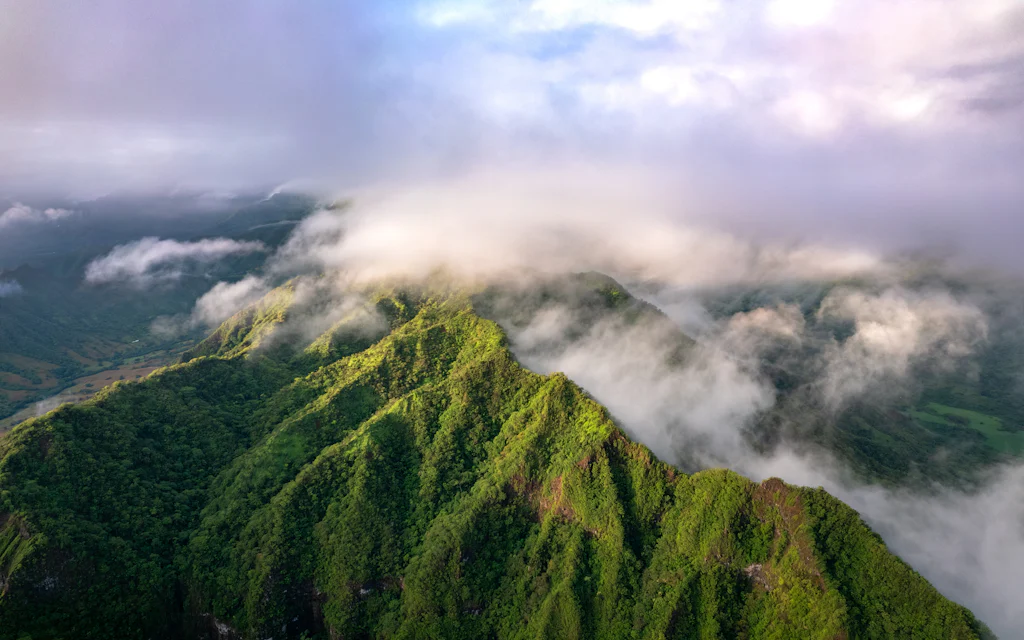
Nuuanu Pali Lookout, Oahu: Views, Photos, History & Tips
17 min readYndira W. Tonin
The Nuuanu (Nuʻuanu) Pali Lookout is a free clifftop viewpoint about 15 minutes from downtown Honolulu, perched 1,200 feet up in the Koolau (Koʻolau) Range, where the trade winds funnel through a gap in the mountains and hand you the best windward Oahu view you will get without a helicopter. Parking is $7 per vehicle for nonresidents, free for Hawaii residents, and the whole stop takes about twenty minutes, assuming the wind lets you stand up.
These details were last verified in 2026.
That is the short version. Here is the part the brochures leave out, this lookout will try to take your hat, your sunglasses, your hair appointment, and a little of your dignity, all in the first ten seconds.
And you will love it anyway.
The Nuuanu Pali Lookout (officially the Nuuanu Pali State Wayside, because the state never met a place name it could not lengthen) is one of those rare Oahu stops that is genuinely free, genuinely fast, and genuinely unforgettable. It is also the site of a battle that decided who ruled the island. Not bad for a place you can visit in flip flops on the way to the beach.
Let us get into it.
Getting to the Nuuanu Pali Lookout
Tap to open Google Maps with turn-by-turn directions.
Table of contents
- What the Nuuanu Pali Lookout actually is
- The wind, the part nobody warns you about properly
- The Battle of Nuuanu, how this cliff decided who ruled Oahu
- Pork, ghosts, and the old road, the legends of the Pali
- The best time to visit (and a quick go/no-go)
- Parking, fees, hours, and getting there
- What to do nearby once the wind's done with you
- What to bring (so the gusts do not win)
- Is the Nuuanu Pali Lookout worth it?
- Nuuanu Pali Lookout FAQ
01
What the Nuuanu Pali Lookout actually is
Picture the Koolau Range as a long green wall running down the spine of Oahu, separating sunny Honolulu on one side from the green windward coast on the other. The Pali is the notch in that wall, the low point where wind, water, and eventually a highway found a way through.
Stand at the railing and the whole windward side opens up below you like a relief map someone painted by hand. You are looking down on Kaneohe (Kāneʻohe) and Kailua, out across Kaneohe Bay, and on a clear day all the way to Mokolii (Mokoliʻi), the little cone shaped island everyone calls Chinaman's Hat. The cliffs themselves drop nearly vertically, draped in green, with thin waterfalls that sometimes blow upward in a strong gust. Yes, upward. We will get to the wind.
This is the windward Oahu view people fly drones to get, and you can have it for the price of a parking spot.
The lookout sits at roughly 1,200 feet of elevation, which is high enough that the temperature drops a few degrees and the clouds feel close enough to flick. The platform is paved, railed, and short, a two minute walk from the car. No hiking boots, no permits, no scrambling. If you have got a rental car and twenty spare minutes, you have got the Pali.
It is also the kind of place that rewards a clear morning and punishes a lazy afternoon, which is the one thing the postcards never mention. More on timing shortly. First, the wind, because you cannot understand this place until you have nearly been knocked into a stranger by it.

Photo by Zach Betten on Unsplash
02
The wind: the part nobody warns you about properly
Everyone tells you the Pali is windy. This is like saying the ocean is damp.
The trade winds hit the windward side, slam into that green wall of mountains, and get squeezed through the Pali gap like air through a pinched garden hose. By the time they reach the railing, gusts can hit 60 miles an hour. The state's own description of the lookout includes the phrase "lean against the wall of wind," which is government speak for "you will look ridiculous, and there is nothing you can do about it."
People have genuinely leaned into it at a 20-degree angle and stayed upright, held up by nothing but moving air.
A short list of things the Pali wind has claimed over the years,
- Hats. So many hats. There is a hat graveyard somewhere down that cliff and nobody talks about it.
- Sunglasses, usually the expensive pair, never the gas station ones.
- Phones held out for the perfect photo by people who learned an expensive lesson.
- Carefully styled hair, returned to you as a single chaotic sculpture.
- Loose receipts, napkins, and at least one toupee in the historical record (probably).
None of this is a reason to skip it. It is a reason to button your jacket, put your phone on a strap, and hold small children by the hand like you mean it. The wind is half the experience, it is what makes standing there feel less like looking at a view and more like the view is looking back and breathing on you.
Just do not bring a drone expecting an easy flight. The Pali eats drones for breakfast and does not apologize.
03
The Battle of Nuuanu: how this cliff decided who ruled Oahu
Here is where the Pali stops being a scenic pull off and starts being one of the most important spots in Hawaiian history.
In 1795, Kamehameha I, the chief who would unite the Hawaiian Islands under a single rule, landed on Oahu with a large invading force and pushed the island's defenders up Nuuanu Valley. The fighting climbed higher and higher up the slopes until the Oahu warriors ran out of valley and ran into the cliffs you are now photographing.
Several hundred of them were driven off the edge, a drop of around 1,000 feet to the windward floor below. It was the battle that effectively delivered Oahu to Kamehameha and set up his unification of the islands a few years later, the same king honored by the King Kamehameha statue in downtown Honolulu. You can read the broader story of Kamehameha I over at Britannica, but the short version is, this exact railing overlooks a turning point in the history of Hawaii.
The number gets quoted a lot because, in 1898, a road crew working in the area reportedly unearthed an estimated 800 skulls at the base of the cliffs, long believed to belong to the warriors of that battle. Take the precise figure with a grain of historical salt, but the broad strokes are well documented and sobering.
So when you stand there and the wind shoves you back from the edge, there is an argument it is doing you a favor.
It is a strange, beautiful kind of place because of that, gorgeous and heavy at the same time. Hawaiians treat the site with respect, and it is worth visiting in that spirit, enjoy the view, take the photos, and remember you are standing somewhere that mattered long before it had a parking lot.

Photo by Josh Smith on Unsplash
04
Pork, ghosts, and the old road: the legends of the Pali
Ask any local about driving over the Pali and you will eventually hear the most famous rule on the windward side, never carry pork over the Pali.
The story ties to Hawaiian legend, Pele the volcano goddess and the demigod Kamapuaa (Kamapuaʻa), who took the form of a pig, and a falling out that means the two should not travel together. Carry raw pork over the Pali Highway, the legend goes, and your car will mysteriously stall until you get rid of it. Plenty of otherwise rational Oahu residents will not test this with a Costco roast in the trunk, and honestly, who can blame them.
(Do I believe it? No comment. Do I leave the kalua pork for after the drive? Also no comment.)
Then there are the Night Marchers, the spirits of ancient warriors said to travel old trails after dark, and the Pali, with its battlefield history, gets a starring role in those stories. The rule there is simple, if you ever sense them, look down, stay still, and do not make eye contact. It is the one piece of local folklore that even skeptics deliver in a slightly lower voice.
Just past the lookout, an abandoned stretch of the Old Pali Road, a 1919 highway that nature has been quietly reclaiming, curls down the cliff through a tunnel of overhanging green. It is beautiful, faintly eerie, and officially closed, with a gate you will see people walk around. We are not going to talk you into a closed road. If waterfalls and a real walk are what you are after, save your legs for a proper Oahu hike with a trailhead that wants you there.
Legends aside, the everyday magic of the Pali is the drive itself, which deserves its own paragraph.
05
The best time to visit (and a quick go/no-go)
The Pali has a personality, and that personality is "moody by lunchtime."
Because the lookout sits right where the windward clouds pile up against the mountains, it has a strong tendency to fog in, gray over, and start spitting rain as the day goes on. You can leave blue sky Waikiki, drive twenty minutes, and arrive at a lookout that is been swallowed whole by a cloud doing its best impression of a wet towel.
The fix is simple, go early. Morning, generally before midday, gives you the best odds of a clear, wide open view before the windward weather rolls in and pulls the curtain. A clear afternoon happens, it is just a gamble, and the Pali is not a long drive to gamble twice if you have to.
Use this quick read before you commit the morning,
Is today a Nuuanu Pali Lookout day?
Green light, go nowOur pick
- Best for
- A clear early-morning windward forecast, blue sky over Kaneohe (not just Waikiki), a buttoned jacket, and a strap on your phone
- The catch
- It can still be a 50-mph day — hold your hat and your kids, and don't lean a phone over the railing
Yellow light, gamble, but go early
- Best for
- Partly cloudy windward skies, building trade clouds, or an afternoon arrival when the curtain tends to drop
- The catch
- The view can vanish into a cloud in minutes — have the windward beaches as your sunny plan B
Red light, save it for tomorrow
- Best for
- A socked-in Koolau forecast, heavy rain, or a high-wind day pushing past comfort
- The catch
- A fogged-in Pali is just a parking lot in a cloud — the drive's still pretty, but skip the $7 and come back clear
One more timing note, the wind and the clouds are two different problems. A clear day can still be a 50-mph day, and a calm day can still be socked in. Check a windward Oahu forecast, not the Waikiki one, they are frequently telling two completely different stories about the same island, twenty minutes apart.
Season matters less than time of day here, but it nudges the odds. Winter (roughly November through March) brings more frequent passing showers and lower cloud, so the "go early" rule gets stricter, first thing in the morning is your friend. Summer trades are steadier and the mornings are more reliably clear, though the wind itself often blows harder. Either way, you are playing the morning, not the month.
If the lookout itself is fogged when you arrive, do not write off the trip. The drive up and over is gorgeous in any weather, the tunnels on the highway pull their famous weather swap trick, and the windward beaches below are often sunnier than the cliffs. Which is the perfect excuse to keep driving.
06
Parking, fees, hours, and getting there
The logistics are refreshingly simple, which is not always the Oahu way.
Where it is: The Nuuanu Pali Lookout sits off the Pali Highway (Route 61), about 5 miles and 15 minutes from downtown Honolulu. From Waikiki, you are looking at roughly 20 to 25 minutes. Plug "Nuuanu Pali Lookout" into your map and follow the Pali Highway up toward the mountains. The turn off is signed.
Hours: The Nuuanu Pali State Wayside is open daily, generally 6 a.m. to 6 p.m. The gate is real, so do not plan a sunset into darkness visit here.
The fee: Parking is $7 per vehicle for nonresidents and free for Hawaii residents with a valid ID. There is a pay station in the lot. It is a state parks fee that funds maintenance, and at seven bucks for the best free ish view on this side of the island, nobody's writing an angry review about it.
Getting there without a car: You really do want a car for the windward side, and for this lookout in particular. If you would rather not drive the Pali yourself, the highway climbs, curves, and ducks through tunnels where the weather flips mid tunnel, a circle island day tour loops the whole island and lets someone else handle the wheel while you handle the gawking.
★4.8(4,263)
Oahu Circle Island Tour with Waimea Valley Waterfall
8 hours
Free cancellation
from
$154
Most visitors base in Waikiki and day trip over the mountains, which works fine, here is a Waikiki hotel search (also on Booking.com) if you are still sorting the home base. If you are mapping how the regions connect, our map of Oahu shows where the Pali sits between town and the windward coast.

Photo by Dakotah Huey on Unsplash
07
What to do nearby once the wind's done with you
The genius of the Pali is that it is the gateway to the entire windward side. You have already done the hard part, driving over the mountains, so keep going.
Kailua and Lanikai beaches. Roughly 15 to 20 minutes down the highway, you hit some of the best beaches in Hawaii, powder sand, that unreal blue water, and the Mokulua islands sitting offshore like they are posing. This is the obvious follow up to a windy lookout, and we have mapped the whole area in our Kailua and Lanikai guide.
Byodo-In (Byōdō-In) Temple. A short drive north into Kaneohe brings you to a serene replica of a 900-year-old Japanese temple, tucked against the same green cliffs you just photographed from above. It is the calm yin to the Pali's blustery yang, full details in our Byodo-In Temple guide.
Hoomaluhia (Hoʻomaluhia) Botanical Garden. Also in Kaneohe, this free garden gives you those towering Koolau cliffs reflected in a glassy lake, with almost none of the wind. It is the Pali's view at sea level, sitting still.
Honestly, the Pali works best not as a destination but as the opening act. Twenty minutes at the lookout, then a full day on the windward coast. For the bigger picture of how to spend it, our roundup of things to do on Oahu lines up the windward side with the rest of the island.
One gentle aside, since people ask, the Pali itself is a clifftop railing, not a picnic spot, it is too windy to keep a napkin on the ground, let alone a charcuterie board. The beaches below are a different story. That is our actual home turf. We run shoreline picnics on the windward sand, starting at $349 for two, where the only thing the breeze ruins is your need to ever leave.
08
What to bring (so the gusts do not win)
You do not need much for a twenty minute lookout. You do need to plan for the wind, because the wind has plans for you.
- A packable jacket or windbreaker. It is cooler at 1,200 feet and the wind makes it feel cooler still. A packable windbreaker lives in a daypack and earns its keep here. (As an Amazon Associate we earn from qualifying purchases.)
- A hat with a chin strap, or no hat at all. A normal hat at the Pali is a donation to the cliff. If you insist, a hat with a cord is the only kind that survives.
- A phone strap or lanyard. Photos at the railing are the whole point, and the gust that ruins one is the same gust that takes your phone with it. A phone lanyard turns a heart attack moment into a non event.
- Reef safe sunscreen. You are heading to the beach next, and Hawaii law plus basic decency call for reef safe sunscreen.
- Closed toe or strapped shoes. The platform is paved and easy, but if you wander the old road's edge, flip flops and 50-mph gusts are a comedy you do not want to star in.
- A real camera or a steady grip. The view is wide and deep, and a phone on a strap captures it fine, but the wind will jostle a long exposure, so brace your elbows on the railing if you want the cliffs sharp.
A quick word on what not to bring. Leave the umbrella in the car. At the Pali, an umbrella is not rain protection, it is a kite with delusions of grandeur, and it will turn inside out before you have finished the thought. Same goes for a wide brim sun hat with no strap, a loose scarf, and any hairstyle you are emotionally attached to. The Pali is come as you are, leave as the wind decides, and that is part of why people remember it.
09
Is the Nuuanu Pali Lookout worth it?
Yes, with one honest caveat.
For a free, fast, drive up stop, the Pali is one of the best things you can do on Oahu. The view is genuinely spectacular, the history is real and moving, and the whole detour costs you twenty minutes and seven dollars. There is almost nothing else on the island with that ratio of payoff to effort.
The caveat is the weather. A fogged in Pali is just a parking lot in a cloud, and that happens often enough that you should treat the lookout as a "go early, go clear" plan rather than a guaranteed showstopper. Build it into a windward day so that even a gray lookout still ends on a sunny beach.
It is also worth being honest about what the Pali is not. It is not a hike, not a beach, and not a place you will spend an hour. If you are after a half day adventure with a payoff at the end, this is not that, it is a five star pull off, not a destination in itself. Set your expectations to "quick, stunning, slightly absurd" and it overdelivers every time. Set them to "main event" and you will wonder what the fuss was about by minute fifteen.
Do that, and the Pali is not a stop. It is the moment the island cracks open, you drive over the mountains, the weather flips, the wind grabs you, and the whole green windward coast rolls out below like it was waiting for you to show up.
Hold onto your hat. Mean it. And tell the cliffs we say hello.
10
Nuuanu Pali Lookout FAQ
Why is the Nuuanu Pali Lookout famous?
Two reasons. First, the view, a 1,200-foot panorama over windward Oahu, from Kaneohe Bay to Kailua, that is considered one of the best free viewpoints on the island. Second, the history, it is the site of the 1795 Battle of Nuuanu, where Kamehameha I's forces drove Oahu's defenders off the cliffs in the fight that delivered the island to him.
How much does it cost to visit the Pali Lookout?
There is no admission fee. Parking is $7 per vehicle for nonresidents and free for Hawaii residents with a valid ID, paid at a station in the lot. The fee supports state park maintenance.
What are the hours of the Nuuanu Pali Lookout?
The Nuuanu Pali State Wayside is open daily, generally from 6 a.m. to 6 p.m. The parking area has a real gate, so it is a daytime stop, do not plan to linger after dark.
Why is the Pali Lookout so windy?
The trade winds blow against the Koolau Range and get funneled through the low Pali gap, accelerating as they squeeze through. Gusts can reach about 60 mph at the railing, strong enough to lean into. Hold onto hats, sunglasses, and phones, and keep small children by the hand.
How long do you need at the Pali Lookout?
About 15 to 20 minutes is plenty to park, walk to the railing, take photos, and read the history plaques. Most people fold it into a longer windward Oahu day rather than visiting on its own, since the beaches and Kaneohe sights are minutes away.
Can you hike the Old Pali Road?
There is an abandoned stretch of the 1919 Old Pali Road just past the lookout that curls down the cliff with waterfall and coast views. It is officially closed, and although people walk around the gate, we would point you toward an open, signed trail instead, there are plenty of legal Oahu hikes with the same kind of reward and none of the risk.
Disclosure: Some links on this page are affiliate links. If you book or buy through them we may earn a small commission, at no extra cost to you. As an Amazon Associate, we earn from qualifying purchases.


