8 Best Hikes on Oahu: Top Trails, Views and Verdicts
22 min readYndira W. Tonin
The best hikes on Oahu are not a secret reserved for ultramarathoners, they are a paved crater rim, a set of old bunkers above a bright blue bay, and a rainforest waterfall twenty minutes from your hotel. The short answer, Diamond Head for the classic, Lanikai Pillbox for the best view per calorie burned, Koko Head Stairs for the people who hate themselves, Makapuu (Makapuʻu) Lighthouse for the easy coastal cruise, and Manoa Falls for the jungle.
Oahu is a strange and wonderful place to hike. You can stand on a knife edge ridge with the whole windward coast unrolling below you, then be back in Waikiki eating a loco moco within the hour.
That is the thing nobody tells you. The best hikes in Oahu are not far flung expeditions, most trailheads sit a 30-minute drive from the city, which means your biggest logistical challenge is usually parking, not survival.
This guide sorts the trails by what you actually want from a morning, the famous one, the brutal one, the easy one with the disproportionate view, the waterfall, the ridge. For each, you get the distance, the difficulty, the parking reality, and an honest verdict on whether it is worth setting an alarm for.
Table of Contents
- Oahu hikes at a glance
- Diamond Head (Leahi), the famous one
- Koko Head Stairs, the StairMaster from another dimension
- Lanikai Pillbox, the best view for the least effort
- Makapuu Lighthouse Trail, the paved coastal cruise
- Manoa Falls, the rainforest waterfall
- Maunawili Falls and the windward jungle
- Kuliouou Ridge, the big payoff climb
- Ehukai Pillbox and the North Shore
- What to pack and how not to become a news story
- Where to stay near the trailheads
- FAQ, hiking on Oahu

The Koolau (Koʻolau) range gives Oahu its ridge hikes. Photo by Tom Henderson on Unsplash
01
Oahu hikes at a glance
Before you lace up, here is the whole lineup in one table, so you can match a trail to your energy level and the amount of suffering you signed up for.
| Hike | Distance (round trip) | Difficulty | Time | Best for |
|---|---|---|---|---|
| Diamond Head | 1.6 mi | Easy, moderate | 1.5 to 2 hr | First timers, the classic photo |
| Koko Head Stairs | 1.8 mi | Hard | 1.5 to 3 hr | Cardio masochists |
| Lanikai Pillbox | 1.7 mi | Easy, moderate | 1 to 1.5 hr | Best view for least effort |
| Makapuu Lighthouse | 2 mi | Easy | 1 to 1.5 hr | Families, winter whales |
| Manoa Falls | 1.6 mi | Easy, moderate | 1 to 2 hr | Rainforest, waterfall |
| Maunawili Falls | 2.5 to 3 mi | Moderate | 2 to 3 hr | Jungle, a swimmable pool |
| Kuliouou Ridge | 4.8 mi | Hard | 3 to 4 hr | The big summit payoff |
| Ehukai Pillbox | 2 mi | Moderate | 1 to 1.5 hr | North Shore surf views |
A few honest rules before you pick one.
Morning is non-negotiable. Oahu trades cool air for crowds, and both run out by midmorning. Trailheads like Lanikai and Koko Head fill their parking by 7 a.m., the sun turns exposed ridges into a frying pan by 10, and afternoon clouds roll over the Koolau like clockwork. Start early or accept your fate.
"Easy" here still means a real trail. A paved crater path is one thing. A "moderate" windward hike is roots, red mud, and stream crossings that turn into water slides after rain. Closed toe shoes with grip are the difference between a good morning and a viral fall video.
The view to effort ratio is wildly uneven, which is the whole reason this guide exists. Some climbs make you earn every foot. Others, like Lanikai, hand you a postcard for fifteen minutes of work, which feels almost rude to the people sweating up Koko Head a few miles away.
02
Diamond Head (Leahi): the famous one
Diamond Head is the hike everyone does, and for once the crowd is right. It is a 1.6-mile round trip up the inside of a 300,000-year-old volcanic crater to a summit bunker that looks straight down the length of Waikiki. This is the postcard, and you are allowed to want the postcard.
The trail is mostly paved and railed, with a stretch of switchbacks, a 99-step staircase, and a short tunnel that makes everyone feel briefly like they are in a heist movie. It is rated easy to moderate, manageable for most kids and grandparents, as long as you respect the heat and bring water.
Here is the part that trips up visitors, you must reserve in advance. Out of state visitors need a timed entry reservation through Hawaii State Parks, at $5 per person to walk in plus $10 to park. Show up without one and you will be turned away at the gate, which is a sad way to start a vacation day.
Go at sunrise. The gate opens at 6 a.m., the light is soft, the air is survivable, and you beat the tour buses that turn the summit into a turnstile by 9. If you would rather have transport and a guide handle the logistics, a guided Diamond Head tour bundles the hotel pickup and the reservation so you just show up and climb.
Verdict, do it once, do it early, and do not let anyone tell you it is too touristy. The view earns its reputation. Just know that a few miles away, a free hike gives you arguably a better one, which we will get to.

Koko Head Crater and the southeast coast. Photo, Jess Loiterton / Pexels.
03
Koko Head Stairs: the StairMaster from another dimension
Koko Head is not a hike. It is a 1,048-step railway tie staircase straight up the spine of a crater, and it has humbled people in far better shape than they thought they were.
The trail follows an old World War II military tramway, which means the "steps" are wooden railroad ties bolted to a brutally steep grade. There is a section in the middle where the ties cross a small gully and the ground drops away beneath them, affectionately known as the part where people sit down and reconsider their choices.
It is under two miles round trip. It will still wreck you. Most people take 30 to 60 minutes to grind up and a wobbly legged 30 to come down, and your calves will file a formal complaint the next morning. There are 1,048 ties in total, and somewhere around tie 600 you will start counting them, which is a documented stage of grief.
You will not be alone up there. Koko Head has become the unofficial outdoor gym of southeast Oahu, so expect locals running repeats past you like the staircase owes them money. Smile, let them pass, and take quiet satisfaction in the fact that you are on vacation and they are doing this on purpose.
Why do it? Because the summit looks back over Hanauma Bay, Hawaii Kai, and the southeast coastline in a single sweeping panorama, and you earned every degree of it. There is no shame in stopping to "admire the view" several times on the way up. That is not resting. That is appreciating. Coming down is its own event, the ties are uneven and your legs are jelly, so take the descent slowly and use the rails on the steep middle section.
Go at dawn, before the sun turns the unshaded ties into a griddle. Bring more water than feels reasonable. And if your knees are already negotiating with you, this is the one hike on this list you have full permission to skip, your body will not miss it.
04
Lanikai Pillbox: the best view for the least effort
If Oahu hiking had a "most bang for your buck" award, the Lanikai Pillbox hike would win it every year and the others would stop showing up to the ceremony.
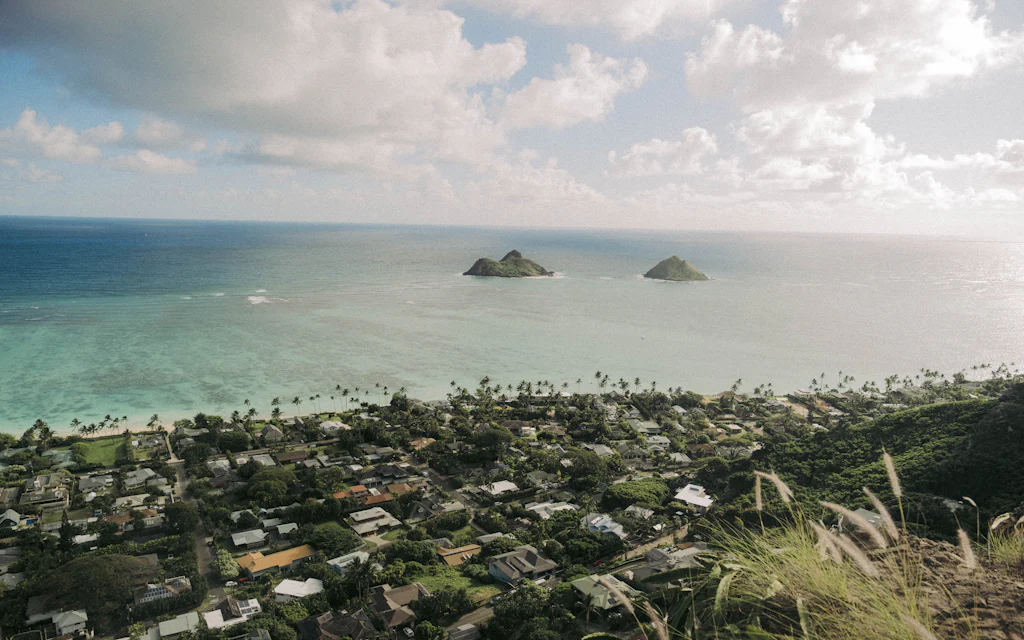
Officially the Kaiwa (Kaʻiwa) Ridge Trail, it climbs about 15 to 20 sweaty minutes up a short, steep, root and rock pitch to a pair of graffitied World War II bunkers perched above Lanikai Beach. From up there you get the Mokulua islands, the impossible blue of Kailua and Lanikai, and a horizon that looks Photoshopped but is not.
Here is my one strong opinion for this entire guide, the best view on Oahu is free, and it is not Diamond Head. Diamond Head costs $5 a head plus $10 to park and gives you a city skyline. Lanikai costs you nothing but a 20-minute scramble and gives you the most beautiful stretch of coast on the island. Per calorie, per dollar, it is not close.
The catch, and it is a real one, is parking. Lanikai is a residential neighborhood that is deeply, understandably tired of hikers, so you park legally on Aalapapa (Aʻalapapa) Drive, walk in respectfully, and keep your voice down. Treating the neighborhood well is the entry fee.
The first stretch is steep and slick when wet, with a couple of spots where you will use your hands. Once you are at the first pillbox the hard part is over. Sunrise here is one of the great free experiences in Hawaii, just bring a headlamp for the dark climb up and pack out everything you bring.

The Lanikai Pillbox view over the Mokulua islands. Photo by Colin + Meg on Unsplash
05
Makapuu Lighthouse Trail: the paved coastal cruise
Makapuu is the hike you do when you want the view without the negotiation. It is a two mile round trip on a fully paved access road that climbs gently to a lookout above the red roofed Makapuu Lighthouse and the southeastern tip of the island.
Because it is paved and never steep, it is the friendliest "real" hike on Oahu, doable with strollers (the determined kind), grandparents, and people who packed exactly one pair of nice sandals. It is exposed to the sun the whole way, so the morning rule still applies, but there are no roots and no mud to ruin your day.
The payoff is the coastline, cobalt water, the offshore islets of Manana (Rabbit Island) and Kaohikaipu, and a lighthouse that looks like it was placed there by a postcard company. There are a couple of lookout platforms, so you can turn around early if the kids tap out. The gate at the bottom opens around 7 a.m. and closes mid evening, and the lot fills fast on weekends, so the morning rule pays off here too.
If you have steady footing and want a little adventure, an unofficial side path branches down to the Makapuu tide pools, where there is a natural swimming hole when the surf is calm. It is rocky, unmarked, and not for flip flops or rough ocean days, treat it as a bonus for confident hikers, not a goal.
Time it right and this is the best whale watching perch on the island. From roughly December to April, humpback whales migrate through these waters, and the elevated lookout puts you right above their highway. On a good winter morning you can count multiple spouts without moving your feet. Bring binoculars and you will earn the gasps.
Verdict, not the most dramatic hike on this list, but the highest ratio of "big view" to "actual difficulty." If you have one easy morning and mixed fitness levels in the group, this is the safe, beautiful pick.
06
Manoa Falls: the rainforest waterfall
Manoa Falls is the trail that makes people forget they are on the same island as Waikiki. It is a 1.6-mile round trip into Manoa Valley that ends at a 150-foot ribbon of waterfall dropping down a mossy cliff, and the whole way there feels like a movie set, because it frequently is one.
The trail is short and not steep, but it is almost always muddy. Manoa Valley is one of the wettest spots on Oahu, which is exactly why the rainforest is so absurdly green and exactly why your shoes will look like they lost a fight. Wear the shoes you do not love. The forest is so cinematic that pieces of it have shown up in Jurassic Park and the TV show Lost, you walk past towering bamboo, giant ferns, and banyan roots the size of furniture.
Parking is a paid lot near the trailhead at about $7 a car, or you can find limited free street parking lower down and walk in, as long as you respect the residential signs. It is only a 20-minute drive inland from Waikiki, which is part of the magic.
You cannot swim at the base, the pool is closed off for falling rock risk and because Hawaii's freshwater streams can carry leptospirosis, but you came for the jungle, not a dip. We wrote a whole guide to hiking Manoa Falls if you want the parking and timing details in full.
Verdict, the easiest way on the island to stand inside a genuine rainforest and look up at a real waterfall. Go in the morning, accept the mud as part of the deal, and pack bug spray, the mosquitoes in the valley treat fresh tourists like a brunch reservation.
07
Maunawili Falls and the windward jungle
Maunawili is the hike for people who loved Manoa Falls but wanted to actually get in the water at the end. It is a roughly 2.5 to 3-mile round trip jungle trail on the windward side that ends at a waterfall with a swimming pool you are allowed to use, a rare and glorious thing on Oahu. (Heads up, the easy Kailua trailhead has been closed since 2021, so it is now a longer back route, see our full Maunawili Falls guide for the current access.)
The trade off for that swim is more work. The trail crosses streams several times, climbs and drops through thick forest, and turns into a genuine mud bath after rain, which on this side of the island is most of the time. There are short rope assisted sections near the falls where you lower yourself down to the pool, so this is a moderate hike that earns the rating honestly.
A quick honesty note, Maunawili has gone through trailhead and access changes in recent years, so check current conditions before you go and respect any closures or rerouting. Trails here are living things, and the official status changes. Do not confuse the Falls route with the much longer Maunawili Demonstration Trail, a separate ridgeline path that connects toward the Pali, great in its own right, but a very different day out.
Two safety notes worth taking seriously, do not jump from the cliffs around the pool (depth and submerged rocks change with every flood), and do not hike it during or right after heavy rain, when the streams can flash flood without warning.
When it is open and the weather has been dry, the reward is a green amphitheater of a swimming hole that feels like a reward you negotiated directly with the island. Bring a dry bag for your phone, water shoes for the slick rocks, and the same leptospirosis caution that applies to every freshwater pool in Hawaii, no swimming with open cuts.
Verdict, the best "jungle plus a swim" combination near Honolulu, as long as you go in with realistic expectations about mud and check that the trail is open first.

The Makapuu Lighthouse lookout. Photo by Josh Smith on Unsplash
08
Kuliouou Ridge: the big payoff climb
When people who hike a lot are asked for the single best hike on Oahu, a surprising number quietly say Kuliouou (Kuliʻouʻou) Ridge. It is a 4.8-mile round trip that climbs through three distinct forest zones to a summit on the Koolau crest, where the entire windward coast spreads out beneath you like someone unfolded a map.
This is a real hike, not a tourist stroll. You start in dry scrub, pass through a shaded ironwood pine forest that smells like a different continent, then grind up a switchbacked staircase to a wind blasted ridge. Plan on three to four hours and a meaningful amount of climbing.
The middle pine section is the surprise. It is cool, soft underfoot, carpeted in fallen needles, and so unlike the rest of the trail that you will briefly wonder if you took a wrong turn into the Pacific Northwest. There is even a covered picnic shelter partway up, a civilized touch on a trail that is about to get distinctly uncivilized. Then the trees open up and you remember exactly where you are.
The final push is a long series of switchbacking wooden and dirt steps up the spine of the ridge, and it is where the hike collects its toll. Take your time. The steps are steep and the wind picks up as you climb. Parking is along the residential Kalaau Place, so arrive early and park considerately, the neighbors share this trailhead with you.
The summit lookout delivers Waimanalo, Bellows, the Mokulua islands, and on a clear day a view that makes the whole climb feel like a bargain. It is exposed and windy up top, so bring a layer and do not dawdle if clouds are rolling in over the ridge.
Verdict, the best full value summit hike that does not require a permit or a death wish. If you are fit, have a half day, and want the kind of view you have to earn, this is the one.
09
Ehukai Pillbox and the North Shore
If your trip is anchored on the North Shore, you do not have to drive back to town for a great hike. The Ehukai Pillbox Trail, also called the Sunset Pillbox, climbs a forested ridge directly across the highway from Ehukai Beach Park, home of the Banzai Pipeline.
It is a roughly two mile round trip up a moderately steep, rooty trail to a pair of bunkers with a clear view over the entire North Shore coastline. In winter, that means looking down on the same monster surf that draws the world's best surfers to Pipeline and Sunset Beach.
The trail is shaded for much of the climb, which is a mercy, but the dirt turns to a slip and slide after the frequent North Shore rain. The first push uphill is the steepest and rootiest part. After that it mellows out as you walk the ridge past a string of bunkers, including one painted with a peace sign that has become the signature photo. You can keep going past the first pillbox to the others for even better angles down the coast.
Parking is the usual North Shore puzzle, small lots and roadside spots near Sunset Beach fill early, especially during the winter surf season when the contests are on. Park legally, cross the highway carefully, and start early before the midday heat and crowds arrive.
This is the move for a winter North Shore day, watch the surf in the morning, hike up for the aerial view of those same waves in the afternoon, then drive to Haleiwa (Haleʻiwa) for shave ice. That is as close to a perfect Oahu day as the geography allows.
Verdict, the best hike on the North Shore, and the rare trail where the view is arguably better in winter, when the swell is doing its thing right below you.
10
What to pack and how not to become a news story
Oahu's hikes look gentle in photos, which is exactly how people get into trouble. Every year, visitors need rescue off these trails, usually because a "quick easy hike" met afternoon rain, the wrong shoes, and an optimistic relationship with the time of day. A little gear and a little humility fix almost all of it.
The non-negotiable kit,
- Real shoes with grip. Slick red mud is the number one hazard on the windward trails. A pair of trail shoes with actual tread prevents the most common Oahu hiking injury, which is the unscheduled sit down.
- More water than you think. Exposed ridges like Koko Head and Lanikai have zero shade and zero water. A hydration daypack keeps your hands free for the scrambly bits.
- A headlamp for sunrise hikes. If you are climbing Lanikai or Diamond Head in the dark for the sunrise, a phone flashlight is not enough. A real headlamp keeps both hands available on the steep parts.
- Reef safe sunscreen and bug spray. The ridges fry you and the valleys feed you to mosquitoes. A mineral reef safe sunscreen handles the sun, and a bottle of insect repellent makes Manoa and Maunawili bearable.
Now the part everyone wants to ask about, the Haiku Stairs, also known as the Stairway to Heaven. It is illegal, it has been illegal for years, and the city began removing the stairs in 2024. Trespassing carries fines, the neighborhood is patrolled, and the "alternate" Moanalua route is a genuinely dangerous all day scramble that generates real rescues. Skip it. The view from Kuliouou or Lanikai is close enough and will not get you a citation or a helicopter ride.
One more rule that locals will thank you for, stay on the trail, respect every closure, and check the official Hawaii hiking safety guidance before heading out. Trails close for landslides, flash flood risk, and sacred site protection, and "but it was on Instagram" is not a defense.
11
Where to stay near the trailheads
Where you base yourself on Oahu quietly decides which hikes are easy and which become a 90-minute commute. The island is small, but the morning traffic into and out of Honolulu is not, and a 6 a.m. trailhead is a lot more appealing from the right side of town.
Waikiki and Honolulu put you closest to the most hiked trails, Diamond Head is practically walkable, and Koko Head, Makapuu, and Manoa are all a short drive east or inland. For the most hikes per minute of driving, Waikiki hotels (also on Booking.com) are the efficient base, plus you get the beach and the food when your legs are done. If your list leans southeast, Koko Head, Makapuu, Diamond Head, the quieter Kahala and Hawaii Kai side (also on Booking.com) puts those trailheads closest of all.
The windward side, Kailua and Lanikai, is the move if your dream hikes are Lanikai Pillbox and Maunawili and you want to roll out of bed and be at the trailhead before the parking fills. It is quieter, greener, and a world away from the Waikiki energy, which is either the appeal or the dealbreaker depending on your trip.
The west side and the North Shore suit a surf and trail trip built around Ehukai Pillbox and the country roads. Ko Olina area lodging (also on Booking.com) anchors the west, while a North Shore stay puts Pipeline and the Sunset Pillbox out your door, just know you are trading proximity to Diamond Head for it.
And after a hard sunrise summit, you do not have to cook. A recovery beach picnic, fully set up and torn down for you, starting at $349, is a low effort way to spend the afternoon when your calves have stopped speaking to you. One soft plug, and we will leave it there.
FAQ: hiking on Oahu
What is the best hike on Oahu?
It depends on your effort budget. For the best view per minute of work, the Lanikai Pillbox hike is hard to beat and free. For the classic, it is Diamond Head. For the most rewarding full length summit, experienced hikers point to Kuliouou Ridge.
What is the hardest hike on Oahu?
Among the popular, legal trails, Koko Head Stairs is the toughest, 1,048 steep railway tie steps that punish your legs in under two miles. Long ridge hikes like Kuliouou and the Olomana Three Peaks are also demanding, with Olomana being genuinely dangerous on its later peaks.
Is the Stairway to Heaven (Haiku Stairs) legal to hike?
No. The Haiku Stairs are illegal to access, trespassing is enforced with fines, and the city began removing the stairs in 2024. The unofficial back route via Moanalua Valley is long, dangerous, and a frequent source of rescues. Choose a legal ridge hike instead.
Do you need a permit to hike on Oahu?
Most popular trails do not require a permit, but Diamond Head requires an advance reservation for out of state visitors ($5 entry plus $10 parking). A few backcountry trails need state permits, and some trailheads sit on restricted land, always check the official status before you go.
When is the best time of day to hike on Oahu?
Early morning, ideally starting at or before sunrise. You get cooler temperatures, emptier parking lots, clearer summit views before the afternoon clouds build over the Koolau, and a safer margin if anything goes slow. For seasonal timing, see our guide on the best time to visit Hawaii. Hiking the other islands? See our best hikes in Hawaii roundup.
Are Oahu hikes safe for beginners?
Many are. Makapuu Lighthouse (paved), Diamond Head, and Manoa Falls are all beginner friendly with basic precautions. The keys are closed toe shoes with grip, plenty of water, an early start, and staying on the marked trail, most Oahu hiking rescues involve people off trail or caught out by afternoon weather.
Can you hike to a waterfall you can swim under on Oahu?
Maunawili Falls is the best known hike with a swimmable pool, when the trail is open and conditions are dry. Manoa Falls, by contrast, does not allow swimming. With any freshwater pool, avoid swimming with open cuts because of leptospirosis risk in Hawaii's streams.
Disclosure: Some links on this page are affiliate links. If you book or buy through them we may earn a small commission, at no extra cost to you. As an Amazon Associate, we earn from qualifying purchases.


