Iao Valley, Maui: First-Timer's Guide to the Needle (2026)
16 min readYndira W. Tonin
Iao (ʻĪao) Valley is a green, deep green valley in the heart of Maui, famous for the Iao Needle, a dramatic, jungle covered rock pinnacle that rises about 1,200 feet from the valley floor. It is one of the most beautiful and historically important spots on the island, and the good news is that seeing it is quick and easy, a short, paved trail leads to the classic lookout.
The catch is the logistics. Iao Valley State Monument now requires nonresident visitors to reserve a timed entry in advance, and the valley is one of the rainiest places on Maui, so timing matters. Get those two things right and it is a lovely, low effort stop.
It is also one of the few genuinely iconic Maui sights that is not a beach, a sunrise summit, or an all day drive, which makes it a perfect change of pace, and an easy one to fit around the rest of a trip.
This guide covers what Iao Valley is, how to visit (reservations, fees, hours), the lookout trail, the valley's dramatic history, when to go for the best odds of a clear view, and what else is nearby in Central Maui. Whether you have twenty minutes or a half day, here is how to make the most of it.
Table of contents
01
What is Iao Valley?
Iao Valley is a green, steep sided valley in the West Maui Mountains, just inland from Wailuku in Central Maui. It is protected as Iao Valley State Monument, and it is both a natural showpiece and a deeply sacred place in Hawaiian history.
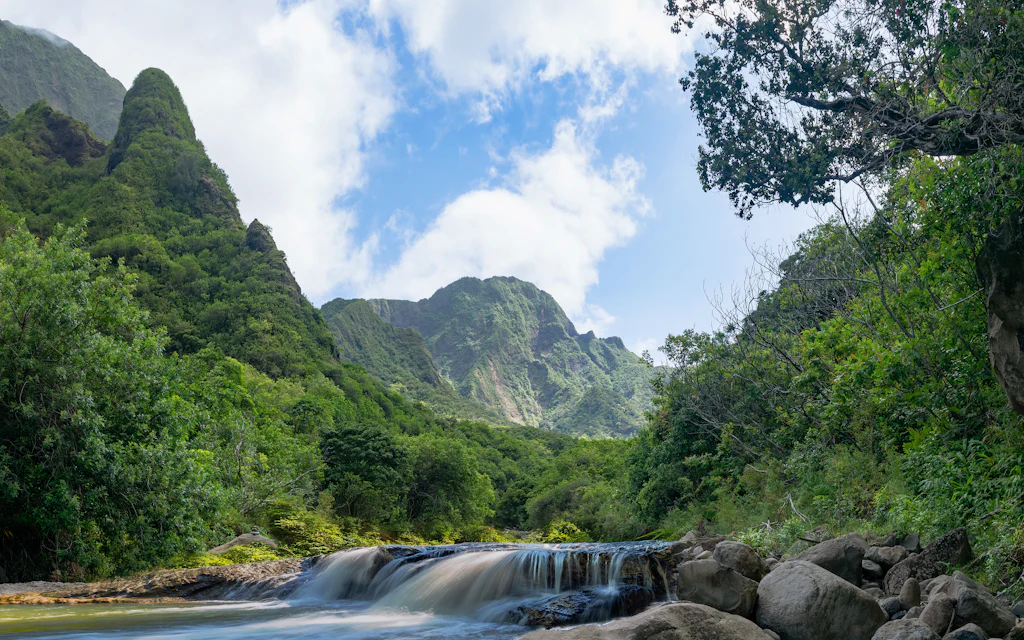
The star is the Iao Needle, or Kukaemoku (Kukaʻemoku), a sharp, green cloaked rock pinnacle that juts up about 1,200 feet from the valley floor (its summit sits over 2,000 feet above sea level). It is not a freestanding spire so much as the end of a narrow ridge, but from the lookout it reads as a single dramatic point, draped in jungle and often wreathed in mist.
Visiting Iao Valley, step by step
- 1Before you go
Reserve a timed slot
Non residents must book online in advance, $5 per person entry plus $10 parking. Check current status. The park has had closures.
- 2Getting there
Drive to Central Maui
About 10 minutes west of Wailuku/Kahului at the end of Iao Valley Road, central, not on the resort coasts.
- 3At the park
Walk the Needle Lookout Trail
A paved 0.6-mile loop with stairs, ~200 ft of climb, 20 to 30 minutes, to the viewpoint over the Iao Needle.
- 4Make time for
The history and gardens
It is the site of the 1790 Battle of Kepaniwai. The free Kepaniwai Heritage Gardens sit just down the road.
The valley is also one of the wettest places on Maui, fed by the rain that pours off nearby Puu (Puʻu) Kukui, which is exactly why it is so impossibly green. Iao Stream runs through it, and the whole place has a cool, damp, cathedral like feel that is a complete contrast to the sunny resort coasts. It pairs naturally with the rest of things to do on Maui for a day that mixes beaches with something greener.
The name Iao means "supreme light" or "cloud supreme" in Hawaiian, a fitting title for a place this dramatic. For centuries the valley was a sacred site, a burial place for Hawaiian chiefs (alii), whose remains were hidden here to protect their mana. That history of reverence still shapes how the valley is treated and presented today, and it is worth carrying that awareness with you rather than treating Iao as just a scenic pull off.

Photo by rjb Studios on Unsplash
02
How to visit: reservations, fees, hours
The single most important thing to know, nonresident visitors must reserve a timed entry in advance. You cannot just show up the way you once could.
Reservations are made online (through the Hawaii state parks system) for a 1.5-hour time slot, bookable up to 30 days ahead, and they tend to fill in peak season, so plan it rather than leaving it to chance. The fees are modest, $5 per person for nonresident entry plus $10 to park a non commercial vehicle. Hawaii residents enter free and do not need a reservation.
The reservation system was introduced to manage crowds and protect the site after years of overuse, and it is part of a wider shift across Hawaii's most popular spots, Hanauma Bay, Diamond Head, and Waianapanapa (Waiʻanapanapa) all run similar systems now. The upside for visitors is real, fewer people, easier parking, and a calmer experience than the free for all of years past. Just treat the booking as a non-negotiable first step, the same way you would a dinner reservation.
One logistical note, reservations are tied to the parking entry, so everyone in your vehicle is covered under the one booking and the per person fee. If your plans are uncertain, book the morning slot you are most likely to use, they are free to grab early and the cost is small, so it is better to hold a spot than to arrive and find the lot full and the entry closed to walk ups.
A few more practicalities. The park is open daily, roughly 7 a.m. to 6 p.m., with the last entry in the late afternoon, so it is a daytime stop. And because this is a state monument in a flood prone valley, it has closed at times for storms, flood repairs, and safety work, most recently for safety improvements that, as of mid June 2026, have it closed through June 26, 2026, so always check the official status and book your slot before you drive out.
03
The Iao Needle Lookout Trail
Do not come expecting a big hike. For a real West Maui Mountains climb nearby, the Waihee Ridge Trail is the one. The main trail is short, paved, and family friendly, this is a scenic stop, not a backcountry trek, and that is part of its appeal.
The Iao Needle Lookout Trail (with its Ethnobotanical Loop) is about 0.6 miles round trip, climbing roughly 200 feet on paved walkways and stairs with railings to a viewpoint that frames the Needle straight on. Most people take 20 to 30 minutes, longer if you linger for photos or walk down toward the stream. It is doable for most ages and fitness levels, though the stairs are a real (if short) climb.
Along the way, interpretive signs and the Ethnobotanical Loop point out native and Polynesian introduced plants, taro, kalo, ti, and others the early Hawaiians cultivated, which adds a bit of substance to the short walk. If you have extra time, paths near the bottom lead down toward Iao Stream, where (when it is safe and open) you can dip your feet in the cold mountain water.
For photographers, the lookout is the money shot, but the light matters as much as the angle, early sun lands on the Needle and lights up the green, while midday tends to flatten it and afternoon often hides it. A wide lens captures the scale of the ridgelines, and a moment of patience for the clouds to part is usually rewarded, the Needle has a habit of revealing itself for a few seconds at a time.
A couple of small things make it better. The pavement gets slick when wet (and it is often wet), so wear shoes with grip. And resist the urge to scramble off trail or into the stream, flash floods are a genuine danger here, the rocks are slippery, and much of the valley is sacred ground meant to be treated with respect, not climbed on.

Photo by Regi Munandar on Unsplash
04
The Battle of Kepaniwai
Iao Valley is beautiful, but it is also the site of one of the bloodiest battles in Hawaiian history, and knowing the story changes how the place feels.
In 1790, Kamehameha I invaded Maui as part of his campaign to unite the islands, and his forces met the Maui army, led by Kalanikupule (Kalanikūpule), here in the narrow valley. What turned the fight was technology, Kamehameha had Western cannons and two foreign advisors, John Young and Isaac Davis, and in the tight confines of Iao the cannon fire was devastating.
The battle was so deadly that, as the story goes, the bodies of the fallen dammed Iao Stream and the water ran red, giving the battle its name, Kepaniwai, "the damming of the waters." It was a decisive step in Kamehameha's eventual conquest, the same campaign honored by the King Kamehameha statue in Honolulu and remembered at sites like the Nuuanu (Nuʻuanu) Pali on Oahu. Standing in the quiet, green valley today, that history is sobering, and part of what makes Iao a place to visit with respect, not just a photo stop.
It is a striking contrast, one of Maui's most peaceful, beautiful places is also the scene of one of its darkest and most consequential days. That layering, beauty over deep, sometimes painful history, is true of a lot of Hawaii, and Iao is one of the clearest places to feel it. A few minutes reading the interpretive signs before you photograph the Needle changes the whole visit.
The valley's role did not end in 1790, either. Iao remained significant to the Hawaiian monarchy and people long after, and its designation as a state monument reflects both its natural and cultural weight. It is one of a handful of places on Maui where you can stand inside a piece of the islands' unification story rather than just read about it on a plaque at a resort.
05
When to go
If there is one rule for Iao Valley, it is this, go in the morning. It is the single biggest thing you can do to actually see the Needle instead of a wall of cloud.
Because the valley is so wet, clouds and rain build through the day, and by afternoon the Needle is frequently hidden in mist. Early morning gives you the best odds of a clear view and the softest light, plus thinner crowds and an easier reservation slot. A bright, clear morning here is genuinely beautiful. A socked in afternoon can be a letdown.
Rain is not necessarily a dealbreaker, though. Mist drifting through the Needle has its own moody beauty, and a passing shower often clears within the hour. What you want to avoid is heavy, sustained rain, which both hides the view and raises the flash flood risk that occasionally closes the park outright.
Crowd wise, the same morning advice applies. The earliest reservation slots are the quietest, and they get you in before the tour vans and the bulk of the day's visitors arrive. By late morning the small lot and short trail can feel busy, which takes some of the serenity out of a place whose whole appeal is its hushed, green calm.
Seasonally, Iao is green and visitable year round, but winter brings more rain and a higher chance of flood related closures, while summer mornings are the most reliable. Whenever you go, build in flexibility, check the forecast, have a backup plan for Central Maui, and do not pin a whole day on a valley that makes its own weather.
06
What else is nearby
Iao is a short visit, so the smart move is to pair it with the rest of Central Maui rather than driving across the island just for the Needle.
Right at the valley you will find the Kepaniwai Heritage Gardens, a free county park with pavilions and gardens honoring the cultures that settled Maui, a peaceful, quick add-on named for that 1790 battle. Just down the road, Wailuku town has a walkable historic main street with local cafes, shops, and some of the island's better casual food, and the nearby Bailey House Museum digs into Maui history.
Wailuku is also one of the more authentic, less touristy corners of Maui, a real working town rather than a resort strip, so it is a good place to get a feel for everyday island life and grab a genuinely local meal. First Friday street parties and a growing scene of small restaurants and shops have given it a quiet renaissance worth a wander after your valley visit.
Central Maui also works as a launchpad. From here it is an easy run to the beaches of the central isthmus, the shops of Kahului, the road up toward Upcountry and Haleakala, and the free grounds and $25 tram of the Maui Tropical Plantation just down the highway in Waikapu. Treat Iao as one stop on a Central Maui morning, Needle, gardens, a Wailuku lunch, and it slots in perfectly without eating your whole day.
If you are building a bigger Maui itinerary, Iao also pairs logically with the central isthmus on a travel or arrival day, since it is so close to the airport. Many people knock it out the morning they fly in or the morning they fly out, it is short enough to fit either, and it is a gentle, low stakes introduction to the island's greener, wilder interior before the beach days begin.

Photo by Chris Abney on Unsplash
07
Getting there and where to stay
Iao Valley sits at the end of Iao Valley Road (Highway 32), about a 10-minute drive west of Wailuku and roughly 15 minutes from the Kahului airport, genuinely central and easy to reach.
Most visitors do not stay in Central Maui, though. The lodging is out on the sunny coasts. The South Maui (Kihei, Wailea) and West Maui (Kaanapali (Kāʻanapali), Kapalua) resort zones are where you will likely base, and Iao is an easy half day trip from either, roughly 30 to 45 minutes' drive. You can compare Maui hotels on Expedia (also on Booking.com) across the south and west coasts, and our Maui map lays out the drive times.
A guided waterfall and rainforest hiking tour is a nice way to pair Iao's green scenery with more of Maui's green, waterfall rich side if you would rather not drive yourself.
★4.9(1,458)
Small Group Waterfall and Rainforest Hiking Adventure on Maui
5 hours
Free cancellation
from
$187
A last, on brand note, we run beach picnics on Oahu, not Maui, so we have no stake in your Maui itinerary, but if your trip also touches Oahu, our picnic packages (from $349 for two) are there for a sunset on the sand. On Maui, give Iao a clear morning and a little respect, and it is one of the loveliest short stops on the island.
08
Tips for visiting
A handful of small things make an Iao visit smoother,
- Book your reservation first, and check the park's current status, closures happen.
- Go in the morning for the best chance of a cloud free Needle.
- Wear shoes with grip, the paved trail gets slick in the frequent rain.
- Bring a light rain layer. It can shower even when the coast is sunny.
- Do not enter the stream or scramble off trail, flash floods are a real danger.
- Treat it as sacred ground, stay on the paths and be respectful.
- Pair it with Central Maui (Heritage Gardens, Wailuku) rather than a special trip.
Get those right and Iao is a short, scenic, deeply Hawaiian stop that rewards very little effort, exactly the kind of place that reminds you Maui is far more than just its beaches.
FAQ
Do you need a reservation for Iao Valley?
Yes, nonresident visitors must reserve a timed entry in advance through the Hawaii state parks system, for a 1.5-hour slot bookable up to 30 days ahead. Hawaii residents enter free without a reservation. Entry is $5 per person for nonresidents, plus $10 to park. Always check the official status before you go, as the park has periodic closures.
How long is the Iao Valley trail?
The main Iao Needle Lookout Trail is about 0.6 miles round trip, climbing roughly 200 feet on paved walkways and stairs to the viewpoint over the Needle. Most visitors finish it in 20 to 30 minutes. It is short and family friendly, though the stairs are a brief but real climb, and the pavement can be slippery when wet.
What is the Iao Needle?
The Iao Needle (Kukaemoku) is a striking, jungle covered rock pinnacle that rises about 1,200 feet from the floor of Iao Valley, its summit more than 2,000 feet above sea level. It is actually the end of a narrow ridge, but from the lookout it appears as a single dramatic green spire, the valley's iconic landmark.
Is Iao Valley worth visiting?
Yes, for most Maui visitors. It delivers dramatic, sacred scenery for very little effort, a short paved trail to a dramatic lookout, plus deep Hawaiian history. Just go in the morning before clouds hide the Needle, reserve ahead, and pair it with Central Maui so it is an easy add-on rather than a long detour.
When is the best time to visit Iao Valley?
Morning is best. Iao Valley is one of the wettest spots on Maui, so clouds and rain build through the day and often hide the Needle by afternoon. An early start gives you the clearest views, softest light, thinner crowds, and easier reservation slots. Summer mornings are the most reliable. Winter brings more rain and possible closures.
How do you get to Iao Valley?
Iao Valley is at the end of Iao Valley Road (Highway 32), about 10 minutes west of Wailuku and 15 minutes from Kahului airport in Central Maui. From the South Maui (Kihei, Wailea) or West Maui (Kaanapali) resort areas it is roughly a 30-to-45-minute drive, an easy half day trip.
There is no public food or much in the way of services right at the monument, so plan to eat in Wailuku or pack something. And fuel and restrooms are easiest to sort in Wailuku or Kahului before you head up the valley road, since the park's facilities are limited to a small lot and basic restrooms near the trailhead.
The drive up Iao Valley Road is short but pretty in its own right, climbing from town into the green as the mountains close in around you. It is a paved, easy road suitable for any rental car, no four wheel drive or white knuckle switchbacks here, unlike some of Maui's other scenic drives. That accessibility is a big part of why Iao is such an easy win, dramatic mountain scenery at the end of a ten minute drive on a normal road, no special vehicle or all day commitment required.
Why is Iao Valley historically important?
Iao Valley was the site of the 1790 Battle of Kepaniwai, where Kamehameha I's forces, using Western cannons, defeated the Maui army in his campaign to unite the Hawaiian Islands. The battle was so deadly that fallen warriors were said to dam Iao Stream, giving it the name Kepaniwai, "the damming of the waters."
Is Iao Valley wheelchair or stroller accessible?
Partly, the main paths are paved, but the best view has stairs. The walkways from the lot are paved and short, so you can enjoy the valley and stream at ground level with a stroller or wheelchair. The climb to the Iao Needle overlook has a flight of stairs, so that final viewpoint is not step free.
Disclosure: Some links on this page are affiliate links. If you book or buy through them we may earn a small commission, at no extra cost to you. As an Amazon Associate, we earn from qualifying purchases.