Byodo-In Temple Oahu: How to Visit, Tips & Practical Info
18 min readYndira W. Tonin
A Byodo-In Temple visit is the rare Oahu attraction that asks you to slow down, take your shoes off, and stop checking your phone, a nearly 1,000-year-old Japanese temple recreated in the green folds of the Koolau, about 30 minutes over the mountains from Waikiki. It is not a beach, it is not a hike, and it is gloriously, deliberately quiet.
Here is the short version. The Byodo-In Temple Oahu sits in the Valley of the Temples in Kaneohe, on the windward side. It is open daily 8:30 a.m. to 4:30 p.m., admission runs $10 for adults, and you will want about an hour to do it right. Go early, dress like you are visiting somebody's grandmother, and bring a camera, the temple against that wall of green cliffs is one of the most photographed spots on the island, and it earns it.
Below, everything you actually need, hours, parking, what to wear, how to get there from Waikiki, the best time to dodge the tour buses, and what to pair it with on the windward coast.
Getting to the Byodo-In Temple
Tap to open Google Maps with turn-by-turn directions.
Table of Contents
- Is the Byodo-In Temple worth it?
- A nearly 1,000-year-old temple, built in 1968
- What you will actually see at Byodo-In
- Byodo-In Temple hours, admission, and parking
- How to get to the Byodo-In Temple from Waikiki
- The dress code, what to wear at a working temple
- The best time to visit, and how long to stay
- Seeing Byodo-In without a car
- What else to do nearby on the windward side
- FAQ, visiting the Byodo-In Temple
01
Is the Byodo-In Temple worth it?
Yes, with one honest asterisk I will get to in a second.
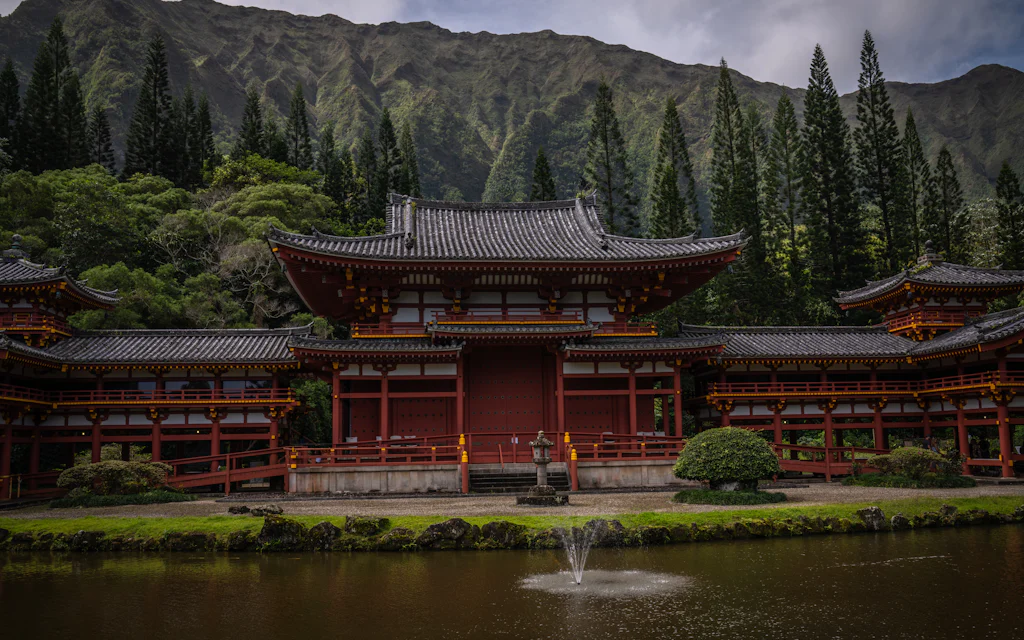
The Byodo-In Temple is worth it because there is nothing else like it on Oahu. The island is wall to wall beaches, ridgelines, and surf breaks, and then tucked into a memorial park in Kaneohe there is a vermilion Japanese temple sitting on koi ponds with the 2,000-foot Koolau cliffs rising straight up behind it. It photographs like a movie set and feels like a held breath.
It is also small, calm, and refreshingly easy. No permit lottery, no four mile trail, no tide chart to read. You park, you walk in, you wander for an hour, you leave calmer than you arrived. On an island where half the famous spots come with a logistics headache, that counts for a lot.
It works for almost everyone, too. Couples come for the photos, families come for the bell and the koi, grandparents handle the flat, shaded loop without breaking a sweat, and culture buffs come for the history. It is one of the few Oahu attractions you can confidently put on an itinerary that spans three generations and a wide range of fitness levels.
Now the asterisk. If you have got three days on Oahu and you still have not seen the North Shore or put your feet in the ocean, skip the temple this trip. It is a half hour each way for a quiet hour, and quiet hours are not what short Oahu trips are starving for. The temple rewards the unhurried, second timers, slow travelers, anyone whose itinerary already has white space in it. Force it into a packed day and you will spend the whole visit doing mental math about traffic.
Who loves the Byodo-In Temple?
Slow travelers & second timersOur pick
- Best for
- A calm hour off the beach, no permits, no crowds at 8:30am
- The catch
- Needs white space in your day — not a rushed-itinerary stop
Photographers
- Best for
- A red temple mirrored on a koi pond under 2,000-ft cliffs
- The catch
- Tour buses kill the light and the quiet after mid-morning
Families with kids
- Best for
- Ringing the 3-ton bell, feeding koi, chasing peacocks
- The catch
- It's a quiet temple — manage the indoor-voice expectations
History & culture fans
- Best for
- A faithful tribute to 1053's Byodo-in and Japanese Hawaii
- The catch
- It's a 1968 replica, not an ancient ruin — know that going in
02
A nearly 1,000-year-old temple, built in 1968
Here is the fact that breaks everyone's brain at the entrance, the Byodo-In Temple is a faithful replica of a temple that is nearly a thousand years old, and it opened in 1968.
The original Byodo in (Byōdō-in) sits in Uji, Japan, just outside Kyoto, and dates to 1053, an 11th-century building closing in on its thousandth birthday. It is a UNESCO World Heritage Site and, if you have ever held a Japanese 10-yen coin, you have already seen it, the Phoenix Hall is stamped right on it. The Oahu version is a smaller scale recreation, built to honor the 100th anniversary of the first Japanese immigrants arriving in Hawaii in 1868.
So no, it is not ancient, and the temple's own staff will tell you so happily. It is a tribute, a piece of Kyoto rebuilt in a Hawaiian valley by the descendants of the people who left Japan and never went back. Knowing that, the place lands differently. You are not looking at a museum piece. You are looking at homesickness made permanent, in cedar and bright red paint.
It is also a non denominational Buddhist temple, an active one. You do not have to be Buddhist, or anything in particular, to walk in. People come to pray, to scatter ashes, to take engagement photos, and to stand quietly in front of the Buddha, all on the same Tuesday afternoon, all without anyone batting an eye.
If the building itself looks oddly familiar from a screen, that is not déjà vu. The temple has stood in for a Japanese setting in films and TV for decades, most famously in the opening of the show Magnum, P.I., with cameos in Hawaii Five-0 too, so a few visitors arrive certain they have been here before. They have, sort of, from a couch.
Kaneohe's Byodo-In vs Uji's Byodo in
Byodo-In Temple, OahuOur pick
Valley of the Temples, Kaneohe
- Built 1968 for the Japanese immigration centennial
- Smaller scale tribute, famously assembled without nails
- Non denominational, all faiths welcome
- $10, no lines, peacocks included
Byodo in, Japan
Uji, near Kyoto
- Phoenix Hall dates to 1053, nearly 1,000 years old
- UNESCO World Heritage Site
- Stamped on the 10-yen coin
- A 14-hour flight and a bucket list line
03
What you will actually see at Byodo-In
The temple grounds are compact, but they pack a lot into a short loop. Here is what you are walking up to.
Five things to find on the temple loop
The Bon sho bellRing it first
A three ton, five foot brass bell cast in Japan. The custom is to ring it before you enter, to spread happiness and chase off evil spirits.
Phoenix Hall and the Amida BuddhaShoes off
The main hall, assembled without a single nail, houses a nine foot golden Buddha watched over by 52 smaller Bodhisattva statues. Dim, still, and incense scented.
The koi ponds and gardensTwo acres
Koi the size of small dogs, plus black swans and the occasional turtle, all wrapped in Japanese gardens. Fish food from the gift shop makes you a celebrity.
The meditation pavilion and peacocksKeep quiet
An open air spot where visitors actually meditate. Give it a wide, silent berth if occupied. Wild peacocks roam the area and pose on their own schedule.
The gift shop8:30 to 4:30
Sells fish food, incense, charms, omamori, and postcards near the entrance. It closes only on Thanksgiving and Christmas Day.
The Bon sho, the sacred bell
A three ton, five foot brass bell cast in Japan, hanging in its own little bell house near the entrance, and yes, you are meant to ring it. The custom is ringing it before entering, to spread happiness and chase off evil spirits. It produces a deep, chest rattling tone that you will hear echoing off the cliffs for the rest of your visit, usually courtesy of a delighted seven year old who has discovered their life's purpose.
The Phoenix Hall and the Amida Buddha
The main temple building, all symmetry and red lacquer, famously assembled without a single nail, houses a nine foot golden Buddha, one of the largest carved figures of its kind outside Japan, watched over by 52 smaller statues of Bodhisattvas floating on clouds around the hall. You take your shoes off before entering. It is dim, still, and smells of incense, and it asks for the kind of quiet that is hard to fake.
The koi ponds and the gardens
The temple is mirrored in two acres of ponds stuffed with koi the size of small dogs, plus black swans and the occasional turtle, with the surrounding Japanese gardens wrapping the whole loop. You can purchase fish food at the gift shop, at which point the koi will treat you like a celebrity and stage a thrashing, open mouthed mob scene that is somehow both peaceful and faintly menacing.
The meditation pavilion and the peacocks
Tucked along the path is a small meditation pavilion, an open air spot where visitors actually sit and do the thing the temple was built for. If it is occupied, give it a wide, silent berth. The wild peacocks, meanwhile, roam the area like they own the deed, which, functionally, they do. They will pose, they will strut, and they will absolutely scream like a haunted Victorian child right when you are lining up the perfect shot. Consider it part of the experience.
The gift shop
A small gift shop near the entrance sells the fish food (the single best two dollars you will spend on the windward side), plus incense, charms, omamori, and postcards. It runs the same 8:30-to-4:30 schedule as the temple grounds, closing only on Thanksgiving and Christmas Day.
04
Byodo-In Temple hours, admission, and parking
Here are the current Byodo-In Temple Oahu hours and admission for 2026, verified against the temple's official site so you are working from the real thing,
- Hours (as of 2026): Open daily, 8:30 a.m. to 4:30 p.m., with last entrance at 4:15 p.m., so do not roll up at 4:10 expecting a leisurely visit. The temple recommends arriving by 3:30.
- Admission: General admission is $10 for adults (13 to 64), $8 for seniors (65+), $6 for children (2 to 12), and free for under-2s. Kama'aina rates apply with a Hawaii ID.
- Payment: Credit, debit, and contactless only, the temple stopped handling cash on January 1, 2023. Purchase at the gate, or online ahead of time (online tickets never expire).
- Parking: The free parking era is over, the on site lot runs $6 per hour now. It is small, and on weekends and midmorning it fills, so an early start does double duty.
A family of four is looking at roughly $32 in admission, plus about $6 an hour for parking, call it $38 all in, about the cost of a single round of shave ice, and a far quieter way to spend an hour. It is one of the better value attractions on the island, which on Oahu is not a sentence I get to write often.
One more practical note, the temple sits inside the working Valley of the Temples Memorial Park, so drive slowly and keep it respectful on the way in. People are visiting graves. The vibe is gentle for a reason.
There is no restaurant on site and no real food beyond gift shop snacks, so eat before you come or save your appetite for Kaneohe town on the way out. Restrooms are available near the entrance, and the main loop is largely flat and stroller- and wheelchair friendly, though the temple building itself has a step or two and the shoes off rule to navigate.
Byodo-In Temple at a glance
05
How to get to the Byodo-In Temple from Waikiki
It is located at 47 to 200 Kahekili Highway, Kaneohe, HI 96744, punch "Byodo-In Temple" into your maps app and it will take you straight there. From Waikiki it is about 30 to 40 minutes, traffic depending.
The drive itself is half the fun. You climb up and over the Koolau range on the H-3 or the Pali Highway, and somewhere in the tunnel the weather changes its mind, you leave sunny Honolulu and pop out the windward side into mist, deep green, and those impossible vertical cliffs. It is one of the great five minute scenery swaps in Hawaii.
A few routing notes,
- H-3 is the fastest and the most jaw dropping, a highway built straight through the mountains on towering pillars. Take it at least one direction.
- Pali Highway drops you past the Nu'uanu Pali Lookout if you want to bolt on a viewpoint.
- Build in buffer for Honolulu rush hour (roughly 7 to 9 a.m. and 3 to 6 p.m.), which can quietly double your time over the mountains.
- Coming from Ko Olina or the west side? Add 30 to 40 minutes. You are crossing the whole island. From the North Shore, drop down the windward coast through Laie and Kualoa, slower, but the prettier road by a mile.
You will want a car for this one, and honestly for most of the windward side. If you are still sorting your route around the island, our map of Oahu lays out how the regions connect and where the temple sits in the bigger picture. Most visitors base in Waikiki and day trip over the Pali. If that is you, here is a Waikiki hotel search (also on Booking.com) to sort the home base first.
06
The dress code: what to wear at a working temple
This is the one rule people get wrong at a sacred site, so I will say it plainly, no beach attire. The Byodo-In Temple is an active place of prayer and meditation, not a photo backdrop with a gift shop, and the staff will (politely) turn the dress code into a thing if you show up in a wet swimsuit.
You do not need to overthink it. Aim for the same outfit you would wear to visit a relative you want to impress mildly.
What to wear at the temple
Practical packing for the day, a packable sun hat for the open grounds, reef safe sunscreen if you are beach hopping after, and comfortable walking shoes since you will be on your feet for the loop. If you care about the photos, a compact travel tripod earns its space for the reflection shots.
Inside the temple hall, keep your voice down and do not photograph people mid prayer. Obvious, maybe. Worth saying anyway.
A note for anyone planning an engagement or portrait shoot here, casual photos with your phone or camera are completely fine and need no permission, but organized or professional shoots require a permit arranged with the temple in advance. If you are showing up with a photographer, a dress change, and a tripod the size of a small child, sort it out beforehand rather than improvising at the gate. And whatever the shot, do not climb on the railings, lean into the pond, or stage anything that turns a place of prayer into a prop, the staff have seen every variation and they will, gently, end it.
07
The best time to visit, and how long to stay
Go first thing, the moment the gates open at 8:30 a.m. This is the single best piece of advice in this whole guide.
The temple is gorgeous and it is no secret, which means the tour buses know about it too. They start rolling in midmorning, and the moment they do, the serenity packs up and leaves with them, you go from a quiet koi pond to forty people doing the same photo. Beat them by an hour and you will have the place close to empty, the light soft, and the fish hungry.
Late afternoon is the runner up. Most day tours have moved on by 3 p.m., so the last hour before the 4:15 p.m. cutoff is quiet again, with warmer light on the temple's red face.
How long do you need? Budget about an hour. That is enough to ring the bell, see the Buddha, feed the koi, lap the pond, and let a peacock photobomb you. Photographers and slow wanderers can happily stretch it to two. Anyone trying to "knock it out" in fifteen minutes has misunderstood the entire point of the place, this is the rare Oahu stop that punishes a hurry.
For weather, remember the windward side runs cloudier and rainier than the south shore. A passing shower is not a disaster here. The grounds look even more cinematic with mist on the cliffs and the leaves dripping. But check the forecast, and lean toward a clear morning if you can pick your day.
As for the calendar, there is no bad season, the temple keeps the same schedule year round and looks good in every kind of light. Weekdays are quieter than weekends, and you will dodge the biggest crowds outside the summer and winter holiday peaks. If your trip overlaps with a Japanese cultural event or a New Year's bell ringing, that is a bonus worth timing for, but the day to day experience is consistent enough that you can just pick a clear morning and go.
08
Seeing Byodo-In without a car
No rental? You have still got good options, because the temple sits on the windward leg of nearly every Oahu circle island tour, and a few are built around it specifically.
A circle island day tour loops the whole island in one go, usually pairing the temple with the North Shore, a beach or two, and lunch, so you knock out Byodo-In and a half dozen other sights in a single driver handles everything day. It is the move if you have only got a day and do not want to drive the Pali yourself. Look for one that lists the temple by name and includes the admission, a few do, which saves you the gate fee and the awkward "wait, that is not included?" moment in the parking lot.
★4.9(3,932)
Hidden Gems of Oahu Circle Island Tour with Byodo In Temple
9 hours
Free cancellation
from
$159
If you would rather build your own route, the classic Oahu circle island day tour covers the same windward coast and the North Shore. Either way you get the temple plus the scenic crossing without touching a steering wheel, which, if you have seen Honolulu traffic, is its own small vacation.
Determined to visit Byodo-In on public transit? It is doable. TheBus route 65 (Kaneohe, Ahuimanu) runs from downtown Honolulu in roughly 45 minutes. Get off near Hui Iwa Street and it is about a 15-to-20-minute walk on foot into the memorial park, uphill at the end. The fare is a few dollars with a HOLO card. Check the current schedule, plan the return timing carefully, and budget half a day for the round trip. For most visitors the tour or a rental car wins on time and sanity, but the bus is a real option if you are patient and on a backpacker budget.
09
What else to do nearby on the windward side
The temple takes an hour. The crossing over the mountains takes thirty more. So do yourself a favor and make a windward day of it, the Kaneohe area and the coast just north are some of the prettiest, least rushed real estate on Oahu.
What to pair with the temple nearby
Kualoa Ranch20 minutes north
A 4,000 acre private nature reserve in the valley where they filmed Jurassic Park and Lost. The natural pairing with the temple.
Ho'omaluhia Botanical Garden5 minute drive
A free, sprawling 400 acre garden with a mirror flat lake and that same Koolau wall as a backdrop. Quiet, gorgeous, and underrated.
Heeia State Park12 minute drive
A quiet bayside park on Kaneohe Bay with a historic fishpond below, a good leg stretch between the temple and lunch.
The Kaneohe SandbarBoat only
A stretch of waist deep white sand in the middle of the bay you can reach only by boat. A surreal afternoon when the weather plays along.
Kailua and Lanikai beaches15 minutes south
Postcard sand when you are ready to trade serenity for the beach. Check our guide for parking and access details.
- Kualoa Ranch is a twenty minute hop up the coast, a 4,000-acre private nature reserve in the impossibly green valley where they filmed Jurassic Park, Lost, and roughly half of Hollywood's jungle scenes. It makes the natural pairing with the temple, and we have got a full Jurassic Park tour guide on what to book.
- Heeia State Park is located a twelve minute drive away on Kaneohe Bay, a quiet bayside park with a historic fishpond below, and a good leg stretch between the temple and lunch.
- Ho'omaluhia Botanical Garden is a five minute drive away, a free, sprawling 400-acre garden with a mirror flat lake and that same Koolau wall as a backdrop. Quiet, gorgeous, wildly underrated.
- The Kaneohe Sandbar is a stretch of waist deep white sand in the middle of the bay you can only reach by boat, a genuinely surreal afternoon if the weather's playing along.
- Kailua and Lanikai beaches are a 15-minute drive south when you are ready to trade serenity for postcard sand. Our Kailua and Lanikai guide has the parking and access details.
One honest aside, since the windward coast is our backyard, Byodo-In is a temple, not a picnic spot, but if your trip has a "toes in the sand, somebody else handles the setup" day in it, our $349 Sunset Picnic for Two sets up about 20 minutes south in Waimanalo. Different mood entirely, same gorgeous coast.
For the bigger picture of how all of this strings together, the things to do in Oahu guide maps the whole island's greatest hits.
The beat the tour buses plan
- 18:00 a.m.
Over the mountains
Leave Waikiki after rush hour starts thinning. Take the H-3 for the drama.
- 28:30 a.m.
Gates open, go
Ring the bell, walk the loop while the grounds are near empty and the light is soft.
- 39:15 a.m.
Phoenix Hall, then koi
Shoes off for the Buddha before the first groups land. Feed the koi after.
- 410:00 a.m.
Hand it to the buses
As the parking lot fills, you are done, windward day ahead, Kualoa, Hoomaluhia, or Kailua.
FAQ: visiting the Byodo-In Temple
What does Byodo-In mean?
"Byodo" means equality in Japanese, the Temple of Equality. The name fits the Oahu version doubly well, it is non denominational by design, open to every faith, and the location inside a memorial park means worshippers, mourners, and tourists all share the same quiet.
How do you pronounce Byodo-In?
"Byoh doh een," three even beats, no stress theatrics. Locals will understand any good faith attempt, and if all else fails, "the Japanese temple in the Valley of the Temples" gets you directions anywhere on the windward side.
Can you get married at the Byodo-In Temple?
Yes, the temple hosts weddings and vow renewals regularly, and the red hall against the Koolau cliffs is one of the most photographed ceremony backdrops in Hawaii. Arrangements go through the temple in advance. This is not a show up with an officiant situation. Casual engagement photos are fine without a permit, organized shoots are not.
Is the Byodo-In Temple free?
No, the Byodo-In Temple is not free. General admission is $10 for adults (13 to 64), $8 for seniors (65+), and $6 for children (2 to 12), free for under-2s, with kama'aina rates for Hawaii residents. Parking on site runs $6 per hour. It is still one of the better value hours you will buy on Oahu.
Do you need to buy Byodo-In tickets in advance?
No, walk up works fine. There is no timed entry system and no sellouts. Buy at the gate with a card. Online tickets exist and never expire, which makes them handy for flexible itineraries, but the only thing an early purchase saves you is thirty seconds at the entrance.
What else is in the Valley of the Temples?
It is a working memorial park serving several faiths, Buddhist, Christian, and more, spread across the valley floor, with the Byodo-In as its centerpiece. That is worth knowing for tone, you drive past the occasional memorial service and family visits on the way in, so keep the speed down and the music off.
When the rest of Oahu has you sunburned, sand blasted, and three beaches deep, the Byodo-In Temple is the island's reset button, an hour of cool air, deep green, and one very loud bell. Ring it once for luck. The peacocks will handle the rest.
Disclosure: Some links on this page are affiliate links. If you book or buy through them we may earn a small commission, at no extra cost to you. As an Amazon Associate, we earn from qualifying purchases.