King Kamehameha Statue, Oahu: History and Visitor Guide
17 min readYndira W. Tonin
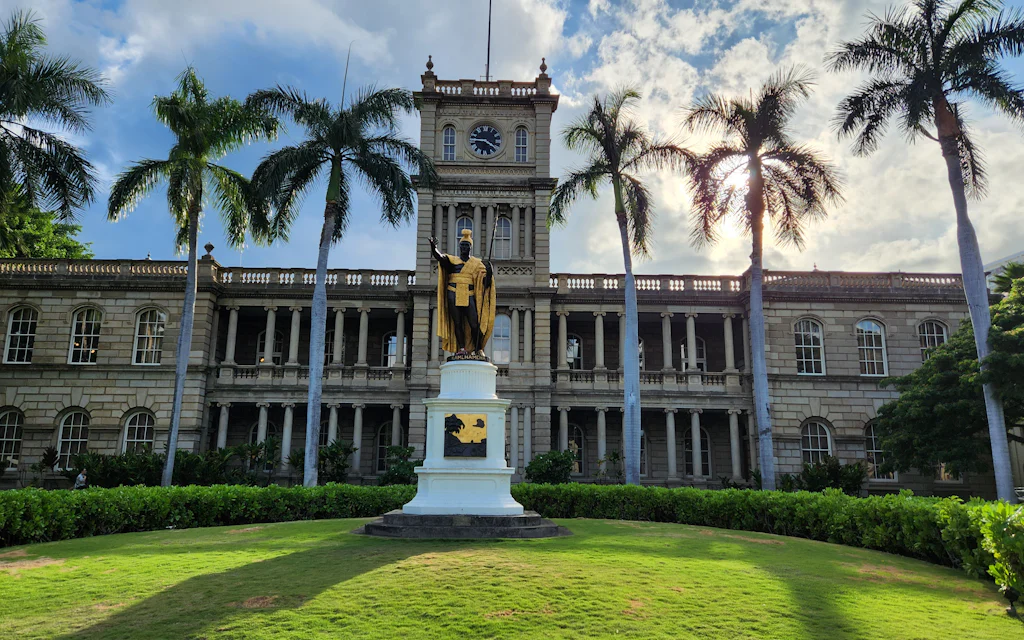
The King Kamehameha statue is the striking golden and bronze figure standing in front of Aliiolani (Aliʻiolani) Hale in downtown Honolulu, right across the street from Iolani Palace. It honors Kamehameha the Great, the warrior chief who unified the Hawaiian Islands into a single kingdom by 1810, and it is one of the most photographed landmarks in Honolulu.
The information here was confirmed for 2026.
Visiting is free and quick, the statue stands on a public sidewalk, so you can walk right up, any time of day. But the figure means far more once you know the man behind it and the surprising story of the statue itself.
This guide covers who Kamehameha was, exactly where to find the statue, the strange tale of how it was made (and nearly lost at sea), the moving Kamehameha Day lei draping every June, the other Kamehameha statues across Hawaii and beyond, and how to fit it all into a Honolulu day.
Table of contents
01
Who was King Kamehameha the Great?
To understand the statue, start with the man, because Kamehameha is to Hawaii what George Washington is to the United States, and then some.
Born on Hawaii Island in the 18th century, Kamehameha I rose through a turbulent era of warring chiefs to do something no ruler before him had managed, unite all the major Hawaiian Islands under a single government. Through decades of warfare, alliance, and shrewd adoption of Western weapons and advisors, he forged the independent Kingdom of Hawaii.
Kamehameha's path to a unified Hawaii
- 11782
Rise on Hawaii Island
Kamehameha takes power on the Big Island after the Battle of Mokuohai, beginning decades of conquest.
- 21795
Maui, Molokai, and Oahu fall
His army wins the brutal Battle of Nuuanu, driving Oahu's defenders over the Pali cliff.
- 31810
The islands become one
Kauai's chief cedes peacefully, for the first time in history, all the Hawaiian Islands are a single kingdom.
- 41819
A lasting dynasty
Kamehameha the Great dies. His line rules the Kingdom of Hawaii for generations, and the statue honors it all.
His campaign included one of the most dramatic battles in Hawaiian history, the 1795 Battle of Nuuanu (Nuʻuanu) on Oahu, where his forces drove the island's defenders up the valley and over the cliff at what is now the Nuuanu Pali Lookout. By 1810, the last holdout island of Kauai (Kauaʻi) had ceded peacefully, and the islands were one.
Kamehameha is remembered not only as a conqueror but as a lawgiver and protector, his famous "Law of the Splintered Paddle" (Kanawai (Kānāwai) Mamalahoe (Māmalahoe)) enshrined the protection of ordinary people, even in wartime, and it still appears in Hawaii's state constitution today. The story behind it is telling, as a young warrior, Kamehameha got his foot stuck in lava rock while chasing fishermen, who struck him on the head with a paddle to defend themselves. Years later, instead of punishing them, he declared a law protecting the weak from the powerful, a remarkable act for any ruler of the era.
The statue, then, is not just art. It is Hawaii honoring its founding father, the figure who gave the islands a shared identity that endured through the monarchy, the overthrow, annexation, and statehood. To understand him is to understand why Hawaiians regard their history with such pride.
02
Where is the King Kamehameha statue?
The most famous King Kamehameha statue stands in the heart of historic downtown Honolulu, and it is easy to find.
The address is 417 South King Street, in front of Aliiolani Hale, the handsome historic building that houses the Hawaii State Supreme Court and the Judiciary History Center. It stands directly across King Street from Iolani Palace, the only royal palace on American soil, so the two landmarks are a single, walkable stop.
The statue is right on the public sidewalk, in the open air, so there is no gate, ticket, or opening hour, you can visit any time, day or night, and photograph it freely. The figure depicts Kamehameha in royal regalia, a gilded cloak and helmet, one arm extended in welcome (or, some say, in a gesture of peace), the other holding a spear.
A small detail worth knowing for your photos, the statue you see is brightly gilded, the cloak, helmet, and sash are finished in gold leaf, which is why it gleams so dramatically in sunlight against the older bronze. That gilding is periodically restored, so the figure looks far more vivid in person than a dull bronze monument. It genuinely shines.
If you are exploring downtown, the statue anchors a cluster of historic sites within a few blocks, Iolani Palace, the State Capitol, Kawaiahao (Kawaiahaʻo) Church, and the edge of Chinatown, making it a natural centerpiece for a walk through old Honolulu, which we map in our things to do in Honolulu guide. Aliiolani Hale behind it is worth a look too, the building houses the free Judiciary History Center, and the structure itself was originally designed as a palace before becoming the seat of Hawaii's courts.

Photo by Tim Foster on Unsplash
03
The strange story of the statue
Here is what most visitors never learn, the statue in Honolulu is not the original, and the original has a genuinely wild backstory.
The project began in 1878, when Hawaiian government official Walter Murray Gibson wanted a monument to mark the centennial of Captain Cook's arrival. He commissioned American sculptor Thomas Ridgeway Gould, then working in Florence, Italy, to create a bronze statue of Kamehameha. The finished figure was cast in Paris and shipped toward Hawaii, and then disaster struck.
The ship carrying the original statue sank near the Falkland Islands in the South Atlantic. With insurance money, a second statue was cast from the same mold, and that is the one that arrived safely in Honolulu aboard the British ship Aberaman in 1883, and which you see in front of Aliiolani Hale today.
The twist, the original statue was later salvaged from the shipwreck and recovered, reportedly found by a sea captain who spotted it in a Falkland Islands port. Rather than waste it, it was sent to Kapaau (Kapaʻau) on the Big Island, near Kamehameha's birthplace, so the "first" statue and the "second" statue both survive, on different islands. It is a strange, almost mythic origin for a monument, lost at sea, mourned, replaced, and then recovered, like the king's own story of struggle and endurance.
There is one more layer of meaning in the design. Sculptor Thomas Gould worked from descriptions and a small number of references rather than a life portrait, Kamehameha had died decades earlier, so the figure is an idealized, heroic vision rather than a documentary likeness. The pose, with the cloak of a high chief and the outstretched hand, was meant to project the dignity and mana (spiritual power) of a unifying king, which is exactly the impression it still gives well over a century later.
04
Kamehameha Day and the lei draping
If you can time your visit to one day, make it June 11, because that is when the statue truly comes alive.
Kamehameha Day, June 11, is a Hawaii state holiday honoring the king, first proclaimed in 1871 by his grandson Kamehameha V and celebrated since 1872. It is one of the oldest holidays in Hawaii, and the centerpiece tradition is the lei draping ceremony, each year, fire truck ladders and lei bearers drape the Honolulu statue in enormous fresh lei, strands many feet long, sometimes stretching 18 feet or more, until the bronze figure is garlanded head to spear in flowers.
Here is the one strong opinion in this guide, most visitors snap a quick photo of the bare statue and move on, but the statue is at its most moving on Kamehameha Day, draped in towering lei and surrounded by chant, hula, and a floral parade. If your trip overlaps with early to mid June, rearrange your day to catch it, it is the difference between seeing a monument and witnessing a living tradition.
The broader celebration includes the spectacular King Kamehameha Celebration Floral Parade through Honolulu, with pau riders (women on horseback in flowing, flower draped regalia representing each island) and a host of cultural events overseen by the state's King Kamehameha Celebration Commission. It is one of the proudest, most beautiful days on the Hawaiian calendar.
If you want to catch the lei draping specifically, it is worth checking the exact date and time in advance, since the ceremony is often held on the closest convenient day around June 11 rather than always on the 11th itself, and it draws a respectful crowd. Arrive a little early, hang back, and let the chant, the lei bearers, and the fire truck ladders do their work, it is a genuinely emotional thing to watch a community garland its founding king in flowers, year after year, more than two centuries on.
05
The other Kamehameha statues
The Honolulu figure is the famous one, but it is not alone, there are actually several King Kamehameha statues, and knowing them adds to the story.
The cast of characters,
- Kapaau, Big Island, the original, salvaged from the shipwreck statue, standing near Kamehameha's birthplace in North Kohala. Purists consider this the "real" one.
- Honolulu, Oahu, the second cast, the most visited, in front of Aliiolani Hale (the one this guide is mostly about).
- Hilo, Big Island, a later statue in Wailoa River State Park, the largest of them.
- Washington, D.C., a casting in the U.S. Capitol's National Statuary Hall, representing the state of Hawaii, where it too is draped in lei each Kamehameha Day.
So the king watches over Hawaii from several places at once, and even keeps an eye on the U.S. Capitol. If you are island hopping, seeing the Big Island original near his birthplace is a meaningful counterpart to the Honolulu statue, same king, same mold, two very different settings.
The Kapaau original, in particular, is a quieter, more reflective experience than the busy Honolulu version, it stands in a small North Kohala town near where Kamehameha was born and raised, far from the city crowds, and is also draped in lei each June. Many Hawaiians consider it the more authentic of the two precisely because of that connection to his homeland. Seeing both, the recovered original near his birthplace and the famous replacement at the seat of his kingdom, bookends his story in a way a single statue cannot.

Photo by Nico Smit on Unsplash
06
What is nearby: Iolani Palace and historic Honolulu
The statue's greatest asset is its neighborhood, it stands at the center of the most historic few blocks in Hawaii, so a visit naturally becomes a tour of the islands' royal past.
Directly across the street is Iolani Palace, the official residence of Hawaii's last monarchs and the only royal palace on U.S. soil, a genuinely moving museum of the Kingdom of Hawaii and its overthrow, well worth a guided tour. Steps away are Kawaiahao Church, the coral block "Westminster Abbey of the Pacific," and the Hawaii State Capitol with its open, volcano inspired architecture.
A short walk takes you into Chinatown, one of the oldest in the U.S., with its markets, lei stands, art galleries, and some of Honolulu's best and most affordable food, a perfect pairing with the history, and covered in our Hawaiian food guide.
Worth knowing if the history grabs you, Iolani Palace is the emotional heart of the area. It was the home of King Kalakaua (Kalākaua) and Queen Liliuokalani (Liliʻuokalani), the site of the 1893 overthrow of the Hawaiian Kingdom, and later where the queen was imprisoned in her own palace. Touring it, with the statue of the kingdom's founder standing just outside, gives you the full arc of the Hawaiian monarchy, its triumphant beginning and its tragic end, in a single block.
Because everything clusters so tightly, the smart move is to treat the statue not as a quick stop but as the gateway to a half day in historic Honolulu, the statue, the palace, the church, and a Chinatown lunch make a rich, walkable, and largely free morning steeped in Hawaiian history, arguably the best way on the island to understand how modern Hawaii came to be.
07
How to visit the statue
Visiting the King Kamehameha statue is about as easy as a Honolulu sight gets, but a few tips help.
The basics, it is free, outdoors, and always accessible, since it stands on a public sidewalk. There is no admission and no set hours. Allow just 10 to 15 minutes for the statue itself, or build it into a longer downtown walk. Early morning gives the best light and the fewest people for photos. The statue faces roughly toward Iolani Palace, so morning sun lights the front nicely.
Getting there, you have options. Downtown Honolulu is a short drive or rideshare from Waikiki (about 10 to 15 minutes), and TheBus runs there frequently and cheaply. Driving yourself means dealing with downtown parking, there are paid lots and garages nearby, but street parking is limited and metered, so transit or rideshare is often easier for a quick visit.
A couple of photo and etiquette notes. The statue is genuinely large and set on a tall pedestal, so step back across the plaza (or shoot from the Iolani Palace side) to get the whole gilded figure in frame against the sky. And if you happen to visit when it is draped in lei, admire the offerings but do not touch or take them, they are a living tribute, placed with care, not decoration.
Many guided tours also include the statue, a Pearl Harbor and Honolulu city tour often pairs the memorial with a downtown drive past the statue and Iolani Palace, and Honolulu city and history tours stop here as a matter of course, a good option if you would rather have the history narrated than read the plaques yourself.
08
Is it worth visiting?
Honestly? The statue alone is a five minute stop, but its setting and story make it absolutely worth working into a Honolulu day.
If you are the kind of traveler who likes to understand a place, the King Kamehameha statue is one of the most meaningful landmarks in Hawaii, it is the islands' founding father, rendered in bronze, at the doorstep of their royal palace. Pair it with an Iolani Palace tour and a Chinatown lunch and you have a half day that explains modern Hawaii better than any beach can.
If you just want a quick photo of a famous landmark on your way somewhere else, that works too, it is free, central, and genuinely striking, especially the gilded cloak catching the morning sun. Either way, taking two minutes to read up on Kamehameha first turns a tourist photo into something you will actually remember.
It also rewards a certain kind of traveler more than others. If beaches and tours are all you are after, the statue can stay a quick photo. But if you find that the places you remember most are the ones you understood, the ones with a story, then this corner of Honolulu, with its founding king, its royal palace, and its weight of history, will likely stick with you longer than another afternoon by the pool.
The one time it leaps from "worth a stop" to "rearrange your trip" is Kamehameha Day in June, when the lei draping and parade make it unforgettable. The rest of the year, treat it as the centerpiece of historic Honolulu rather than a destination in itself, and you will come away glad you stopped, and a little wiser about the islands you are visiting.
09
Getting there and where to stay
Most visitors see the statue as part of a downtown Honolulu outing from a Waikiki base, which is the easy, central place to stay for a first Oahu trip. From Waikiki it is a quick rideshare, a cheap bus ride, or a short drive to downtown. You can compare Waikiki hotels on Expedia (also on Booking.com) for a base close to everything, then day trip into the historic district.
Pair the statue with the rest of downtown and historic Honolulu, Iolani Palace, the Capitol, Kawaiahao Church, Chinatown, for a half day that needs no car, just comfortable shoes. And to get more out of every Hawaiian place name and tradition you will meet along the way, our guide to the language spoken in Hawaii is a lovely companion.
If you would rather not navigate downtown parking, a circle island or city tour from Waikiki handles the logistics and usually pairs the statue with Pearl Harbor or a wider Honolulu loop, a good fit if the statue is one stop on a fuller sightseeing day rather than a dedicated trip. Otherwise, rideshare or TheBus from Waikiki is the simplest way in and out for a quick visit.
A small, on brand aside, we run beach picnics on Oahu, so we are firmly in the "history in the morning, beach in the afternoon" camp, pair a downtown walk with a sunset on the sand and you have a perfect Oahu day. Our picnic packages start at $349 for two if you would like the beach half handled. That is the only pitch. The statue, like all the best of Honolulu's history, is free.
FAQ
Where is the King Kamehameha statue in Honolulu?
It stands at 417 South King Street in downtown Honolulu, in front of Aliiolani Hale (the State Supreme Court building) and directly across the street from Iolani Palace. It is on a public sidewalk, so it is free to visit and photograph any time, with no admission or set hours.
Who was King Kamehameha?
Kamehameha the Great (Kamehameha I) was the warrior chief who united all the major Hawaiian Islands into a single kingdom by 1810, founding the Kingdom of Hawaii. He is regarded as Hawaii's founding father, remembered both as a conqueror and as a lawgiver whose "Law of the Splintered Paddle" protecting ordinary people endures in Hawaii's constitution.
Is the King Kamehameha statue free to visit?
Yes. The Honolulu statue stands on a public sidewalk in front of Aliiolani Hale, so there is no admission fee and no set hours, you can walk up and photograph it any time, day or night. The nearby Iolani Palace does charge admission for its tours.
What is Kamehameha Day?
Kamehameha Day is a Hawaii state holiday on June 11 honoring King Kamehameha the Great, first celebrated in 1872. Its signature tradition is the lei draping ceremony, when the statues are draped in enormous fresh lei, alongside the King Kamehameha Celebration Floral Parade through Honolulu with pau (horseback) riders.
Why are there multiple King Kamehameha statues?
The original statue sank near the Falkland Islands on its way to Hawaii in the 1880s. A second was cast from the same mold and placed in Honolulu, then the original was salvaged and sent to Kapaau on the Big Island near Kamehameha's birthplace. Additional statues stand in Hilo and in the U.S. Capitol in Washington, D.C.
How long do you need at the King Kamehameha statue?
The statue itself takes only 10 to 15 minutes to see and photograph. Most visitors fold it into a longer walk through historic downtown Honolulu, with Iolani Palace, Kawaiahao Church, the State Capitol, and Chinatown all within a few blocks, you can easily spend a half day in the area.
What is near the King Kamehameha statue?
It sits in the heart of historic Honolulu, Iolani Palace (the only royal palace on U.S. soil) is directly across the street, with Kawaiahao Church, the Hawaii State Capitol, and Chinatown's markets and food all within a short walk. The cluster makes a rich, mostly free half day of Hawaiian history.
Disclosure: Some links on this page are affiliate links. If you book or buy through them we may earn a small commission, at no extra cost to you. As an Amazon Associate, we earn from qualifying purchases.


