Road to Hana Maui: The Stops Worth It, Mile by Mile
29 min readYndira W. Tonin
The Road to Hana is Maui's legendary scenic drive, 64 miles of rainforest waterfalls, one lane bridges, and cliff edge ocean views, less a route to somewhere than the destination itself. This Road to Hana Maui guide covers the stops in order, the reservation drill, tour prices, and the 2026 no go list, with every fee checked as of July 2026, written for first timers planning the one big Maui day.
By the numbers it sounds terrifying and is actually fine, roughly 620 curves and 59 bridges, 46 of them one lane, at maybe 25 miles an hour, which turns 64 miles into approximately a 10 to 12 hour day. You are not driving to Hana, you are spending a day pulling over, and that is the whole idea.
Table of Contents
- The Road to Hana at a glance
- When to go and what time to leave
- Drive it yourself or take a Road to Hana tour?
- The first stretch, Paia to Twin Falls
- Waterfalls and gardens
- Keanae and the banana bread
- Waianapanapa State Park, the black sand beach
- Hana town
- Beyond Hana, Kipahulu in Haleakala National Park
- What to pack for the drive
- Driving the Hana Highway, tips and etiquette
- Mistakes to avoid
- Where to stay
- FAQ, Road to Hana Maui
01
The Road to Hana at a glance
Here is the whole drive in numbers. The route follows Hawaii Routes 36 and 360 along Maui's north coast, and a useful quirk to know up front, where Route 36 becomes Route 360 near Haiku, the mile markers reset to zero, and those little green signs are how locals and guides reference every stop from there on.
What you are signing up for
The single most important mindset shift, the drive is the destination. You are not optimizing for arrival time, you are budgeting a full, unhurried day to pull over a dozen times, get rained on, eat banana bread, and stand under a waterfall.
Getting to the start of the Road to Hana
Tap to open Google Maps with turn-by-turn directions.
It is genuinely one of the most beautiful drives on earth, winding through jungle so green it looks artificial, past black sand beaches and pools and bamboo forests. It is also long, twisty, and occasionally white knuckle. Respect both halves of that sentence and you will love it.
Worth it? For most visitors, yes, and by a wide margin. The honest exceptions are travelers who hate winding roads, get severely carsick, or have half a day, and for them a tour or the first scenic stretch beats the full out and back.
Start early, go slow, do not try to see all of it. The journey in order, anchor stops only,
The Road to Hana day, mile by mile
- 16:45am
Paia, gas, breakfast, restroom
The last full service town. Leave with a full tank, snacks, and small bills.
- 2Mile 2
Twin Falls
First waterfall of the day and the most crowded. If it is mobbed, better falls are ahead.
- 3Miles 9 to 12
Waikamoi, Garden of Eden, Kaumahina
Bamboo loop trail, the 26-acre arboretum, and the first wayside park with restrooms.
- 4Mile 17
Keanae Peninsula
Lava rock coast, taro fields, and Aunty Sandy's banana bread, warm, in the parking lot.
- 5Mile 19
Upper Waikani Falls
The Three Bears, three side by side drops, visible from the road.
- 6Mile 32
Waianapanapa State Park
The black sand beach. Arrive inside your reserved time slot, no reservation, no entry.
- 7Hana
Lunch and a breather
Food trucks, Hasegawa General Store, Hamoa Beach. Decide here, push on or turn back.
- 8Mile 42*
Kipahulu, Pipiwai Trail + the pools
Bamboo forest, 400-ft Waimoku Falls, Seven Sacred Pools. *Highway 31 markers, then home before dark.
02
When to go and what time to leave
Timing makes or breaks this drive, and it comes down to one rule, leave early.
Be on the road by 7am, ideally earlier. A late start is the most common mistake on this road, and an early one is the difference between a relaxed day and a stressful one. You beat the tour buses and the rental car convoy already forming behind you, seeing waterfalls and beaches without the crowd, and you bank enough daylight to actually reach the far stops without rushing back in the dark.
Driving it after dark is genuinely no fun, no streetlights, and the 7am start is what gets the classic Hana day home before sunset with margin. Forum veterans recommend the far end first template, drive out with few stops, book a midday Waianapanapa slot, and work backward. On the return, leave Hana before 3pm or after 6pm and you skip the single file afternoon parade, when the road can feel twice as long, or spend the night in Hana and own the morning road.
Gas up in Paia before you go. Paia town, at the start, is the last full service stop.
Hana has one small, pricey pump and not much else. Start with a full tank and you never think about it again.
As for season, the Road to Hana is good year round, but it runs through the wettest, greenest part of Maui, so expect rain in any month, that is why the waterfalls exist. Winter brings large waterfalls and a slightly higher chance of road closures after heavy storms.
Summer is drier and busier. Our best time to visit Hawaii guide covers the broader seasons.
One weather note that matters, do not drive it during or right after a heavy storm. Flash flooding, rockfall, and the occasional closure are real on this road. A normal passing shower is fine and part of the charm, a tropical downpour is a day to postpone.
If your schedule allows, pick a weekday over a weekend, the road is busiest on weekends, with both visitors and locals out enjoying it. And check the road status the night before, Maui's county and emergency sites post closures after storms or landslides, and the occasional bridge repair can reroute the drive. A two minute check beats discovering a closure at mile marker 20 with no way around.
Pick a clear ish morning, set an early alarm, and treat the early start as non-negotiable. Everything else about the day gets easier from there.
03
Drive it yourself or take a Road to Hana tour?
This is the first real decision of the itinerary.
Drive it yourself if you want to set your own pace, linger where you like, skip what you do not, and stop for that roadside banana bread on a whim. A standard rental handles it, the Hana Highway is paved the whole way, so a Jeep is a want, not a need, unless you tackle the rough back road past Kipahulu.
Consider a guided tour if the idea of 620 curves and 46 one lane bridges makes your palms sweat, if you get carsick as a driver, or if taking in the view beats gripping the wheel all day. A good driver guide knows the stops, handles the hairy bits, and narrates the history and legends you would otherwise miss.
Drive it yourself vs take a tour
Drive it yourselfOur pick
+ audio guide = the sweet spot
- Your pace, linger, skip, stop on a whim
- Cheapest once you have the rental car
- You handle Waianapanapa booking, gas, parking
- Driver mostly watches the road, not the views
Guided tour
Pickup, lunch, local at the wheel
- Someone who is driven it a thousand times
- Narration, history, legends, the right stops
- Reservations and parking handled for you
- Fixed schedule, no lingering at a favorite
A small group Road to Hana Maui tour is the easy button, pickup, lunch, and a local at the wheel, you watch scenery instead of blind curves while someone else parks at the crowded stops.
Road to Hana tours in 2026 price out plainly. Polynesian Adventure runs from $249, Valley Isle about $294 with tax, Temptation's eight seat limo vans $335 to $449 with the helicopter leg, and Hana and Beyond, Native Hawaiian owned, from $210 with the Waianapanapa entry handled for you, and the big operators all include hotel pickup.
What a Road to Hana tour costs
Hana & BeyondLocal pick
From $210, Native Hawaiian owned, Waianapanapa entry handled.
Polynesian AdventureThe classic
From $249, the big coach classic, lunch included.
Valley Isle ExcursionsSmall group
About $294 with tax, 12 passenger vans, meals included.
Temptation ToursSplurge
$335 to $449, eight seat limo vans, helicopter combo at the top.
Audio app self driveMiddle path
Shaka Guide $24.99 or GuideAlong from $19.99, narration while you keep the wheel.
★4.8(3,311)
Small-Group Road to Hana Adventure Tour with Pickup & Lunch
8 to 11 hours
from
$210
There is also a middle path, a GPS audio guide app that narrates the journey stop by stop while you do the driving. It is the cheapest option by far, keeps the flexibility of self driving, and means you are not constantly pulling over to read a guide. For confident drivers who still want the stories, it is the sweet spot.
★4.7(241)
Shaka Guide Maui "Classic" Road to Hana Audio Driving Tour
15 to 18 hours
Free cancellation
from
$25
On cost and logistics, guided tours run a full day with hotel pickup, lunch, and water included, which removes the gas, parking, and reservation headaches entirely, a good operator even handles the Waianapanapa booking for you. Self driving is cheaper once you have the rental car, but factor in the gas, the park fees, and the reservation legwork before you call it the budget option.
Whatever you choose, the stops below are the same. The only question is who is doing the driving, and whether you would rather have the freedom or the front seat view.
04
The first stretch: Paia to Twin Falls
The official drive starts in Paia, a funky little former plantation town worth a short stroll before you commit to the curves. Grab breakfast, fill the tank, buy snacks, and use the bathrooms, the next reliable ones are the wayside parks with their picnic tables at miles 12 and 22.
From Paia, the road follows the coast and then turns inland into the green. The mile markers (which count up to Hana) become your map. Locals and guides reference everything by mile marker, so watch for the little green signs.
Your first marquee stop is Twin Falls, around mile marker 2. It is the first waterfall of the day, fully family friendly, an easy walk to the lower falls, and consequently very popular.
It is lovely, but because it is first and easy, it draws crowds. Parking is $10 with only 55 stalls available, gates open at 7:10am with last entry at 4:30pm, rideshare drop offs are not allowed, and the property closes to visitors the first Saturday of each month while the farm stand pours the sugarcane juice it has poured since 1997.
Every list of great scenic drives includes this road, and the classic Hana stops and highlights cluster after mile 10, so settle in, keep the speed low, and bank the early time with zero pressure to hit every stop.
Just before Paia, if you have a few minutes, Hookipa Lookout is worth a pause, it is one of the best windsurfing and surf beaches on Maui, and in the cooler months you can often spot green sea turtles hauled out on the sand below. It is a gentle warm up for the day and a reminder to keep the camera within reach from the very start.
Set your rhythm here, pull over only at the stops you have chosen, use the official pullouts, and let faster local traffic pass. The day works best as a relaxed series of stops, not a race between them.
05
Waterfalls and gardens
The heart of the Road to Hana is its middle stretch, where the waterfalls and gardens come one after another. This is the part people picture, and it delivers. The temptation is to stop constantly, and that is exactly how people run out of daylight before Hana, choose three or four waterfall stops, not ten.
Quality over quantity is the entire secret. Each stop follows the same rhythm, find a legal pullout, walk in, marvel, photograph, walk back, and none of it is fast, which is why your 7am start is doing quiet heavy lifting all day.
Garden of Eden Arboretum (mile marker 10)
A manicured 26-acre botanical garden with sweeping coastal overlooks, famous as a filming location. There is an entry fee, but the views and the easy paths make it a worthy, low effort stop, and a natural companion to our Hawaii flowers guide. Just before it, the Waikamoi Ridge Trail (mile 9.5) is a short rainforest loop through towering bamboo and tall trees, a free alternative to the paid garden and a good early leg stretch, and the rainbow eucalyptus trees near mile 7 peel in streaks of green, orange, and purple, one of the most photographed roadside sights on the drive.
Honomanu Bay (mile marker 14)
The hairpin above Honomanu Bay is the drive's first dramatic coast reveal, a black pebble bay far below the road with wide overlooks on both approaches. The steep spur road down chews rental cars, so take the photos from the top and keep the deposit.
Upper Waikani Falls, the "Three Bears" (mile marker 19)
Upper Waikani Falls is a three tiered waterfall visible right from the road, named for its three side by side drops. It is pretty much the postcard shot of the middle stretch, easy to see, hard to park. Pull over only where it is safe and legal, and enjoy it from the roadside rather than scrambling down the embankment.
Wailua Falls (mile marker 45, past Hana)
Wailua Falls is an 80-foot waterfall that tumbles right beside the road on the way to Kipahulu, one of the most photographed and easiest to see falls on the entire route, no hike required. Note where it lives, you reach it after Hana town, so do not panic when the biggest roadside falls have not appeared by mile 30.
They are coming. Our full Wailua Falls guide covers the stop in detail.
The wayside parks: Kaumahina and Puaa Kaa
Kaumahina State Wayside Park (mile 12) and Puaa Kaa State Wayside Park (mile 22) are free roadside parks with restrooms and ocean lookouts, handy, legal places to stretch your legs and use a bathroom. The Wailua Valley State Wayside (mile 18) adds a sweeping lookout over taro fields and the coast for almost no effort.
Beyond the named sights, the stretch is dotted with smaller cascades and pull offs that reward sharp eyed passengers. You will not catch them all, and that is fine, let the passenger play spotter while the driver watches the road. Keep an eye on the sky, too, rain upstream can swell a calm pool or waterfall quickly, so admire the bigger falls from a sensible distance and skip swimming if the water is high, fast, or muddy.
06
Keanae and the banana bread
About halfway out, a short side road drops to the Keanae Peninsula, a flat finger of old lava jutting into the ocean, where waves explode against black rock and a small, deeply local community has farmed taro for generations.
It is one of the most striking stops on the whole drive, and many visitors blow right past the turnoff. Take it. The raw, wild coastline here, no beach, just black lava and white surf, is a complete change from the green you have been driving through, and it stays with you long after the drive.
Keanae is also home to the most famous snack on the road, Aunty Sandy's banana bread, baked fresh and sold warm. It has near mythical status, and the line tells you it earns it.
Whether or not you are a banana bread person, this is a rite of passage, buy a loaf, eat it warm in the parking lot, and understand what the fuss is about. Further along, a few more roadside legends are worth the cash you should always carry, Hana Farms, Coconut Glen's for vegan coconut ice cream served in a coconut shell, Nahiku Marketplace for island style tacos and kalua pork, and the Halfway to Hana stand for shave ice.
The roadside legends worth stopping for
Aunty Sandy'sKeanae · the legend
Banana bread baked fresh and sold warm. The line tells you it earns the myth.
Halfway to Hanamile ~17
Banana bread and shave ice institution at the natural recalibration point.
Hana Farmsnear Hana
A farm stand gone professional, banana bread several ways, hot sauce, coffee.
Coconut Glen'smile ~27.5
Vegan coconut ice cream served in a coconut shell, with theatrical cheer.
Nahiku Marketplacemile ~28.7
Island style tacos, kalua pork, and coffee, the closest thing to a food court out here.
Beyond the named legends, the drive is studded with roadside fruit and snack stands, coconut candy, fresh pineapple, smoothies. They are part of the experience and a nice way to support the small communities the road runs through.
Carry small bills. Many are cash only and run on the honor system.
This is also the natural place to recalibrate. Roughly halfway, midmorning if you left on time, are you on pace, or have you over lingered?
The honest answer here tells you whether to push for the far stops beyond Hana or start turning around. Either is fine, just decide on purpose.
Just past the turnoff, the Keanae Arboretum offers a free, shady walk among labeled tropical trees if you want to stretch your legs. Between the lava coast, the taro fields, the arboretum, and the snacks, Keanae easily justifies a longer stop than most people give it.
A quiet local respect note, Keanae is a living community, not an attraction. Park where you should, keep noise down, do not wander into yards or taro fields, and leave it exactly as you found it.
07
Waianapanapa State Park: the black sand beach
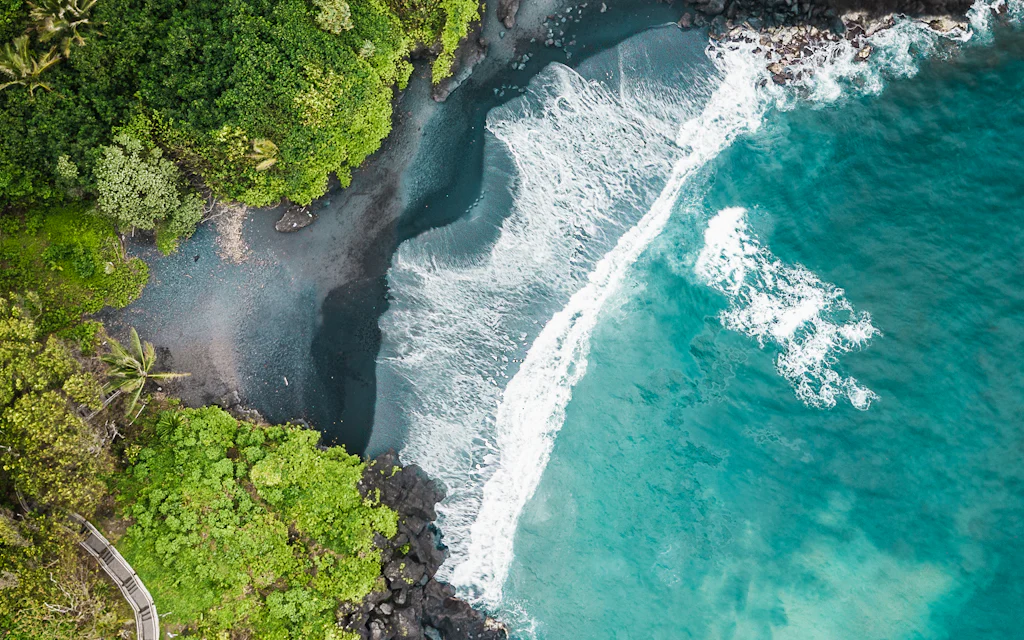
If there is one stop that competes with the waterfalls for the trip's signature image, it is Waianapanapa State Park, located around mile marker 32, which features a jet black volcanic sand beach with surrounding green cliffs, sea caves, and bright blue water.
The contrast is unreal in person, black sand, blue ocean, green jungle. Lava tubes, blowholes, a freshwater cave, and short walking trails along the sea cliffs round out the grounds, our dedicated black sand beach guide covers the reservation, safety, and the legend in full.
The logistics that matter, current as of July 2026, Waianapanapa requires advance reservations with timed entry for all nonresident visitors, $5 per person plus $10 per vehicle, booked through the Hawaii state parks site. Slots open 30 days ahead and release at midnight Hawaii time, and the park is open 7:00am to 6:00pm daily.
They sell out, so book the moment you lock your Road to Hana date, turning up without one means being turned away from the trip's best beach. The system now runs four entry windows and you must arrive inside the first 30 minutes of yours.
New for summer 2026, a construction project closed the eastern day use lot, rerouted black sand beach access through the west end of the park, and suspended campervan camping into 2027, with short full closures possible on road work days. The beach itself stays open, the walk just changed.
What the day costs in fees
A safety word, because the beach earns it, the black sand is beautiful but the surf here can be powerful and dangerous, with strong currents and shore break. Admire it, wade carefully if at all, and do not turn your back on the ocean. This is a looking and photographing beach far more than a swimming one.
The park's name and caves come with a Hawaiian legend of a princess named Popoalaea, which the interpretive signs tell well, worth two minutes before you wander the lava tubes and freshwater caves that give the place its name. If you are staying overnight in Hana, sunrise here, before the reservation crowds arrive, is one of the quietest and most spectacular moments on the entire east side.
Budget real time here, at least an hour. After the close quarters of the car and the jungle, the open black coastline is where most people's Road to Hana photos, and memories, come from.
08
Hana town
After all that you reach Hana itself, a small, quiet, intentionally remote town, and that is precisely its charm.
There is a small store, various food trucks, a historic church or two, one quietly upscale hotel, the Hana-Maui Resort, and a slow pace that feels a world away from the resort coasts. People who expected a destination leave underwhelmed, people who expected a peaceful Hawaiian town leave charmed.
Practical notes for Hana, grab a bite, use the facilities at Hana Beach Park by the bay, top up gas if you are continuing past town, though brace for the price, and take a beat to rest before either turning around or pushing on to Kipahulu. Red Sand Beach (Kaihalulu) near town is a striking, if tricky to reach, detour for the sure footed.
The big decision in Hana is whether to turn around or keep going. Many people stop here and head back the way they came. But some of the best activities, the Pipiwai Trail, the pools of Oheo, sit a little beyond Hana, in Haleakala National Park.
If you left early and have daylight, push on. If it is midafternoon and you are tired, turning back is no failure.
A few local institutions reward a wander, the historic Hasegawa General Store, a wonderfully cluttered island fixture that has served Hana for over a century. And, a short drive away, Hamoa Beach, a gorgeous gray sand crescent the author James Michener once called one of the most beautiful beaches in the Pacific. If you only stretch your legs at one beach near Hana, make it Hamoa.
Just past it, Koki Beach is a wilder, red tinged stretch below the Ka Iwi o Pele cinder cone, striking to look at, often too rough to swim. And just north of town, the Hana Lava Tube (Kaeleku Caverns) is a self guided walk through a huge, 500-plus-year-old lava tube, a fun rainy day or simply different stop.
Down at Hana Bay, a small black and gray beach with a pier, you will often find locals fishing and kids swimming in the calm, protected water. It is the town's living room, a lovely, unhurried place to eat your packed lunch and just watch Hana be Hana for a while.
Either way, do not rush Hana itself. The whole point of the drive was to slow down, and Hana is where slowing down becomes the entire activity.
09
Beyond Hana: Kipahulu in Haleakala National Park
The stretch past Hana, into the Kipahulu District of Haleakala National Park, is where the drive saves some of its best for the determined. It is about 10 more miles, and only worth it if you started early enough to have the daylight.
The Pipiwai Trail: bamboo forest and Waimoku Falls
The highlight is the Pipiwai Trail, a roughly 4-mile round trip hike that is, for many, the single best thing on the whole Road to Hana. It climbs through jungle past the Makahiku Falls overlook and a massive old banyan tree into a surreal bamboo forest, a dense, towering grove that creaks and rattles in the wind, and ends at the 400-foot Waimoku Falls.
If you only do one hike out here, make it Waimoku Falls. Nothing else on the route pays off this well per mile.
The Seven Sacred Pools (Pools of Oheo)
Nearby are the Seven Sacred Pools, properly the Pools of Oheo, a series of tiered pools and waterfalls tumbling toward the sea in the Oheo Gulch.
The 2026 reality check
The pools are no longer accessible for swimming, the National Park Service shut entry due to safety concerns and the closure has officially held through 2026, so the view from the Kuloa Point Trail by the Kipahulu Visitor Center is the visit now. The tiered drop to the sea still earns the stop.
Our Seven Sacred Pools & Pipiwai Trail guide has the full honest rundown. Just steer clear of the unofficial swimming holes people chase out here, like the Venus Pools, they sit on posted private land and flash flood without warning.
This area is part of Haleakala National Park, so getting in requires the park pass, $30 per private vehicle, valid for three days, covering both the Kipahulu and Summit districts, and the park is cashless, so bring a card. If you are also doing the Haleakala summit sunrise, one pass covers both within its window, worth knowing.
A real talk caveat, heading past Hana the road gets rougher and more remote, and some rental agreements get twitchy about the far "back side" loop through dry ranch country around the bottom of the island, mostly paved now with a few rough miles at Kaupo. The out and back to Kipahulu on the paved road is fine and well traveled.
The full circle beyond is a different, more committing proposition. Know which one you are doing.
An interesting footnote near Kipahulu, the aviator Charles Lindbergh is buried in the churchyard at Palapala Hoomau, a peaceful, off the radar stop for the curious. And if you are tempted by the full "back side" loop around the south of the island, weigh it carefully, the unpaved, narrow sections and skittish rental car policies make the simple out and back the right call for most visitors.
If you make it here, you have earned it, bamboo, waterfalls, and pools at the literal end of the road, with most of the day's crowds long since turned back.
10
What to pack for the drive
The Road to Hana is a long day in a remote place, and what you bring decides which small miseries you skip. None of this is heavy or exotic, but something always gets forgotten at 6am.
- Snacks, supplies, and plenty of water. A large stocked cooler keeps everyone happy between the fresh banana bread stands.
- A swimsuit and a quick dry towel, worn or put at the top of the bag, for any waterfall or beach stop where conditions are safe.
- Water shoes or sturdy sandals for slick trails and rocky stops, and wear real hiking shoes for Pipiwai.
- A light rain jacket. It is the rainforest. Brief showers are guaranteed and part of the fun.
- Bug spray. The green stops have mosquitoes, and you will be glad you have it.
- Motion sickness tablets if anyone might be prone, 620 curves is a lot, keep motion comfort in mind.
- Cash in small bills for the honor system fruit stands and banana bread.
- A full tank of gas and a charged phone, with offline maps downloaded, since coverage drops out for long stretches.
On food specifically, the roadside stands are a joy but unreliable as a full meal, and Hana's few options are limited and can close early. Pack an actual lunch, sandwiches, fruit, snacks for the kids, rather than counting on finding a proper meal at the right moment. A picnic at a waterfall lookout beats a hangry scramble in a town with two open kitchens.
Our Hawaii packing list covers the broader trip, but for this one day, the cooler, the rain jacket, the cash, and the motion sickness tablets are the difference makers people most often forget.
One more on the car itself, a smaller vehicle is easier on the narrow road and the tight pullouts than a giant SUV, and a convertible is more novelty than asset given the frequent rain. Whatever you drive, start with a full tank, a clean windshield, and an empty bladder, the three things you will most wish you had sorted once the curves begin.
Pack the night before. A 7am departure is hard enough without hunting for sunscreen and small bills at dawn.
11
Driving the Hana Highway: tips and etiquette
This is a real road that real people live and work on, and how you drive it matters, for safety and for being a decent guest. The honest difficulty rating first, the Hana Highway is challenging, not scary. The curves demand an alert driver and a gentle pace, and most people getting behind the wheel find it very manageable in daylight and dry ish weather.
Hana Highway etiquette, the short version
Yield and use the pulloutsthe golden rule
Locals drive this daily. A car stacks up behind you, use the next pullout and wave.
One lane bridges run on courtesy46 of them
First to arrive goes. A friendly wave sorts the rest. Never stop on a bridge for photos.
Never stop in the roadblind curves
Legal pullouts and lots only, fully off the lane. The photo is not worth the accident.
Steady pace, easy brakesanti carsick
Smooth and slow beats speed and brake, your passengers' stomachs agree.
Offline maps, headlights onno signal
Cell service dies past Paia. Download maps, tell someone your plan, light up in the gloom.
Beyond the mechanics, there is the matter of respect, the Road to Hana passes through small, tight knit Hawaiian communities and sacred sites.
Much of the land along the road, including some of the famous "hidden" waterfalls, is private property, do not trespass, do not block driveways, do not pick fruit, flowers, or plants, and take your trash with you, when in doubt, ask. Some private "attractions" along the way are on local land, treat the whole route as someone's home, because it is.
Tap the horn before blind one lane curves, it is local courtesy you get used to fast, odd once and then obviously sensible. The bridge rule is three cars per direction, first to arrive crosses first. The pullover rule is simpler still, five cars stacked behind you means you let someone pass.
Park only in designated pullouts and obey the no parking signs, the county installed 70 of them, a ticket runs $35 plus a $200 surcharge, and Waikamoi Bridge is the most cited spot on the entire route. Keep your headlights on in the rainforest gloom, too, and remember cell service is frequently dead past Paia, download offline maps and tell someone your plan before you lose signal.
The travelers locals appreciate are the ones who go slow, pull over, smile, and leave no trace. Be that car. It costs you nothing and it keeps this extraordinary road open and welcoming for the next person.
12
Mistakes to avoid
A few predictable errors turn a dream drive into a long, grumpy outing. Most of them are made before the car even starts moving, which is good news, they are all avoidable the night before.
The mistakes that ruin Road to Hana days
Starting latethe #1 mistake
A 10am start buys crowds, full lots, a rushed afternoon, and curves in the dark. Leave by 7.
Trying every stopdaylight math
There are dozens. Attempting all means experiencing none. Pick a handful and savor them.
Booking the same evening10 to 12 hours
No luau, no dinner reservation. You will be tired and possibly late for both.
Driving tired or post storm620 curves
The road demands an alert driver and decent conditions. Flash floods and rockfall are real.
Racing to Hana townwrong goal
The drive is the destination. The town is just where the pavement quiets down.
No gas, cash, or bathroom planremote road
Fill up in Paia, carry small bills, use waysides when you see them.
Two of these deserve the extra underline. First, do not schedule anything for the same evening, no luau, no dinner reservation. This outing runs 10 to 12 hours, you will be tired, and the last hour of curves in fading light is not where you want to be checking the clock.
Do the sunset math on the way out, too, if you are leaving Kipahulu much after 3:30 or 4pm, you will be finishing the drive at dusk, and the road does not get easier when the jungle goes dark. Second, screenshot your reservations and download offline maps before you leave, not later on the road, cell coverage vanishes for long stretches past mile marker 10, and a map you only have online is a map you do not have.
Most of this collapses into a ten minute routine the night before, weather, road advisories, screenshot the Waianapanapa slot, gas, cooler, 6am alarm, and the itinerary stops being theoretical.
Still worth it vs now off limits
Still worth itOur pick
legal and open
- Waianapanapa, with the timed reservation
- Pipiwai Trail and Waimoku Falls
- Wailua and Upper Waikani from the road
- Hamoa Beach past Hana
Off limits in 2026
closed or trespassing
- Bamboo Forest, closed private land
- Blue Pool, no legal access
- Venus Pool, posted and enforced
- Oheo pools swimming, NPS closure
Three chased spots are now flat no goes. The Bamboo Forest at mile 6.7 is closed private land with cut fences and 35 rescues to its name, the Blue Pool past Hana has no legal access, and Venus Pool is posted and enforced. East Maui residents spent 2025 documenting the damage, the county now writes tickets to match, and the Hawaii Tourism Authority drafted a Hana destination management plan in 2026 with more signage and enforcement coming.
Avoid these and you have avoided 90 percent of the bad Road to Hana days. The rest is just driving slowly and looking around.
13
Where to stay
Most people do the Road to Hana as a long day trip from wherever they are based on Maui, usually the resort areas of West Maui (Lahaina, Kaanapali) or South Maui (Kihei, Wailea). That works, but it takes an already long day and stacks resort driving onto it.
The quietly brilliant alternative, stay a night in or near Hana. A night out east splits the drive over two easy days and shows you Hana after the day trippers leave, when the town is at its best. The places to stay in Hana offer no volume, the Hana-Maui Resort plus a handful of vacation rentals, and they book up quite far ahead, so plan early.
Day trip vs a night in Hana
Day trip
How most people do it
- One long 10 to 12 hour push from the resort side
- Far stops only if you left by 7am sharp
- Hana at its busiest, midday
- Back on the curves while tired
Overnight in HanaOur pick
Split it over two days
- Unhurried stops both directions
- Hana after the day trippers leave, the magic hours
- Sunrise at the black sand beach before the crowds
- Cabins, camping, rentals, or the Hana-Maui Resort
There is also camping for the hardy. Waianapanapa State Park has cabins and tent sites right by the black sand beach (reserved well in advance through the state), and a drive-in campground sits inside the national park near the Pipiwai trailhead in Kipahulu. Waking up out east, with the coast to yourself before the first day trippers arrive, is a genuinely different travel experience from racing the road in a single day.
If you are basing on the resort side and day tripping, choosing a home base in South or West Maui keeps you closer to the start of the drive and the rest of the island's beaches and dinners. Our where to stay in Maui guide compares the areas, book early, because the good rooms on both coasts go fast in high season.
Wherever you sleep, the drive itself is the headline. For everything else Maui, Haleakala, the beaches, the snorkeling, the towns, our things to do on Maui guide maps out how the Road to Hana fits into the rest of the island.
One last honest note, since we are an Oahu outfit, we set up our beach picnics over on Oahu, not Maui, so we cannot meet you at the end of this drive. But the principle is the same one we built a business on, the best Hawaii days are unhurried, well planned, and spent outside. The Road to Hana is that day, in its purest form.
Where to stay: compare Maui hotels on Booking.com or on Expedia to find your base.
FAQ: Road to Hana Maui
Is the Road to Hana open today?
The highway itself is open year round, but sections can close temporarily after heavy rain, flooding, or rockfall, and the rougher stretch past Kipahulu around the back of Haleakala is sometimes closed or restricted. Check the Maui County and state highway advisories the morning you go, and never drive through flooded crossings.
Can you do the Road to Hana in half a day?
Yes, drive the first 17 miles and turn around at Keanae. That gets you Twin Falls, the rainbow eucalyptus, the botanical gardens at the Garden of Eden, and the lava coast at Keanae where Aunty Sandy sells the banana bread of record, in roughly 5 to 6 hours round trip. You give up the black sand beach and the bamboo forest, but a relaxed half day taste beats a rushed full run, and it suits travelers prone to car sickness.
Should you drive the Road to Hana in reverse?
Not as a first timer. The reverse route around the island's south side uses the rougher back road, where stretches are unpaved, narrow, and excluded by some rental agreements.
Driving the standard Paia to Hana direction also means every mile marker, guidebook, and audio tour lines up with what is outside your window. Save the backwards loop for a second visit.
Is the Road to Hana suitable for kids?
Yes, with two adjustments. Plan a stop every 30 to 45 minutes, the wayside parks with restrooms earn their keep, and take motion sickness seriously, seat kids where they can see the road ahead, skip the screens, and bring the tablets you packed. The fresh air stops are half the cure, and the black sand beach is a guaranteed redemption arc.
How much does the Road to Hana cost?
For a couple, about $50 in fees plus gas and snacks, as of 2026, $5 per person and $10 parking at Waianapanapa, $30 per vehicle for Haleakala National Park at Kipahulu, and the Garden of Eden's entry fee if you stop in. The road itself is free. A guided tour replaces the whole list at a per person price.
Is there cell service on the Road to Hana?
Barely, plan to be offline. Signal drops out not long past Paia and stays spotty through the rainforest and around Hana, so download offline maps and a playlist before you leave Kahului. Treat it as part of the point, the drive is better when nothing is buzzing, and tell someone your plan before you go, just in case.
Read this next: The Road to Hana banana bread ranking.
Disclosure: Some links on this page are affiliate links. If you book or buy through them we may earn a small commission, at no extra cost to you. As an Amazon Associate, we earn from qualifying purchases.


