Hawaii Flowers: 20 of the Most Beautiful Tropical Blooms
20 min readYndira W. Tonin
The Hawaii flowers most visitors fall for are, honestly, mostly immigrants wearing the place's name. The plumeria you get at the airport, the red hibiscus on every aloha shirt, the bird of paradise in the hotel lobby, none of them are actually from here. The real Hawaiian natives are quieter, rarer, and worth the hunt.
Start with the famous one. The flower you picture when you picture Hawaii, soft, white, five petals, a smell that makes you close your eyes, is almost certainly the plumeria, the one most likely to land around your neck the moment you step off the plane.
Here is the small plot twist, it is not from here either. Plumeria was carried in from Central America around 1860 and simply decided Hawaii was home, which, fair.
This is a field guide for visitors, what you are looking at, what it smells like, what a hawaiian lei actually means, and whether you can take any of it home (mostly no, and we will explain why before you smuggle a lei through security).
Table of Contents
- The plumeria, the lei flower
- The yellow hibiscus is the state flower (not the red one)
- Bird of paradise and the loud tropicals
- Orchids, mostly imported, only three native
- The fragrant ones, pikake, gardenia, tuberose
- Hawaii's native flowers
- What a lei actually means
- Can you bring Hawaiian flowers home?
- Where and when to see them
- FAQ, Hawaii flowers and leis
01
The plumeria: the lei flower
Start with the famous one. The plumeria lei is the postcard, the airport greeting, the flower tucked behind an ear in every photo your aunt has ever liked.
Hawaii's headline flowers
PlumeriaMost famous
Soft, five petals, sweet, the classic lei flower, in white, pink, yellow, and a sunset orange that looks fake.
HibiscusState flower
Dinner plate blooms on every hedge. The state flower is the native yellow one, not the famous red.
Bird of paradiseShowiest
Spiky orange and blue, like a bird mid takeoff. Native to South Africa, not Hawaii.
PikakeMost fragrant
Tiny white jasmine with an outsized scent, the prized, pricey lei flower.
Ohia lehuaMost Hawaiian
Red firework stamens blooming on fresh lava. Native, sacred, and under threat.
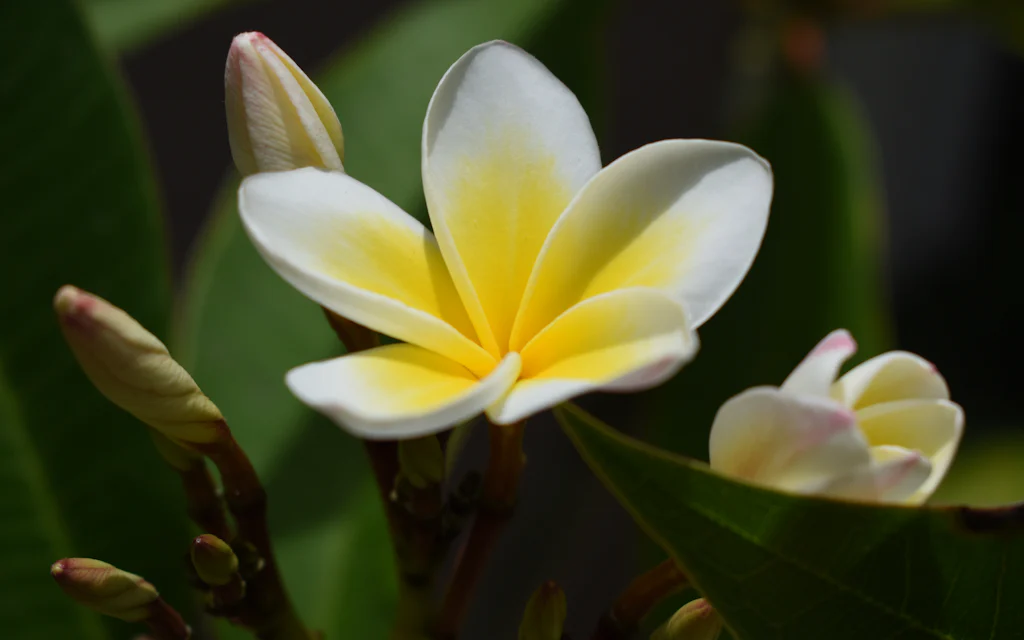
Plumeria (some people call it frangipani) grows on small, sculptural trees all over the islands, in white, yellow, pink, and a sunset orange that does not look real. The smell is the whole point, sweet, a little creamy, the kind of scent that reattaches itself to a memory for the rest of your life.
It is the most common flower strung into leis, partly because it is gorgeous and partly because the trees are generous to the point of absurdity. One mature plumeria drops more flowers on the sidewalk in a morning than most plants grow in a year.
A small piece of local body language, since you will see it and wonder, a flower worn behind the right ear traditionally signals single and available, behind the left means taken. Wear it on the wrong side and you may get more conversation than you bargained for.
One honest myth buster, because it surprises people. Plumeria has almost no nectar, so it tricks moths into pollinating it with scent alone and gives them nothing, the flower equivalent of inviting someone to dinner and serving a candle. Beautiful and a little ruthless. Respect.
You will find plumeria trees doing their thing in nearly every yard, park, and hotel courtyard on every island, which is exactly why a fresh plumeria lei is the affordable, abundant classic. There is simply a lot of it, falling freely, smelling like a vacation.
A quick tip if you go looking. The trees drop their leaves and look like dead sticks in winter, then explode back into bloom once the weather warms. So a bare plumeria tree in January is not dead, it is just on island time, like the rest of us.
If you only learn one flower of hawaii by name, make it this one. You will be wearing it within the hour.
02
The yellow hibiscus is the state flower (not the red one)
Now the plot twist nobody at the resort will tell you. Ask a hundred visitors to name the hibiscus state flower of Hawaii and ninety nine will picture the big red one on every aloha shirt ever printed.
They are wrong, and so was the state for about forty years.
The official state flower is the native yellow hibiscus (Hibiscus brackenridgei, or mao hau hele, "pua mao hau hele" in full), made official by the Hawaii Legislature in 1988. The red one everyone pictures is usually a hybrid, lovely but not the title holder. Mao hau hele is genuinely rare in the wild and listed as endangered, which is part of why most people have never knowingly seen the actual state flower.
It is a very Hawaii situation, the flower on all the merchandise is not the flower on the paperwork.
The state flower vs the famous impostor
Yellow hibiscusOur pick
Hibiscus brackenridgei, mao hau hele
- The official state flower since 1988
- Native, and genuinely rare in the wild
- Pale yellow, often with a maroon throat
- Endangered, the one to nod at
Red hibiscus
Usually a hybrid of H. rosa sinensis
- The one on every aloha shirt
- Introduced, bred into every color
- Everywhere, hedges and hotel landscaping
- Lovely, but not the title holder
Mao hau hele and the native hibiscus
Hibiscus is everywhere here, hedges, hotel landscaping, that one enormous bush outside your rental that is somehow always blooming. Seven species are considered native, a couple of them genuinely rare, and growers have bred the rest into a paint-store's worth of colorful varieties.
Beyond mao hau hele, the natives worth knowing include koki'o ke'oke'o, a fragrant white hibiscus that can grow into a small tree, and hau, the sea hibiscus you will see growing in large tangled stands along the shoreline, its flowers opening yellow in the morning and aging to deep orange by evening. The introduced red and pink kinds are the ones you will photograph most, but the native species are the quiet ones actually doing the cultural work.
A few things worth knowing as you admire them,
- A hibiscus flower famously lasts about a single day, then politely falls off, which is why you see them tucked behind ears rather than saved in vases.
- Despite living one glorious day, the plant just keeps producing, so the bush is never actually empty.
- The native yellow one is the protected celebrity. The loud reds and pinks are the friendly extroverts you will photograph most.
So when you spot a yellow hibiscus in the wild, give it a small nod. You are looking at the actual state flower, not the famous impostor.
03
Bird of paradise and the loud tropicals
Some Hawaiian flowers whisper. These ones show up to the party in a sequined jacket.
The bird of paradise is the showstopper, a spiky orange and blue bloom that genuinely looks like a tropical bird mid take off, peering out of the leaves to see if you are paying attention. You are. Everyone always is. And like most of the loud ones, it is an import, bird of paradise is native to South Africa and only moved to Hawaii because the climate was an upgrade.
Then there is heliconia, which comes in two memorable shapes. The hanging "lobster claw" dangles bright red and yellow bracts like a string of chili peppers designed by someone with no chill. The upright parakeet variety looks, fittingly, like a row of little beaks.
Add the gingers, which are louder than they sound. Red ginger (awapuhi ula ula) is the waxy red torch you see in every arrangement, native to Malaysia, brought over as an ornamental around 1928, and now naturalized to the point of looking local. White and yellow ginger smell incredible and are also imports. Most of Hawaii's gingers arrived from Asia in the 1800s and never left.
Then the anthurium, the heart shaped one so glossy that first time visitors routinely tap it to check if it is plastic. (It is not. It just commits to the bit.) It only reached Hawaii in 1889 and is now the islands' most cultivated decorative flower, with bougainvillea close behind on every wall and roadside.
These are the flowers doing the heavy lifting in every hotel lobby floral arrangement, because they are dramatic, structural, and last for ages in a vase. They come in colors a plumeria can only dream about, which is especially useful when a florist needs a centerpiece that reads from across a ballroom. Cut one of these and it will outlast your tan, your sunburn, and possibly your relationship with whoever you traveled with.
Where do you see them? Honestly, everywhere, botanical gardens, roadside, the planter outside the poke shop. But the green, rainy windward and Hilo sides grow them with the most enthusiasm.
Another import worth hunting down is the blue jade vine, whose striking bright blue blooms hang in clusters several feet tall, there is almost no other flower that color in nature, which is exactly why people come looking for it.
One more for the collectors. Up in the cool uplands of Maui, the protea grows, a spiky, almost prehistoric looking bloom that seems engineered rather than grown. It is not classically tropical, but it has become a signature Maui flower, known for holding its shape for weeks, and a star of the islands' cut flower farms.
Here is the tidy consequence, a lot of the dramatic tropical arrangements sold on the mainland started life on a Hawaii farm, got inspected, boxed, and flown out. Which is a useful preview of the rules we will get to in a minute.
None of these go into a traditional lei. They are too big and too stiff. They are for looking, for photographing, and for quietly intimidating the houseplants you left at home.
04
Orchids: mostly imported, only three native
Here is a fact that surprises people standing in a gift shop wall of them, almost none of Hawaii's famous orchids are Hawaiian. Only three orchid species are native to the islands, Liparis hawaiensis, the Hawaii jewel orchid, and a very rare bog orchid, and all three are small, green, and so inconspicuous you would walk past them on a trail.
The showy types you actually see are all introduced, and Hawaii grows them by the millions. Dendrobium is the workhorse, the colorful sprays used in nearly every commercial lei. Vanda is the big exotic face most people picture when they hear "orchid." Cattleya is the ruffled showpiece, and phalaenopsis (the "moth orchid") is the one sold as a houseplant everywhere. These varieties are grown in nurseries throughout the Hilo and Puna areas of the Big Island, which is the commercial orchid capital of the state. That is why a "Hawaiian" orchid lei is real Hawaii agriculture even though the flower's family tree starts in Asia.
A few things worth knowing as you shop for one,
- Orchid leis are commonly the cheaper, longer lasting option, which is exactly why they are used for big group events and graduations.
- They have almost no fragrance, you buy an orchid lei for the look and the durability, not the scent.
- The blooms hold up for days out of water, so they travel better than a delicate plumeria or pikake strand.
So admire the orchids. Just know that the rarest, most genuinely Hawaiian orchid in the state is a plain little thing most visitors would never photograph.
05
The fragrant ones: pikake, gardenia, tuberose
Close your eyes on a warm Hawaii evening and the air does something unfair. That is the fragrant flowers, and they are the connoisseur's category.
Hawaii's fragrant flowers, by the nose
PikakeThe romantic one
Local jasmine, Princess Kaiulani's favorite. The most prized scent, and the priciest lei.
Pua keni keniThe color changer
The 'ten-cent flower', blooms cream, ages to deep orange over a single day.
TuberoseThe heavy hitter
One stem perfumes a whole car, romantic for twenty minutes, then a negotiation.
Gardenia (kiele)The classic
A thick, creamy scent everyone recognizes and nobody can quite describe.
Pikake is the local jasmine, small white blooms with a scent so prized it was the favorite of Princess Kaiulani (Kaʻiulani), the name even means "peacock." A pikake lei is delicate, expensive, and the move for a wedding or a serious date, because it smells like the most romantic thing that has ever happened to anyone.
Pua keni keni is the "ten cent flower," named for what a string of them once cost. It blooms cream and ages to a deep orange over a single day, and a lei of them is a slow rolling color change you can literally smell across a room.
Then tuberose, the heavy hitter. One stem can perfume an entire car, which is romantic for about twenty minutes and then becomes a negotiation. Gardenia (kiele) rounds out the group with that thick, creamy scent everyone recognizes and nobody can quite describe.
A few honest notes for your nose,
- Fragrant leis cost more than plumeria, because the flowers are smaller and someone strung every single one by hand.
- They also fade faster, so they are bought for the day, not the week.
- If you have ever wondered why a fresh lei feels like a luxury, this is why, it is hours of quiet work that lasts an afternoon.
Worth every cent. A pikake lei on a warm night is the kind of detail that makes a Hawaii honeymoon feel like it was scored by an orchestra.
06
Hawaii's native flowers
Here is the part most flower lists skip, and the part that actually matters. Most of the famous hawaiian flowers are introduced. The truly native ones are quieter, rarer, and tangled up in the culture.
The headliner is the ohia lehua, a tree topped with a wild burst of red (sometimes yellow or white) stamens that looks like a tiny firework frozen mid explosion. It is one of the first plants to colonize fresh lava, which is about the most Hawaii thing a flower can do, show up to bare rock and decide to bloom anyway.
There is an old legend that picking a lehua blossom brings rain, framed as the tears of two separated lovers. Skeptics call it superstition. Hikers who have picked one and then been rained on tend to go quiet on the subject.
The ohia is also under real threat from a fungal disease called Rapid Ohia Death, which is why you will see "clean your shoes" signs at trailheads. Take them seriously, it is genuinely one of the most important native trees in the islands.
Then the ilima, a low golden flower so delicate it takes hundreds, sometimes close to a thousand, to string a single lei. That made the ilima lei royalty's flower, the kind once reserved for chiefs, because the labor alone was a flex.
Naupaka is the one with the best story. The beach version blooms only half a flower, as if someone tore it down the middle, and the mountain naupaka up in the forest does the same. The legend ties them together, two separated lovers, one sent to the shore and one to the uplands, each carrying half a bloom. Hold a beach naupaka next to a mountain one and you have a whole flower again. It is the kind of thing that sounds made up until you are standing on the sand looking at a flower with no left side.
Up on Haleakala, the silversword (ahinahina) is the native worth the altitude. It is a summit endemic, it grows nowhere else on Earth, and it spends years, sometimes decades, as a low silver rosette before sending up a single tall stalk of hundreds of maroon flower heads. Then it blooms once, sets seed, and dies. It has been federally protected since 1992, which is why you will see "stay on the trail" signs around it. If you are heading up the mountain, our things to do on Maui guide covers the Haleakala sunrise where you will spot them. And the rarest of all is the alula, the "cabbage on a stick" cliff plant that is nearly extinct in the wild and survives mostly because botanists keep it alive by hand.
Hawaii's native blooms
Ohia lehuaIconic
Red firework stamens, first to colonize fresh lava. Sacred, and threatened by Rapid Ohia Death.
IlimaRoyal
A low golden flower. It takes hundreds to string one lei, which made it royalty's.
NaupakaThe legend
The half flower of the two lovers legend, a beach half and a mountain half.
SilverswordMaui only
Ahinahina, Haleakala's summit endemic. Blooms once after decades, then dies.
AlulaRarest
The 'cabbage on a stick' cliff plant, nearly extinct in the wild.
For the full, properly credentialed version of the native story, Hawaii Magazine's guide to native flowers is excellent, the National Tropical Botanical Garden protects living collections you can actually visit on Kauai and Maui, and the National Park Service's silversword page has the Haleakala story in full.
The bigger picture, roughly 90% of Hawaii's native flowering plants grow nowhere else in the world, and a sobering share of them are endangered or already gone, mostly from habitat loss and introduced pests. Learn a few of these and you will see Hawaii differently, not as a postcard, but as a place with its own quiet, stubborn natives that were blooming here long before the plumeria showed up and stole the spotlight.
07
What a lei actually means
A lei is not a party favor. It is a gift, and like most good gifts it comes with a little etiquette you will be glad you knew.
The short version, a lei is given as a sign of affection, respect, celebration, or welcome. Birthdays, graduations, weddings, arrivals, farewells, if it matters, there is a lei for it.
What goes into a Hawaiian lei
PlumeriaCommon
The everyday classic, abundant, fragrant, and the most affordable.
PikakePrized
Delicate jasmine, hand strung, the move for a wedding or a serious date.
Pua keni keniFragrant
Cream to orange blooms you can smell from across a room.
IlimaRoyal
Hundreds of tissue thin blooms per lei, historically reserved for chiefs.
Kukui or shellTravels home
Nuts and shells, the keepsake lei that survives airport inspection.
A few quiet rules that locals appreciate,
- Accept it graciously. Refusing a lei is genuinely rude. If someone offers you one, lower your head a little and let them place it over you.
- Wear it draped, not clutched. It should rest over your shoulders, hanging down both front and back.
- A closed lei is for general celebration. An open (untied) lei is traditionally given to expectant mothers and certain dignitaries. You do not need a PhD in this, just know there is more going on than "flower necklace."
- Do not throw it in the trash in front of the giver. When a lei fades, the gentle tradition is to return it to nature, hang it on a tree, or scatter the flowers, rather than bin it like a receipt.
How to wear (and retire) a lei
And leis are not just a tourist thing locals tolerate. They are woven through real life here. Show up to a Hawaii high school graduation and you will see students so buried under stacked leis they can barely see over them, which is exactly the point.
There is even a holiday for it. May 1 is Lei Day across the islands, with contests, music, and more flowers than seems structurally advisable. It started in 1928, the writer Don Blanding floated the idea, a colleague named Grace Tower Warren coined "May Day is Lei Day in Hawaii," and the first one was held in the lobby of the Bank of Hawaii in downtown Honolulu. If you can time a visit around it, do.
And the airport lei reality check, because someone has to say it, the leis handed out on those "lei greeting" tours are lovely, but the most meaningful lei you get in Hawaii is almost always the one someone made or chose for you, not the one bundled into a package deal.
A real lei is a sentence in flowers. Worth treating like one.
08
Can you bring Hawaiian flowers home?
Short answer, some, with rules, and a lot less than you would hope. Before you try to carry a fresh lei through security like contraband, read this.
Can you fly Hawaiian flowers home?
Hawaii is its own fragile ecosystem, so the United States Department of Agriculture inspects everything leaving the islands to keep pests off the mainland. As of 2026, most fresh flowers and foliage are allowed to the continental US after inspection, but there are hard exceptions.
The big ones to remember,
- Anything with soil is a no. Potted plants, roots in dirt, leave them.
- No berries, and no citrus, on most leis. That includes some seed and fruit leis you will be tempted by.
- Gardenia, mauna loa, and jade leis often face restrictions because of the pests they can carry, so check before you buy one as a gift to fly home.
- Going to a foreign country (or Australia and New Zealand in particular)? Far stricter. Often nothing fresh at all.
The clean workaround locals suggest, buy a kukui nut, shell, or seed lei as your keepsake. They sail through inspection, they last forever, and they do not wilt in your carry on by hour three.
For the current, official list of what is allowed, the state agriculture department's guidance and the airport agricultural inspection station are the sources that actually matter, rules change, and the agriculture officer at the airport has the final word, not a blog.
So enjoy the fresh lei in the islands, where it belongs. Bring home the nuts and shells, and the photos, and the smell that will ambush you in a grocery store three years later.
09
Where and when to see them
Good news, you do not have to hunt. Hawaii is essentially one enormous, unfenced flower display, and most of the famous blooms grow year round in this climate. The short version of seeing Hawaii flowers is that you barely have to try.
Seeing Hawaii in bloom
Still, if you want to be deliberate about it, a few easy moves,
- Botanical gardens are the cheat code. On Oahu, Foster Botanical Garden and the green Hoomaluhia Garden put hundreds of species in one walkable place. The National Tropical Botanical Garden on Kauai is the serious native collection.
- Plumeria peaks in the warm months, roughly late spring through fall, when the trees go from pretty to ridiculous. Our best time to visit Hawaii guide covers the seasons if you are timing a trip around the bloom.
- Just walk a neighborhood. Some of the best flower spotting is a free stroll past front yards that casually out garden anything you have ever attempted.
If you are spending your days on Oahu, our things to do on Oahu guide folds the gardens in alongside the beaches and hikes, so you are not making a special trip just for petals. Our island things to do hub covers the gardens on the other islands too.
And since this is what we do for a living, one honest aside, every beach picnic we set up on Oahu can open with a fresh plumeria lei greeting, because flowers are how you say welcome here, and we are not about to skip the welcome, you can see how that works here.
But you do not need us, or a tour, or a ticket. The best flower moment in Hawaii is usually free, a warm evening, a breeze off the water, and a scent in the air that you will be chasing for the rest of your life.
FAQ: Hawaii flowers and leis
Is the bird of paradise native to Hawaii?
No. Despite being one of the most photographed flowers in the islands, bird of paradise (Strelitzia reginae) is native to South Africa. It was introduced as an ornamental and thrived in Hawaii's climate, like most of the big, showy tropicals you see in hotel arrangements.
Are any orchids native to Hawaii?
Only three. The islands have just three native orchid species, all small, green, and rare, including Liparis hawaiensis and a very rare bog orchid. Every showy orchid you see in leis and arrangements (dendrobium, vanda, cattleya) is introduced and grown commercially, mostly on the Big Island.
What is the rarest Hawaiian flower?
Probably the alula or the Haleakala silversword. The alula ("cabbage on a stick") is nearly extinct in the wild and kept alive largely by botanists. The silversword grows only on Haleakala, blooms once after years or decades, then dies, and has been federally protected since 1992.
Can you grow plumeria from a cutting at home?
Yes, easily. Plumeria roots readily from a cut branch, let the cut end dry for a week, then plant it in well draining soil. It needs heat and sun, so on the mainland it is reliably hardy outdoors only in the warmest zones (roughly 9 to 11). Elsewhere people grow it in pots and bring it inside for winter.
What does the plumeria flower symbolize?
Positivity, new beginnings, and the spirit of aloha. Plumeria is closely tied to love and welcome in Hawaii, which is part of why it is the go to lei and greeting flower. The behind the ear placement adds its own meaning, right ear for single, left for taken.
Where can you buy a real Hawaiian lei?
Chinatown in Honolulu is the lei district, start there. The lei shops on Maunakea Street string fresh ones daily, and you can book an airport lei greeting for arrivals. For something quick and cheap, grocery stores like Foodland sell simple orchid and plumeria leis. A basic lei is inexpensive. A maile or double strand runs much more.
How do you keep a Hawaiian lei fresh?
Refrigerate it in a sealed bag with a little moisture. Most fresh flower leis last two to three days if you keep them cool, seal the lei in a plastic bag, give it a light mist, and store it in the fridge overnight, never the freezer. Sturdier ti leaf and kukui nut leis last far longer and travel better.