Hawaii Souvenirs: The Best to Buy and Bring Home
17 min readYndira W. Tonin
The best Hawaii souvenirs are the ones that are genuinely of Hawaii, made, grown, or crafted in the islands, rather than the mass produced trinkets stamped with palm trees that could come from anywhere. A bag of real Kona coffee, a koa wood bowl, a ukulele, or a jar of local honey carries a piece of the islands home with you, and your money supports Hawaiian farmers and makers rather than an overseas factory. Drinking it on the island first? Our best coffee in Oahu post has the cafes and the farm.
These details were last verified in 2026.
This guide covers the best authentic Hawaii souvenirs to buy, edible, wearable, and crafted, what to skip, how to spot the real thing, and where to shop so you come home with treasures rather than landfill.
The golden rule, before we start, look for the words "Made in Hawaii" (and "100% Kona" on coffee), shop local markets and small businesses where you can, and when in doubt, choose something edible or handmade over a plastic knick knack.
Table of contents
- What makes a good Hawaii souvenir?
- Edible souvenirs, coffee, nuts, and treats
- Koa wood and Hawaiian crafts
- A ukulele, the musical souvenir
- Wearable souvenirs, aloha shirts and jewelry
- Flowers, beauty, and the scent of Hawaii
- What to skip (and what is illegal)
- Where to shop in Hawaii
- Souvenirs for every budget
- FAQ
01
What makes a good Hawaii souvenir?
A good Hawaii souvenir does two things, it genuinely connects to the islands, and it supports the people who live there. The difference between a great souvenir and a forgettable one usually comes down to authenticity.
Hawaii souvenirs, buy this, skip that
Worth buyingOur pick
Made in Hawaii, supports local
- 100% Kona (or Kau) coffee
- Hawaiian grown macadamia nuts
- Koa wood crafts and a real ukulele
- Local honey, sea salt, and chocolate
- Local art, jewelry, and lauhala weaving
Skip it
Mass produced and imported
- "Kona blend" coffee (mostly filler beans)
- Macadamia nuts not grown in Hawaii
- Plastic leis and overseas "Hawaiian" tees
- Cheap ukuleles assembled from foreign parts
- Shells and coral (illegal to take)
The problem is that a huge share of "Hawaiian" souvenirs in the big tourist shops were never within 2,000 miles of Hawaii, they are made overseas and decorated with surfboards and hibiscus to look the part. They contain no Hawaiian materials, support no local families, and tend to fall apart. The good stuff, by contrast, is grown or handmade in the islands and proudly labeled as such.
So the test is simple, was it actually made in Hawaii? Look for "Made in Hawaii" labeling, "100% Kona" on coffee, and the names of local farms, artists, and makers. When you buy the real thing, you bring home something with a story, and you put your tourist dollars where they do the most good.
There is a bigger reason this matters than authenticity for its own sake. Hawaii's cost of living is brutal, and small farmers, artists, and makers are part of what keeps island culture alive against the pressures of tourism and development. Choosing the local koa carver over the imported tiki, or the family coffee farm over the gas station blend, is a small act of support that adds up across millions of visitors. The most meaningful souvenir, in other words, is one that leaves a little of your money in the islands you came to enjoy, and that almost always means buying something real.
02
Edible souvenirs: coffee, nuts, and treats
Edible souvenirs are the smart traveler's choice, they are authentic, affordable, easy to pack, and they get used and shared rather than gathering dust. Hawaii's food gifts are genuinely some of the best you can bring home from anywhere.

Photo by Bozhin Karaivanov on Unsplash
The icons,
- 100% Kona coffee. Grown in the volcanic soil of the Big Island's Kona district, this is some of the most prized coffee on earth. The crucial catch, buy "100% Kona," not a "Kona blend" (which can be as little as 10% Kona beans). The real thing is expensive, around $30 for an 8 oz bag, but it is a genuine luxury. Kau (Kaʻu) coffee, also from the Big Island, is a superb (often cheaper) alternative. (Cannot get to a farm? You can find real 100% Kona coffee online to ship home, just check that it says 100% Kona.)
- Macadamia nuts. Hawaii grows most of the world's macadamias, and they make a perfect, packable gift. Check that the package says 100% Hawaiian, many "Hawaiian" macadamia products are sourced globally, so look for Hawaiian grown macadamia nuts specifically.
- Local honey, jam, and sea salt. Hawaiian honey (including white, creamy ohia lehua honey), tropical jams (guava, passionfruit/lilikoi), and sea salts like pink alaea salt are wonderful, inexpensive finds.
- Chocolate. Hawaii is the only US state that grows cacao, so a bar of Hawaii grown chocolate is a true local rarity.
A few more edible treasures worth hunting down, Maui onions and the sweet, candy like Maui Gold pineapple. dried tropical fruit (mango, pineapple) and li hing mui (the sweet salty sour dried plum powder that locals dust on everything). Hawaiian grown vanilla. And at the playful end, the islands' famous love of Spam, a can of Spam musubi seasoning or local snacks is a fun, very Hawaii stocking filler. Most edible souvenirs are inexpensive, pack flat in a suitcase, and clear customs easily (commercially sealed, shelf stable food is generally fine), which is exactly why they are the savvy traveler's go to.
Many of these double as great gifts for the people back home, and they connect to the wider food scene in our Hawaiian food guide.
03
Koa wood and Hawaiian crafts
For a keepsake that lasts a lifetime, nothing beats genuine Hawaiian craft, and the king of them all is koa wood.
Koa is a beautiful hardwood that grows only in Hawaii, prized for its rich, shifting grain of golden brown, auburn, and deep chocolate. Skilled woodworkers turn it into bowls, boxes, jewelry, phone cases, and more, each piece unique. It is not cheap, real koa is a precious, slow growing resource, but a koa bowl or pendant is an heirloom. Look for established makers and ask whether a piece is solid koa or a veneer.
Beyond koa, Hawaii's craft traditions run deep, lauhala (the woven leaves of the hala tree) becomes hats, bracelets, and mats. Niihau (Niʻihau) shell lei, made from tiny shells on the island of Niihau, are so fine they are considered fine jewelry and priced accordingly. And local artists across the islands sell paintings, prints, and photography that capture Hawaii far better than any postcard. These crafts carry real cultural weight, much like the traditions in our poi and language guides.
When you buy a handmade craft, it is worth taking a moment to learn its story, many makers are happy to tell you which island the koa came from, or how a lauhala hat is woven, and that knowledge becomes part of the gift. A few traditional items also deserve respectful handling, a Niihau shell lei or a piece tied to Hawaiian cultural practice is not just decoration but a continuation of skills passed down for generations. Buying directly from the artist, at a craft fair or studio, both gets you the real thing and lets you thank the person who made it, a far better experience than grabbing a wrapped box off a shelf.

Photo by Adhitya Sibikumar on Unsplash
04
A ukulele: the musical souvenir
If you want a souvenir you can actually play, a ukulele is the ultimate Hawaiian keepsake, a piece of the islands' music to take home.
A ukulele is portable (it fits in a carry on), beginner friendly, and instantly evocative of Hawaii. A decent starter costs around $50 to 100, while Hawaii's legendary makers like Kamaka (crafting in Honolulu since 1916) sell heirloom instruments. The one caution, not every ukulele labeled "made in Hawaii" is fully made there, some are assembled locally from imported parts, which is fine, but worth knowing when you compare prices.
We have written a whole guide to the Hawaiian ukulele, its history, the four sizes, and how to choose and start playing one, so if a uke is calling your name, start there. Buy it from a real music shop rather than a souvenir stall, and you will come home with an instrument that sounds good and lasts.
What makes the ukulele such a special souvenir is that it keeps giving long after the tan fades, every time you pick it up and strum a few chords, you are literally playing a piece of Hawaii. Unlike a shelf trinket, it invites you to actually do something, and learning a simple Hawaiian song on it back home is the kind of posttrip project that keeps the islands close. It is also a gift that suits all ages, from a kid's first instrument to an adult's new hobby, and even a modest one looks and sounds lovely. If you want the ultimate version, a solid koa ukulele from a Hawaiian maker is both a beautiful object and a working instrument, a souvenir and an heirloom in one.
05
Wearable souvenirs: aloha shirts and jewelry
Hawaii's wearable souvenirs let you carry a little of the islands' style into everyday life, done right, they are genuinely good, not kitsch.
The aloha shirt (the original "Hawaiian shirt") is a real piece of island culture, and a well made one from a Hawaii brand, in quality cotton or rayon, with a tasteful print, is a world away from the garish polyester versions. A muumuu is the flowing dress counterpart. For jewelry, look for Hawaiian heirloom jewelry (gold pieces with engraved Hawaiian designs), koa wood jewelry, Niihau shell lei, and pieces incorporating plumeria and other island motifs.
A few more wearables worth a look, puka shell necklaces (a beachy classic), kukui nut lei (polished dark nuts, traditionally worn and surprisingly durable), and locally designed t-shirts and pareo (sarongs) from island artists. As with everything here, the made in Hawaii version is the one to seek out, it will be better made and actually meaningful.
A quick word on the aloha shirt, since it is the souvenir most people picture. The good ones are a genuine slice of 20th-century Hawaii history, originally tailored from Japanese kimono fabric in the 1930s and now an iconic, even office appropriate garment in the islands (locals wear them on "Aloha Friday"). Brands like Reyn Spooner, Kahala, and Tori Richard are island institutions. A reverse print shirt in muted colors reads as classy rather than costume. Buy one of those over a neon polyester gift shop version and you will have something you actually wear at home, which is the whole point of a wearable souvenir.
06
Flowers, beauty, and the scent of Hawaii
Some of the most evocative souvenirs capture Hawaii's flowers and fragrances, though a few come with rules about crossing borders.
Hawaii's flowers and plants make beautiful gifts, you can buy certified, agriculture inspected fresh flowers, lei, and even potted plants (like orchids or a pineapple plant) packaged for travel, but they must pass agricultural inspection to leave the state, so buy from vendors who handle this. Our Hawaii flowers guide covers the islands' blooms in depth.
For fragrance and beauty, kukui (candlenut) oil and monoi (coconut oil infused with tiparé flowers) are traditional Hawaiian skin and hair treatments. plumeria- and pikake scented soaps, lotions, and perfumes bottle the smell of the islands. And locally made beauty products make lovely, packable gifts. A bar of plumeria soap is a tiny souvenir that transports you straight back to Hawaii every time you use it.
Scent, in fact, may be the most underrated souvenir category of all, smell is the sense most tied to memory, so a familiar island fragrance can summon a whole trip in an instant. Look for small batch Hawaiian soap and candle makers at craft fairs, and consider a bottle of locally made plumeria or coconut body oil. If you would rather bring home the living thing, a hardy potted orchid or a certified pineapple plant (inspected for travel) can grow on a windowsill for years, a green reminder of the islands long after you are home. Just plan ahead for these, confirm the vendor provides the agricultural certification, and check that your home state or country allows the specific plant before you buy.
07
What to skip (and what is illegal)
Here is the one strong opinion in this guide, and it will make you a better souvenir buyer instantly, skip the cheap "Hawaiian" junk made overseas, and never, ever take anything from nature.
The stuff to avoid, mass produced trinkets, plastic leis, snow globes, fridge magnets, and "Hawaiian" shirts and tikis made in overseas factories, which support no one local and end up in a drawer. "Kona blend" coffee is another trap, it sounds premium but is mostly cheap filler beans with a token amount of Kona. And be wary of "made in Hawaii" claims that really mean "assembled in Hawaii from imported parts."
More important, some "souvenirs" are illegal or harmful to take. Do not collect or buy shells, coral, live rock, or sand, taking coral and live rock is illegal, removing sand from beaches is prohibited, and even sea shells play a role in the ecosystem. Likewise, leave lava rocks where they are (locals will warn you of Pele's curse, and it is discouraged regardless). The best natural souvenirs are photographs, take those instead, and buy your keepsakes from people, not from the reef.
One more honest caution worth its own line, be skeptical of anything marketed with vague "Hawaiian" mystique but no maker, farm, or "Made in Hawaii" label, and that includes some items sold inside Hawaii. A surprising amount of the merchandise in the busiest tourist zones is imported. The palm tree packaging is marketing, not provenance. If a vendor cannot tell you where or by whom something was made, treat that as your answer. It takes only a few seconds to flip a tag or ask, and it is the single habit that separates a drawer full of forgettable trinkets from a few keepsakes you will genuinely treasure.
08
Where to shop in Hawaii
Where you shop matters as much as what you buy, and the best souvenirs are rarely in the obvious tourist shops.

Photo by Anastasiia Chepinska on Unsplash
Seek out,
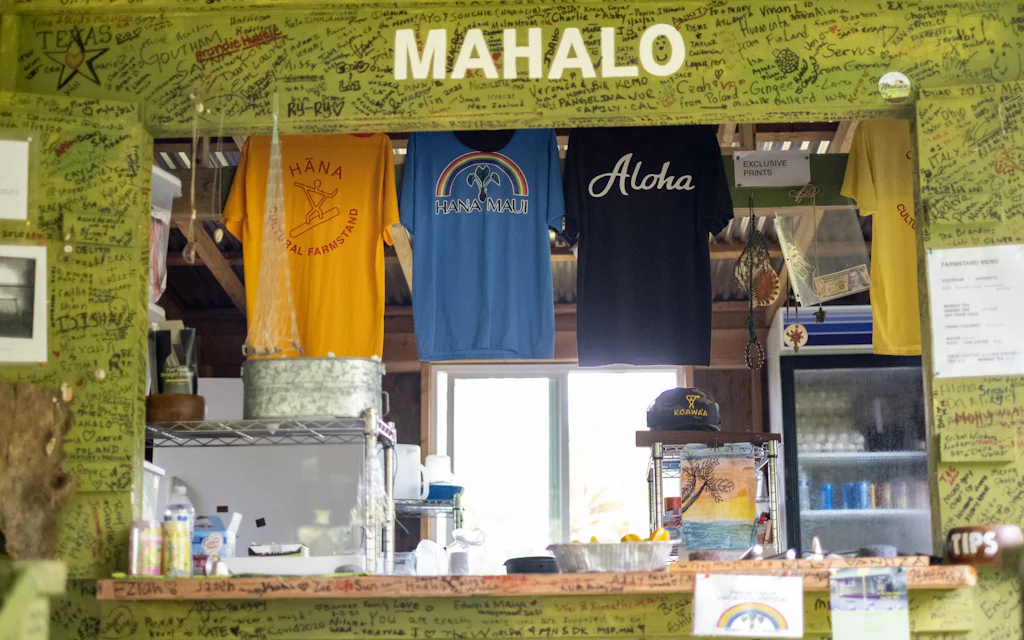
- Farmers' markets and craft fairs. The KCC Farmers Market on Oahu, and markets across every island, are the best places for local coffee, honey, produce, food, and handmade crafts straight from the makers.
- Swap meets. The Aloha Stadium Swap Meet on Oahu is a sprawling treasure hunt for affordable local goods (mixed with imports, so shop with a discerning eye).
- "Made in Hawaii" stores and festivals. Look for shops and annual fairs (like the Made in Hawaii Festival) dedicated to local products.
- Local coffee farms and food producers. On the Big Island you can tour a Kona coffee farm and buy beans at the source, the freshest, most authentic way to get your coffee.
A few shopping habits help, too. Go to the markets early, the best handmade goods and fresh produce sell out, and farmers' markets often wind down by late morning. Bring cash and a tote bag, since small vendors may not take cards and you will want to carry your finds. And do not be shy about talking to the makers, asking a coffee farmer about their roast or an artist about their work almost always leads to a better purchase and a memory attached to it.
Skip the impulse buys at the airport and the big chain "Hawaiiana" stores for your main souvenirs. They are where the imported junk concentrates and the markups are highest. The exception worth noting, some airport and ABC-store items (sealed macadamia nuts, chocolate, coffee) are fine as last minute, genuinely Hawaiian grabs, just check the label like you would anywhere else.
09
Souvenirs for every budget
The beauty of Hawaii souvenirs is that meaningful ones exist at every price point, so you do not need to spend big to bring home something real.
On a budget, you are spoiled, a bag of macadamia nuts, a jar of lilikoi jam, a bar of Hawaiian chocolate, a plumeria soap, or a packet of alaea sea salt are all genuinely local, useful, and a few dollars each, perfect for gifts and stocking fillers. A midrange keepsake might be a bag of 100% Kona coffee, a kukui nut lei, a locally designed shirt, or a small koa piece. And for a splurge or a once in a lifetime keepsake, a fine koa bowl, a Kamaka ukulele, Hawaiian heirloom jewelry, or an original piece of local art will last for decades.
A smart approach for gift givers, buy a few inexpensive edible items in bulk (a box of macadamia nuts, several bars of chocolate, packets of li hing mui or salt) to cover coworkers, neighbors, and casual gifts, then spend on one or two special keepsakes for yourself or close family. That way you check off the whole gift list affordably and authentically without blowing the budget, and you still come home with something lasting. Edible gifts also solve the "what do I get for the office" problem neatly, everyone enjoys a taste of Hawaii, and nothing ends up in a junk drawer.
Whatever your budget, the principle holds, choose authentic over kitsch, buy from local makers, and you will come home with something worth keeping. A little of Hawaii's aloha travels surprisingly well, and if your trip touches Oahu, we run beach picnics (from $349 for two) that make for the kind of sunset memory no shop can sell.
FAQ
What are the best souvenirs to buy in Hawaii?
The best Hawaii souvenirs are things genuinely made in the islands, 100% Kona coffee, Hawaiian macadamia nuts, koa wood crafts, a ukulele, local honey and sea salt, Hawaiian chocolate, aloha shirts from local brands, and local art or jewelry. Look for "Made in Hawaii" labeling, and shop local markets over chain tourist stores.
What should you NOT buy or take from Hawaii?
Avoid mass produced "Hawaiian" trinkets made overseas and "Kona blend" coffee (mostly filler beans). More importantly, never take shells, coral, live rock, sand, or lava rock from beaches and the ocean, collecting coral and sand is illegal or prohibited, and it harms the ecosystem. Take photos of nature instead.
What is the most popular Hawaiian souvenir?
Macadamia nuts and Kona coffee are the most popular Hawaii souvenirs, they are authentic, affordable, easy to pack, and make great gifts. Other favorites include ukuleles, koa wood items, aloha shirts, Hawaiian chocolate, and local honey, jams, and sea salts.
Is Kona coffee a good souvenir?
Yes, 100% Kona coffee is one of the best Hawaii souvenirs, prized worldwide and grown only in the Big Island's Kona district. Just be sure to buy "100% Kona," not a cheaper "Kona blend," which contains only a small percentage of real Kona beans. Expect to pay around $30 for an 8 oz bag of the genuine article.
Can you bring plants or flowers home from Hawaii?
Yes, but they must pass agricultural inspection to leave the state. Many vendors sell certified, pre inspected fresh flowers, lei, and potted plants (like orchids or pineapple) packaged for travel. Buy from sellers who handle the inspection and paperwork, and check your destination's rules for bringing in plant material.
Where is the best place to buy souvenirs in Hawaii?
The best places are farmers' markets, craft fairs, swap meets (like the Aloha Stadium Swap Meet on Oahu), "Made in Hawaii" shops and festivals, and local farms and producers, these support local makers and carry the authentic goods. Skip the airport and big chain tourist shops for your main souvenirs, where imported items and markups concentrate.
Are macadamia nuts from Hawaii?
Most of the world's macadamia nuts are grown in Hawaii, mainly on the Big Island, and they are a classic local souvenir. However, not every "Hawaiian" macadamia product uses Hawaiian grown nuts, some are sourced globally and just packaged with island branding, so check the label for "100% Hawaiian" to get the real thing.
Disclosure: Some links on this page are affiliate links. If you book or buy through them we may earn a small commission, at no extra cost to you. As an Amazon Associate, we earn from qualifying purchases.


