Waimea Bay Oahu: A Visitor's Guide with Local Tips
21 min readYndira W. Tonin
Waimea Bay is the beach on Oahu's North Shore that cannot seem to decide what it wants to be. Six months a year it is a glassy, bright blue swimming hole with a giant rock that teenagers leap off for fun. The other six months it is a 30-foot big wave arena where the best surfers on earth go to be humbled. Same sand. Completely different beach, depending on which way the swell is pointing.
These details were last verified in 2026.
Here is the short version. Waimea Bay, Oahu is a wide, sandy bay near Haleiwa, famous for summer snorkeling and its cliff jump rock, for winter's monster surf, and for green Waimea Valley across the road. In calm summer it is one of the island's best swimming beaches. In winter it is strictly a spectator sport.
This guide gives you the honest version of all of it, when the water's safe and when it absolutely is not, the jump rock, the snorkeling, the parking lot that fills before your coffee's cold, the waterfall hike across the highway, and how to fold the whole thing into one good North Shore day.
(If you came for a "ten dreamy hidden gems" reel, fair warning, I am going to spend a paragraph telling you not to drown.)
Getting to Waimea Bay
Tap to open Google Maps with turn-by-turn directions.
Table of contents
- What (and where) is Waimea Bay?
- Summer vs. winter, the two Waimea Bays
- Can you swim at Waimea Bay?
- Snorkeling at Waimea Bay
- The jump rock, should you leap off "Da Rock"?
- Big wave surfing and the Eddie
- Waimea Valley, the waterfall, gardens, and Toa Luau
- Parking, directions, and the best time to go
- Amenities and what to bring
- What else is nearby on the North Shore
- Where to stay near Waimea Bay
- FAQ
01
What (and where) is Waimea Bay?
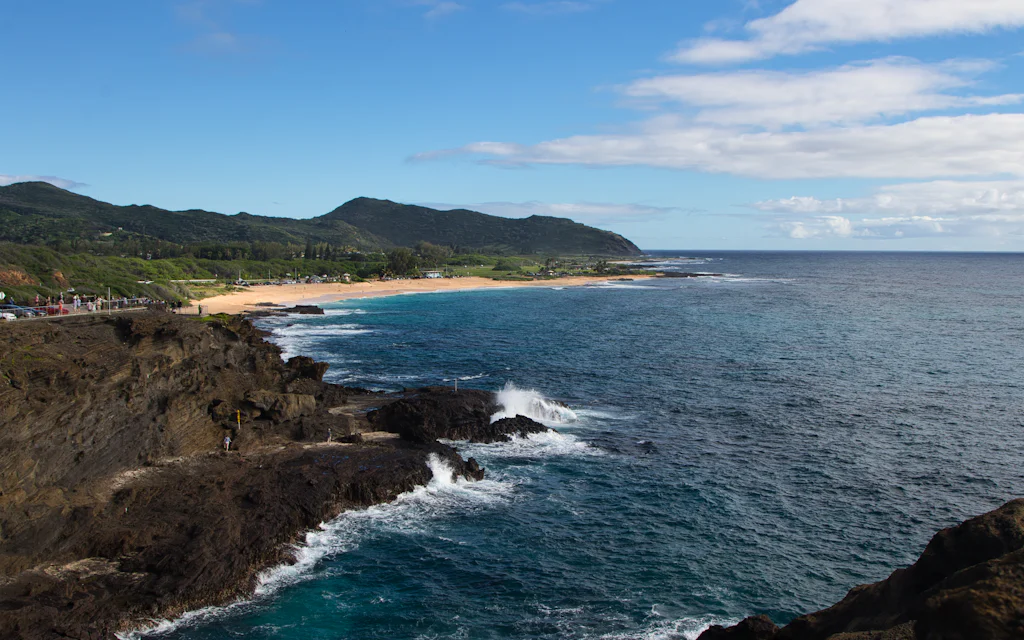
Waimea Bay sits on the North Shore of Oahu, about a 50-minute to one hour drive from Waikiki, just past Haleiwa town as you head north along Kamehameha Highway. It is a deep, rounded bay with a wide crescent of sand, framed by rocky points, with the green ridgeline of Waimea Valley rising behind it. The water, when it is calm, is the kind of blue that makes your phone camera look like it is exaggerating.
The name belongs to two different places that visitors mix up constantly, so let us sort that out before you waste a morning. Waimea Bay is the beach, free, sandy, ocean. Waimea Valley is the green botanical valley directly across the highway, a paid attraction with a paved trail to a waterfall, gardens, and cultural programs. They share a name, a general parking headache, and almost nothing else. There is no waterfall on the beach, and you cannot swim in the valley.
Waimea Bay vs. Waimea Valley
Waimea Bay (the beach)Our pick
- Best for
- Swimming, snorkeling, and the jump rock in calm summer; big-wave watching in winter
- The catch
- Free, but the lot fills by mid-morning — and no swimming when the surf is up
Waimea Valley (across the highway)
- Best for
- An easy paved walk to a 45-foot waterfall, botanical gardens, and the evening Toa Luau
- The catch
- Paid admission, and you can't drive between the two — they just share a name
"Waimea" means "reddish water" in Hawaiian, a nod to the silt the Waimea River once carried down the valley and into the bay. The whole area is deeply significant in Hawaiian history, the valley was a major center of habitation and worship for centuries, so it rewards a little reverence alongside your snorkel gear.
What Waimea Bay is not is a secret. It is a well known, lifeguarded beach park with restrooms and a real parking lot, which means in summer it gets busy and in winter, when the surf is firing, the wall along the road fills three people deep with spectators. That is the trade for a beach this good and this easy to reach, you are rarely going to have it to yourself. For the wider lay of the land, our North Shore Oahu guide maps how Waimea fits between Haleiwa and the famous surf breaks up the coast.

Photo by Braden Egli on Unsplash
02
Summer vs. winter: the two Waimea Bays
The single most important thing to understand about Waimea Bay is that it has a split personality, and the calendar runs the switch.
From roughly May through September, the North Pacific settles down, the big swells go quiet, and Waimea turns into a calm, sandy bottomed bay that is genuinely excellent for swimming and snorkeling. This is the friendly Waimea, the one in the brochures, where kids paddle in the shallows and the jump rock becomes a summer rite of passage.
From about October through April, the North Shore becomes the big wave capital of the world, and Waimea is its most famous amphitheater. Waves here can reach 20, 30, even 40 feet on a serious swell. The shore break alone can pick you up and introduce you to the sand at speed. This is the Waimea where you keep your feet dry and your camera ready.
When to swim and when to just watch
- Jan
- Feb
- Mar
- Apr
- May
- Jun
- Jul
- Aug
- Sep
- Oct
- Nov
- Dec
- Calm season, swim & jump — May, Sep, glassy water, snorkeling, the rock jump is on
- Shoulder, it depends — Apr & Oct, surf can swing either way. Check the forecast
- Big wave season, watch only — Nov, Mar, huge surf, no swimming, a spectator sport
The catch is that the ocean has never once read a calendar. A big winter swell can show up in October, and a freak summer one can roll in during July. The season tells you the odds. The forecast on the day tells you the truth. Before you go, check live conditions on Hawaii Beach Safety and the North Shore surf forecast from the National Weather Service in Honolulu. If there is a high surf advisory up, the decision's already been made for you.
The good news, whichever Waimea you get, it puts on a show. Summer hands you the swim. Winter hands you the spectacle. Just do not arrive in January expecting to snorkel, or in July expecting Pipeline.
03
Can you swim at Waimea Bay?
Yes, in summer, when it is calm, Waimea Bay is one of the best swimming beaches on the North Shore. The bottom is sandy, the bay is deep and wide, and lifeguards are on duty. On a flat summer morning, it is about as good as Oahu swimming gets outside of Waikiki.
In winter, the answer is a hard no, and I mean that with love. The same beach that is a swimming pool in July turns genuinely dangerous from October through April. The shore break at Waimea is notorious, a heavy wave that breaks right on the sand and has put plenty of confident swimmers flat on their backs. Add currents and 20-foot faces and you have got a beach that humbles people who underestimate it every single year.
Here is where I will happily talk you out of the water. If there is any real surf running, if the lifeguards have the warning flags up, or if you are not a strong ocean swimmer, do not get in. The beach is a wonderful place to sit, watch, and shoot photos on a big day, and a calm, lifeguarded beach fifteen minutes away will give your family a far better afternoon. There is no photo worth a rescue.
The rule that keeps you safe is the oldest one in Hawaii, never turn your back on the ocean, and when in doubt, do not go out. Talk to the lifeguards, they will tell you straight whether it is a swim day. Listen to them over your vacation schedule, every time.
If you want a reliable swim no matter the season, our roundup of the best beaches on Oahu maps the calm, protected spots that stay friendly when the North Shore goes feral.
04
Snorkeling at Waimea Bay
In calm summer conditions, the snorkeling at Waimea Bay is a pleasant surprise. Head to the far left side of the bay as you face the water, where the rocky point and reef hold the most marine life, tropical fish, the odd green sea turtle, and decent visibility when the water's flat. It is not the best snorkeling on the island, but for a swim beach it overdelivers.
A few honest caveats. There are no gear rentals at the beach, no snorkel shack, no chair stand, nothing but sand and a lifeguard tower. If you want to snorkel, bring your gear or rent it back in Haleiwa town before you drive out. Rolling up empty handed hoping to rent on site is a classic first timer mistake, right up there with parking at noon (more on that betrayal later).
Snorkeling is strictly a summer activity here. The moment there is swell, visibility drops to soup and the currents turn dangerous, every reason you should not be swimming applies double when your face is in the water and you are not watching the horizon.
Green sea turtles are protected under federal and state law. The standing guidance from NOAA Fisheries is to stay at least 10 feet back, never touch or feed them, and never get between a turtle and the ocean. Give them room and you will still get the moment.
If snorkeling is the whole point of your trip, do not make Waimea your only plan. Sharks Cove, a few minutes up the road, is one of the island's best snorkel spots in summer, our Sharks Cove guide has the honest version, including when to stay out. For guaranteed turtle water with someone else reading the conditions, a boat snorkeling tour stacks the odds far better than hoping the bay cooperates on your one free morning.
05
The jump rock: should you leap off "Da Rock"?
The big rock on the right side of Waimea Bay is one of the most famous cliff jumps in Hawaii, and in calm summer water, leaping off it is a genuine North Shore rite of passage. The rock rises roughly 20 to 30 feet above the water depending on where you launch, and on a flat day the bay below is deep and forgiving.
On a flat day. That qualifier is doing a lot of work, so let me be the killjoy your mother would want at the beach.
The jump is only safe when the water is calm and deep, which means summer, and only summer. People get hurt here every year, almost always by misjudging the conditions, the depth, or their own swimming ability after they hit the water. The climb up the rock is slick and unguarded, the landing zone shifts with the swell, and there is no soft option once you have committed mid air to a decision you made on the way up.
A few honest rules if you are going to do it,
- Only jump in calm summer conditions, never with any winter swell running, full stop.
- Watch locals go first and jump where they jump. They know the deep water from the shallow shelf.
- Check the water depth yourself and never jump headfirst, feet first, every time.
- Do not jump if you are not a confident swimmer who can get back to shore in open water.
And the honest opt out, if you are not completely sure, do not. Watching a teenager backflip off Da Rock while you sip a cold drink on the sand is a perfectly respectable way to experience this. The rock is not going anywhere, and neither is your spine, hopefully.
06
Big wave surfing and the Eddie
Waimea Bay is, more than any other beach, the birthplace of big wave surfing. When the first surfers paddled out into Waimea's giants in the late 1950s, they essentially invented the entire sport of riding waves the size of buildings. Every big wave spot on earth traces a line back to this bay.
That history lives on in "The Eddie", the Eddie Aikau Big Wave Invitational, a surf contest held at Waimea only when waves reach a sustained 20 feet (closer to 40-foot faces). It is named for Eddie Aikau, the legendary Waimea lifeguard and waterman who was lost at sea in 1978 trying to paddle for help after the voyaging canoe Hokule'a capsized. The phrase "Eddie Would Go", meaning he would paddle out when no one else dared, became one of Hawaii's most enduring sayings.
Here is the thing about the Eddie, it almost never runs. The conditions are so specific that the contest has only been held a handful of times in its decades of existence. When it is on, the whole island shows up, the highway clogs, and you will know about it. When it is not, you can still watch the world's best chase giants here on any big winter day, from the safety of the sand.
If watching all that makes you want to try surfing yourself, do it on a beginner friendly wave, not this one. A surf lesson on the calmer breaks near Waikiki or Haleiwa will have you standing up on a foamy two footer, which is roughly four hundred times more fun than getting flattened by a Waimea bomb. You can graduate to "humbled by the North Shore" later, like the rest of us.

Photo by Jeremy Bishop on Unsplash
07
Waimea Valley: the waterfall, gardens, and Toa Luau
Directly across Kamehameha Highway from the beach is Waimea Valley, and if the surf's too big to swim, this is your plan B, and honestly, a worthy plan A in its own right. It is a green, 1,800-acre botanical valley with a paved, mostly flat trail that runs about three quarters of a mile to Waimea Falls, a roughly 45-foot waterfall with a swimming pool at its base (lifeguards on duty, life vests provided when you can swim).
The walk is genuinely easy, stroller- and grandparent friendly, and winds past gardens of native and Polynesian plants, restored Hawaiian living sites, and cultural demonstrations. It is a paid attraction, with admission usually around $25 for adults (check current pricing before you go), and it is run as a nonprofit that protects the valley's cultural and natural heritage. It is one of the few places on Oahu where the history is not a plaque you skim past, it is the whole point.
The valley also hosts the Toa Luau, a smaller, family run luau set on the grounds that consistently rates as one of the most authentic and least Disney fied on the island. If a luau is on your Oahu list, this is a strong pick, and our guide to the best luau on Oahu lays out how it stacks up against the big resort shows.
★4.9(3,583)
Toa Luau at Waimea Valley, Oahu
3 hours
Free cancellation
from
$133
Book the Toa Luau at Waimea Valley ahead in peak season, the intimate ones sell out first, precisely because they are the good ones. Pair the daytime waterfall walk with the evening luau and you have turned "the surf was too big to swim" into the best day of the trip.

Photo by Martin Zangerl on Unsplash
08
Parking, directions, and the best time to go
Waimea Bay is about 50 minutes to an hour from Waikiki, take the H1 to the H2, then Kamehameha Highway north through Haleiwa, and the bay opens up on your left a few minutes past town. The main parking lot is on the makai (ocean) side, with a smaller overflow lot up near Waimea Valley across the road.
Now the bad news, delivered with the gravity it deserves, the lot fills up fast, and on summer weekends and holidays it can be full by midmorning. There are few things in life more spiritually deflating than crawling through a packed beach lot at 11 a.m., watching a family load their cooler with the agonizing slowness of people who know you are waiting. Do not be on the wrong side of that scene.
The fix is simple and non-negotiable, arrive early. Before about 9 or 10 a.m. you will usually find a spot and a calmer beach. Late afternoon, after roughly 4 p.m., is the second best window as the day crowd thins out. Midday is the time to be literally anywhere else.
If wrestling a rental car around the North Shore for a single beach sounds like a poor use of vacation, let someone else drive. A circle island day tour loops the North Shore and hits Waimea, Haleiwa, and the famous turtle and surf beaches, so you get the whole coast without once negotiating a parking space or a left turn against beach traffic.
A practical note, the North Shore runs on a single two lane highway, and in winter, when the surf is huge, traffic to watch it can crawl. Budget extra time on big swell days, and treat the drive itself as part of the show.
09
Amenities and what to bring
For a free beach, Waimea is well equipped. There are lifeguards, restrooms, outdoor showers, picnic tables, and a paved lot, a genuine beach park, not a roadside pull off. There is usually a food truck or two near the lot in season, but do not count on it. The reliable food is back in Haleiwa town.
Because Waimea is a wide, sandy bay rather than a rocky reef cove, it is one of the rare North Shore beaches that is actually comfortable for a proper beach day. Pack accordingly,
- Reef safe sunscreen and a hat. The North Shore sun is no joke, and reflected glare off the pale sand will find the one spot you missed. A reef safe sunscreen is both the kind thing for the reef and, under Hawaii law, increasingly the only kind you can buy on island anyway.
- Water shoes. Handy for the rockier left side and the jump rock climb. A grippy pair of water shoes saves your feet on the rocks.
- A dry bag. North Shore beach lots are a known target for break ins, so bring your phone, keys, and wallet down to the sand in a dry bag rather than leaving them in the car.
- Your own snorkel set. Remember, there is nothing to rent here. A basic snorkel set packs flat and pays for itself by the second beach.
- Water and snacks. Stock up in Haleiwa. On a hot day you will want more water than you think.
One honest aside, since staging beach setups is literally our day job, unlike the reef fronted coves up the coast, Waimea's wide sand actually makes a lovely spot to lay out a spread on a calm summer morning. If you would rather someone else handle the styling, food, and teardown, we run beach picnics on Oahu's roomier beaches from $349. On a big surf winter day, though, skip the picnic here and just watch the waves, different days call for different plans.
10
What else is nearby on the North Shore
Waimea Bay is best experienced as one stop on a North Shore loop, because Oahu's finest run of surf, sand, and shrimp trucks is strung along this single coast. The beach is a one to two hour stop, not a full day, so build a morning around it and let the rest of the coast carry the afternoon.
- Haleiwa town, five minutes south, the North Shore's hub, with the famous garlic shrimp trucks, shave ice piled like a small weather system, surf shops, and the historic harbor. This is where you fuel up before the beach and where you will end up afterward, sunburned and happy.
- Sharks Cove, a few minutes north, one of the island's best summer snorkel spots, with a tide pool maze kids love and a row of food trucks across the road. Our Sharks Cove guide has the timing and the honest warnings about when to stay out.
- Sunset Beach and Pipeline, the legendary winter big wave breaks, where the best surfers on earth show up to be humbled by the same swells that fill Waimea. Spectacular from the sand when the surf's firing, and a quiet stretch of beach when it is not.
- Papailoa Beach, the quiet, turtle loved strand fans know from Lost, a short drive back toward Haleiwa. Our Papailoa Beach guide covers the resident sea turtles and the ten spot parking situation.
String two or three together and you have got a proper half day, a swim or a show at Waimea, a snorkel at Sharks Cove, shrimp in Haleiwa, and the waterfall walk across the road. Go clockwise from Waikiki and you can hit them in a logical order without ever doubling back. For the bigger picture of where each spot sits and how to drive the coast, our North Shore Oahu guide maps the whole route.
11
Where to stay near Waimea Bay
There is no hotel on Waimea Bay itself, this is a beach park backed by a protected valley, not a resort strip, and the area is better for it. So the real question is where to base yourself so the drive out is painless.
Most first time visitors base in Waikiki, about 50 minutes south, and day trip to the North Shore. Waikiki gives you the most hotels at every price point, walkable food and beach, and an easy freeway run to Haleiwa. Browse Waikiki hotels (also on Booking.com) and you will have Waimea and the whole North Shore within an hour's drive.
If you would rather wake up near the surf, the North Shore itself has vacation rentals and the Turtle Bay resort area up toward Kahuku, quieter, slower, and built around the sand and surf lifestyle rather than nightlife. You trade restaurant variety and convenience for the real North Shore morning, coffee on the lanai, an empty beach, and a swim before the first day tripper has even merged onto the H1. It is the right swap for anyone whose ideal Oahu is rural, not urban, and it puts Waimea, Sunset, and Pipeline within a few minutes of your door instead of an hour.
The catch is that the North Shore runs on country town hours, country town prices, and one two lane highway. Wake up steps from the surf, sure, but a forgotten errand can mean a real drive, and if your trip also wants Pearl Harbor and Honolulu's restaurants, a Waikiki base with North Shore day trips is often the saner split. For a fuller breakdown of which area fits which trip, our guide to where to stay on Oahu walks through each one.
FAQ
Can you swim at Waimea Bay?
Yes, in summer. From roughly May through September the bay is usually calm, sandy bottomed, and lifeguarded, one of the best swimming beaches on the North Shore. From about October through April, big wave season makes it dangerous, with a heavy shore break and strong currents. Always check conditions and the lifeguards' flags, and do not swim on high surf days.
How high is the Waimea Bay jump rock?
The famous rock on the right side of the bay is roughly 20 to 30 feet above the water, depending on where you launch from. It is only safe to jump in calm summer conditions when the water below is deep and flat, never with any winter swell running. Jump feet first, watch where locals go in, and skip it entirely if you are not a confident open water swimmer.
Is Waimea Bay free, and how much is Waimea Valley?
The beach (Waimea Bay Beach Park) is free, with free parking when you can find a spot. Waimea Valley, the botanical valley and waterfall hike across the highway, is a separate paid attraction, admission is usually around $25 for adults, but check the current price before you go. They share a name but are run separately.
When is the best time to visit Waimea Bay?
For swimming and snorkeling, come in summer (May, September) and arrive early, before 9 or 10 a.m., to get a parking spot and a calmer beach. For watching the famous big wave surfing, come in winter (October, April), when the surf is huge but the water is off limits for swimming. Either way, mornings beat the midday crowds.
Where do you park at Waimea Bay?
The main lot is on the ocean side of Kamehameha Highway, with a smaller overflow lot near Waimea Valley across the road. It fills fast on summer weekends and holidays, often by midmorning, so arrive early or come after about 4 p.m. A circle island tour is a good alternative if you would rather not fight for a space.
Are there sharks at Waimea Bay?
Despite the name of the famous snorkel spot up the road (Sharks Cove), Waimea Bay is a popular, lifeguarded swimming beach, and shark encounters here are very rare. The real hazards to respect are the winter shore break and currents, not sharks. As anywhere in Hawaii, follow lifeguard guidance and avoid swimming at dawn, dusk, or in murky water.
What is the difference between Waimea Bay and Waimea Valley?
Waimea Bay is the free ocean beach, swimming, snorkeling, the jump rock, and big wave surfing. Waimea Valley is the paid botanical valley directly across the highway, with a paved walk to a 45-foot waterfall, gardens, cultural sites, and the Toa Luau. They share a name and a neighborhood but are entirely separate experiences. Many visitors do both in one day.
More of the island → Oahu's best beaches.
Disclosure: Some links on this page are affiliate links. If you book or buy through them we may earn a small commission, at no extra cost to you. As an Amazon Associate, we earn from qualifying purchases.


