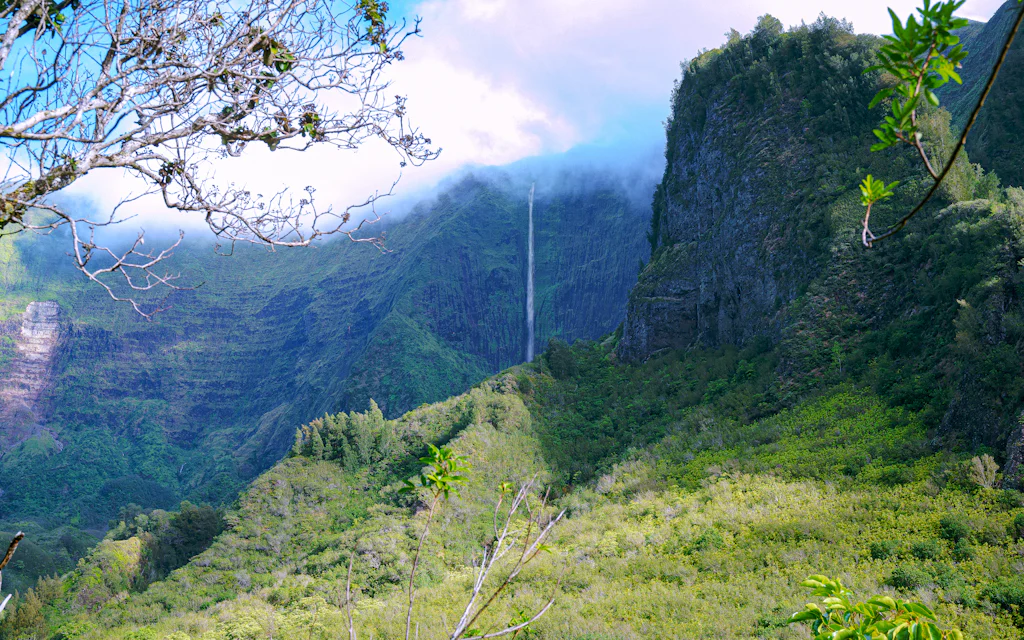
Sacred Falls, Oahu: The Closed Waterfall and Where to Go
18 min readYndira W. Tonin
The Sacred Falls trail on Oahu is closed. Not "closed ish." Not "closed but everyone goes anyway, wink." Closed since Mother's Day 1999, with a locked gate, hazard signs, and rangers who will now arrest you for climbing over that gate.
Here is the honest answer up front, because that is why you are here. Sacred Falls State Park in Hauula has been shut to the public since May 9, 1999, when a rockfall in the narrow valley killed eight hikers and injured roughly fifty more. It has never reopened, the closure is permanent, and entering it is a petty misdemeanor that can cost you a $1,000 fine or up to 30 days in jail.
So no, you cannot legally hike to Sacred Falls. I know. I am fun at parties.
(If you came here hoping for a secret trailhead and a "rangers never check" reassurance, I have bad news about my personality and worse news about the rangers.)
But you did not drive to Oahu to stand in front of a gate and pout. So this guide, checked for 2026, does two things, it tells you the full, honest story of why Sacred Falls is closed, the geology, the tragedy, the enforcement, and then it points you at the legal Oahu waterfall hikes that deliver the same green cathedral payoff without the part where you meet law enforcement.
The windward stretch where Sacred Falls sits (drive past, don't hike in)
Tap to open Google Maps with turn-by-turn directions.
01
What is in this guide
- Can you still hike Sacred Falls?
- What happened in 1999
- Why it is still closed (and will not reopen)
- What it costs to ignore the signs
- Where Sacred Falls actually is
- The only legal way to see the falls
- Legal Oahu waterfall hikes to do instead
- What to bring on the legal ones
- The honest verdict
- Sacred Falls FAQ
02
Can you still hike Sacred Falls?
No. And I want to be specific about how no, because a search for "Sacred Falls Oahu" still surfaces blog posts winking at you from 2014.
Sacred Falls State Park is officially closed to all public access, and entering is illegal. There is a locked gate at the old park entrance. There are signs. There is no permit, no waiver, no "you can go if you sign this" loophole. Hawaii closed the park the day after the 1999 rockfall and never reopened it, which makes this one of the longest running "do not enter" orders of any natural attraction in the islands.
Here is what changed recently, and why the old "everyone goes anyway" advice is genuinely outdated. In July 2025, after video surfaced of young adults climbing over the locked gate, the DLNR's enforcement division told its Oahu branch to start arresting violators rather than just citing them.
This is not a hypothetical. On the 22nd anniversary of the tragedy, officers cited nine hikers in a single morning for being in the closed area.
So when someone's three year old blog post tells you "technically it is closed but nobody enforces it," understand that the someone is describing a Hawaii that no longer exists. DLNR got tired of pulling bodies out of that valley. The enforcement is real now, and every attempt on that gate is now a gamble on an arrest, not a shrug.
It is the same legal gray area energy as the Crouching Lion hike or the infamous Stairway to Heaven, except Sacred Falls has a higher body count and a state that has finally, visibly, run out of patience. Those other two are stories about closure signs and selective enforcement. This one is a story about a mass casualty event the state watched happen and decided it would not allow to repeat.
So treat the old "everyone does it" blog chorus the way you would treat a 2014 restaurant recommendation, nice that it worked out for them once, but the place has changed management, and the new management arrests people.
03
What happened in 1999
To understand why Oahu treats this one differently, you have to understand the day itself.
On May 9, 1999, Mother's Day, the trail was packed. Sacred Falls was one of the most popular hikes on the island back then, an easy 2.2-mile walk up a green valley to an 80-foot waterfall and its swimming pool. Families. Couples. Kids. A normal, beautiful Sunday.
Then the wall came down.
A massive rockfall broke loose from the cliffs high above the falls and rained boulders into the narrow gorge where dozens of people stood. Investigators later estimated that around 50 cubic yards of rock, boulders the size of cars, fell roughly 480 feet and hit the valley floor at about 100 miles per hour. The gorge at that point is only 50 to 100 feet wide, hemmed in by sheer rock on both sides. There was nowhere to run, and no time to try.
Eight people were killed. Around fifty others were injured. Rescuers spent hours carrying the wounded the full 2.2 miles back down the trail by hand, because the gorge was too tight and unstable for anything else.
The Mother's Day rockfall, by the numbers
It remains one of the deadliest natural disasters in modern Hawaii history. And the awful part is that it was not a freak first time event. Rocks fall in that valley frequently, and the news archives read like a drumbeat, people killed by falling rock at the pool, families swept away in a flash flood, swimmers drowned, dozens trapped and rescued, year after year, long before 1999.
Decades of warnings, from the news archives
- 11970
Thirty trapped by a rock slide
A partial list begins, the valley was already shedding stone onto visitors.
- 21972
Flash flood kills two
A 22-year-old woman and a 9-year-old girl die. Several others are injured.
- 31982
Falling rock kills a 4-year-old
Struck at the pool below the falls. A Navy man dies in a fall the same year.
- 41987
A mother and toddler swept away
Killed in a flash flood. Two Hauula men drown at the base pool the same month.
- 51993 to 96
Floods keep coming
Four Boy Scouts swept off and rescued. More swimmers stranded and hurt.
- 61999
The rockfall
Eight killed on Mother's Day. The park closes the next day, permanently.
The legal aftermath dragged on for years. Survivors and families sued, arguing the state had known the valley was dangerous and kept the trail open anyway. The claims ultimately settled for more than $8.5 million. There is no amount of money that unwrites a Mother's Day like that one, but the lawsuits did one practical thing, they made absolutely certain Hawaii would never quietly reopen the trail and roll those dice again.
That is the context every honest guide owes you before it makes a single joke about parking. Eight families went up that trail and came home short.
04
Why it is still closed (and will not reopen)
Twenty six years is a long time to keep a state park shut. So why has not Hawaii just bolted some netting to the cliffs, slapped up a waiver sign, and reopened the thing?
Because the geology says no, and the geology is not negotiable.
Sacred Falls sits at the back of Kaluanui valley, a steep, narrow gorge cut into the windward Koolau range. The same shape that makes it gorgeous, towering vertical valley walls closing in on a slot canyon, is exactly the shape that makes it lethal. Rock keeps falling off those steep cliffs, weathered volcanic stone with no flat ground below to absorb it. Whatever breaks loose funnels straight down onto the old trail. Falling rocks are not a freak event here. They are the valley's weather.
Engineers looked at it. The standard fixes, rock netting, catchment fences, scaling the loose faces, do not work on walls that tall, that vertical, and that actively crumbling. You cannot drape a 1,000-foot cliff in chain link and call it safe.
Add the second hazard, flash floods. A narrow valley with a stream at the bottom is a funnel for rainwater, and a single flash flood can fill the slot in minutes. A sunny afternoon at the beach can be a wall of brown water in the gorge if it is pouring up in the mountains, and you would never see it coming until it arrived. The pre-1999 record above is not only rockfall, it is a landslide and flood ledger, and both hazards are still active.
So the closure is not bureaucratic foot dragging. It is a clear eyed admission that the place cannot be made reasonably safe at any price the state is willing to pay. The valley is doing what valleys do. We are just no longer allowed to stand under it.
05
What it costs to ignore the signs
Let us talk numbers first, since some of you are doing the cold blooded math on whether it is "worth the risk."
Entering a closed state park area in Hawaii is a petty misdemeanor. Per the DLNR's own 2025 enforcement notice, the penalty is a fine of up to $1,000 or up to 30 days in jail, and as of July 2025, officers are explicitly authorized to arrest, not just ticket. People genuinely get fined here, multiple times a year, and the anniversary patrols are a tradition now.
Here is the part the "it is only a fine" crowd skips, a citation in a closed area on Oahu is not the worst case outcome. The worst case is the reason the gate exists.
If a rock comes down, and rocks come down in that valley with grim reliability, there is no fast way out and there is no cell signal worth trusting. A rescue means DLNR officers and firefighters going into the same hazard that hurt you, carrying you 2.2 miles down a gorge that is still actively shedding stone. You would be asking strangers to risk the exact death you decided to gamble on.
So the real cost is not $1,000. It is the possibility of becoming a news story, and the certainty of making other people share your risk to fix it.
I will keep the lecture to one paragraph, because you are an adult and this is a travel journal, not a courtroom. But this is the rare Oahu "is it legal" hike where the honest answer is not a shrug. It is a flat no, and the no is load bearing.
What enforcement looks like now
06
Where Sacred Falls actually is
For the record, and because the geography is genuinely interesting, Sacred Falls is located on the windward (northeast) side of Oahu, just inland from the town of Hauula, between Kaneohe and the North Shore, about an hour's drive along the coast from Honolulu. It is not, despite a lot of confused listings, a North Shore beach attraction. It is a mountain valley a few minutes off Kamehameha Highway.
The park covers about 1,374 acres of the Kaluanui ahupuaa, almost all of it the steep, forested gorge running up into the Koolau range. The falls themselves drop roughly 1,100 feet in stages. The famous lower tier, the one the old trail reached, about 80 feet high, fed the swimming pool that made the hike a classic.
What Sacred Falls actually is
And the name matters. The Hawaiian name is Kaliuwaa Falls, often translated "the canoe leak" or "canoe hold", and the valley is tied to Kamapuaa, the shape shifting pig demigod of Hawaiian legend, who is said to have escaped his enemies up these cliffs. The smooth, canoe shaped groove in the rock face (a dry waterfall chute) is part of his story. Kaliuwaa was a sacred place long before it was a hiking listicle, which is worth sitting with for a second.
So even setting the danger aside, this is not a spot where the respectful move is to hop a gate for a photo. It is a wahi pana, a storied place, that happens to also be trying to kill visitors. Two excellent reasons to admire it from a distance.
It is also worth knowing the lay of the land if you are just driving past. The little town of Hauula is a quiet windward community, not a tourist strip, a gas station, a few plate lunch spots, and homes. The trailhead road runs back into a residential neighborhood toward the gate, so even the approach is somebody's street. That is part of why the closure has teeth, it is not just a state park rule, it is a neighborhood that has watched too many strangers park badly and walk past the signs.
If you want to understand how the windward valleys and the Koolau cliffs fit together, our best hikes on Oahu guide maps out the legal trails that show off the same dramatic terrain.
07
The only legal way to see the falls
So how do you see Sacred Falls, if standing at its base is off the table?
From the air. You cannot visit the valley floor, but the only legal way to actually lay eyes on the waterfall itself is from above, a helicopter tour (or small plane flight) along the windward coast. Several Oahu air tours trace the Koolau range and pass over the Kaluanui gorge, and from a few hundred feet up you get the one thing the closed trail cannot legally give you, the full 1,100-foot drop of Kaliuwaa Falls and the green amphitheater around it, with the Pacific glittering behind you and zero rocks landing on your head.
It is not cheap, and it is a splurge rather than a substitute. But if seeing this specific waterfall is the goal, the air is the answer, and it is the answer the state actively points people toward.
Most windward air tours run somewhere in the 45-to-60-minute range and bundle Sacred Falls with the rest of the postcard, the fluted Koolau ridgeline, the Kualoa coast, sometimes the Nuuanu pali and the windward bays. So you are not paying for one waterfall, you are paying for the whole green wall of the island from an angle no trail can match. If you have ever looked at the Koolau range from the highway and wondered what is hiding in those folds, this is how you find out, legally, and with a seatbelt.
The cheaper, ground level version is to simply drive the gorgeous windward coast it sits on. A circle island day tour rolls right through Hauula on the way to the North Shore, so you pass the mouth of the valley, see the cliffs that make it famous, and get the rest of the windward and North Shore highlights stacked onto one day, no driving, no gate hopping, no incident report.
08
Legal Oahu waterfall hikes to do instead
Now the useful part. You wanted a green valley, a tall waterfall, and a swim. Oahu has those, legally, with actual parking lots and a notable absence of arrest warrants. Our Oahu waterfalls roundup ranks the whole island. Here is where to point the rental car.
Which legal Oahu waterfall hike is right for you?
Manoa FallsOur pick
- Best for
- The easy win: 1.6 mi round trip to a 150-ft fall, 15 min from Waikiki
- The catch
- Mud, crowds, and no swimming at the base — it's a look, not a soak
Waimea Valley
- Best for
- A waterfall you can legally swim under, with a paved path + lifeguards
- The catch
- Paid admission; it's a botanical garden, not a wild trail
Lulumahu Falls
- Best for
- A green, adventurous valley hike near the Pali for the explorer types
- The catch
- Needs a free Na Ala Hele permit; muddy and easy to lose the trail
Likeke Falls
- Best for
- A short, quiet windward scramble to a mossy cascade above Kaneohe
- The catch
- Small and seasonal — a trickle when it hasn't rained
The headliner is Manoa Falls. It is the closest thing to the Sacred Falls experience that is actually open, an easy 1.6-mile round trip walk through dripping rainforest to a 150-foot waterfall, fifteen minutes from Waikiki. It is muddy, it is green, it looks like a movie set (because it has been one), and the only thing it will cost you is a small parking fee and clean shoes. If you only choose one legal waterfall on the island, choose this one.
Sacred Falls vs Manoa Falls
Sacred Falls (Kaliuwaa)
Hauula, closed
- Closed since 1999, entering is illegal
- 1,100 ft in stages. 80-ft lower tier
- Rockfall and flash flood gorge
- Visible legally only from the air
Manoa FallsOur pick
Manoa Valley, open
- Open daily, with a real parking lot
- 150-ft waterfall, 1.6 mi round trip
- Easy rainforest walk, movie set green
- Fifteen minutes from Waikiki
If you would rather have a guide handle the logistics and the trivia, the self guided Manoa Falls option below bundles the trail with the rainforest backstory.
★4.6(231)
Oahu: Manoa Falls Rainforest Self-Guided Hike
3.5 hours
Free cancellation
from
$53
The classier sibling is Waimea Valley on the North Shore. It is a paid botanical garden with a paved path to a waterfall you are actually allowed to swim under, lifeguards and all, the rare Hawaii waterfall that is both legal and safe to get in. Our Waimea Bay guide covers the valley and its falls in full, and the Toa Luau at Waimea Valley lets you turn the same spot into a whole evening.
For the more adventurous, two windward side options scratch the "hidden valley" itch legally, Lulumahu Falls near the Pali (it sits on state land that requires a Na Ala Hele permit, get it, it is free and it keeps the trail open) and Likeke Falls above Kaneohe, a short, lesser known scramble to a mossy cascade. Neither has Sacred Falls' scale, but neither has its gate, either.
Base yourself in town for any of these, most visitors do, then day trip out. You can compare Waikiki hotels (also on Booking.com) and reach every waterfall on this list within an hour's drive.
09
What to bring on the legal ones
Oahu's open waterfall trails are friendlier than Sacred Falls ever was, but "rainforest" is doing a lot of quiet work in that sentence. A few honest pack notes,
- Real shoes. These trails are mud with delusions of being paths. Trail or trail running shoes save you a comedic, dignity ending slip. Flip flops are how you become the cautionary tale.
- Bug spray. The windward valleys are mosquito country, and they have been waiting their whole short lives for your ankles. Insect repellent is not optional up there.
- A packable rain jacket. "It was sunny at the beach" means nothing in a rainforest valley. A light rain shell packs to nothing and saves the hike.
- A dry bag. For the swim under Manoa or Waimea, keep your phone and keys in a dry bag. Waterfall pools and pockets do not mix.
- Reef safe sunscreen. You will be in and out of sun and stream. Go reef safe, which is also just the law and decency move in Hawaii.
That is it. No ropes, no closure signs, no negotiating with gravity.
What to bring on the open waterfall hikes
Real shoesTraction
These trails are mud with delusions of being paths. Trail or trail running shoes save you a dignity ending slip, flip flops do not.
Bug sprayMosquitoes
The windward valleys are mosquito country, and they have been waiting for your ankles. Insect repellent is not optional up there.
Packable rain jacketWeather
Sunny at the beach means nothing in a rainforest valley. A light rain shell packs to nothing and saves the hike.
Dry bagSwim ready
For the swim under Manoa or Waimea, keep your phone and keys dry. Waterfall pools and pockets do not mix.
Reef safe sunscreenSun and stream
You will be in and out of sun and water, so go reef safe, which is also the law and the decent move in Hawaii.
And if a waterfall hike turns out to be one rainy valley slog too many, the windward coast that holds Sacred Falls also holds some of the calmest beaches on the island. A laid out beach picnic at Kailua or Waimanalo, from $349, fully set up and cleared for you, is the lazy, legal, very dry way to spend a windward afternoon. (We run those on Oahu's shoreline, not up any gorges. Our whole thing is not standing under loose rock.)
10
The honest verdict
Sacred Falls is a beautiful, sacred, genuinely dangerous place that the state of Hawaii has decided, correctly, you should not be standing in. The trail is closed, the closure is permanent, the geology earns it, and the enforcement is now real enough to ruin your trip if you test it.
The good news, can you still get the green cathedral experience legally? Yes, several times over. You came to Oahu for green valleys, tall waterfalls, and a swim you will remember, and the island hands you all three on trails that want you there. Manoa Falls for the easy win. Waimea Valley for the legal swim. Lulumahu and Likeke for the adventurous detour. (Our things to do in Hawaii hub maps the rest of the island's legal fun.)
I get why Sacred Falls still pulls at people. It was, by every old account, one of the most beautiful hikes on the island, a real cathedral of a valley with a real swimming pool at the end. Losing it is a genuine loss, not just a bureaucratic shrug. But the same beauty that makes it magnetic is the beauty that killed eight people on a Sunday afternoon, and no photo is worth being the ninth.
The respectful move and the safe move happen to be the same move here, which does not always happen in travel. Admire it from the air or from the highway, learn its name and its story, and spend your actual hiking legs on the valleys that are open for business.
Skip the gate. Take the open trail. The waterfall at the end is just as tall, and nobody has to carry you out of it.
11
Sacred Falls FAQ
What does Kaliuwaa mean?
Usually translated "the canoe leak" or "canoe hold." The name refers to the smooth, canoe shaped groove worn into the cliff face, in legend, the chute the pig demigod Kamapuaa used to escape his enemies. "Sacred Falls" is the tourist era name. Kaliuwaa is the place.
Why does Sacred Falls Oahu still show up on hiking apps?
Stale listings. Old GPS recordings and pre-1999 trail pages still circulate on hiking apps and blogs, which is exactly how people end up at a locked gate, or past it. If a route, pin, or "current conditions" post for Sacred Falls is older than the closure or does not mention it, treat it as fiction.
How much did the state pay after the 1999 rockfall?
The lawsuits settled for more than $8.5 million. Survivors and families argued Hawaii knew the valley's rockfall history and kept the trail open anyway. That legal history is one of the practical reasons the park will not quietly reopen.
Can you see Sacred Falls from the road?
Not the waterfall itself, it sits about two miles back in the gorge. From Kamehameha Highway in Hauula you can see the mouth of Kaluanui valley and the cliffs that frame it, which is a worthwhile thirty second pull off on a windward drive. The falls only reveal themselves from the air.
Is anything near Sacred Falls worth stopping for?
Yes, the windward coast around it is the scenic part. Hauula Beach Park sits right across the highway, Kahana Bay's calm crescent is about ten minutes south, and Laie (the Polynesian Cultural Center) is about ten minutes north. You lose nothing by admiring the valley from sea level and spending your stop on the coast.
Disclosure: Some links on this page are affiliate links. If you book or buy through them we may earn a small commission, at no extra cost to you. As an Amazon Associate, we earn from qualifying purchases.


