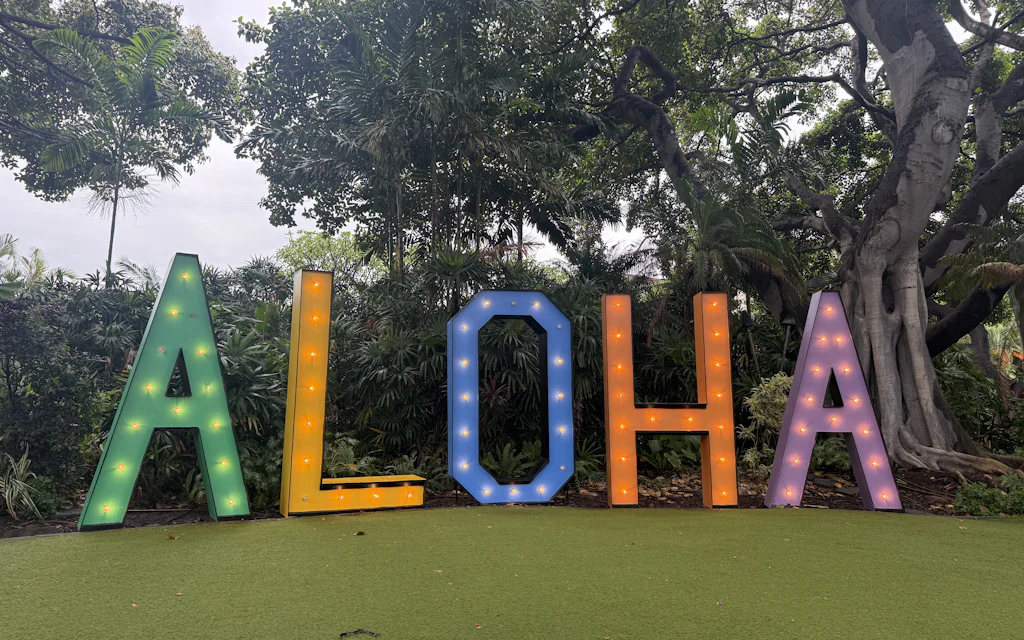
What Language Is Spoken in Hawaii: English, Hawaiian, and Pidgin (2026)
13 min readYndira W. Tonin
The short answer, the language spoken in Hawaii is English day to day, but the state has two official languages, English and Hawaiian (Olelo (ʻŌlelo) Hawaii), and most locals also speak a third, Hawaiian Pidgin. So you'll get by entirely in English, hear Hawaiian woven through place names and culture, and catch Pidgin in everyday local conversation.
Every number here was checked against the latest Census and state figures, current as of 2026.
This guide answers what language is spoken in Hawaii, tells how Hawaiian nearly disappeared and came back, explains Pidgin, and gives you the words worth knowing.
Table of contents
- The three languages of Hawaii
- What language is spoken in Hawaii, by the numbers
- Is Hawaiian still a living language?
- What is Hawaiian Pidgin?
- Hawaiian words every visitor should know
- How to say hello, thank you, and I love you
- How to pronounce Hawaiian words
- Hawaiian words you will see everywhere
- A few Pidgin phrases you will hear
- Using Hawaiian respectfully
- FAQ
01
The three languages of Hawaii
Ask what language they speak in Hawaii and the honest answer is three, layered on top of each other.
English is the everyday language and what you'll use for the entire trip, at hotels, shops, and tours. Hawaii is a US state and English is universal, so a visitor never needs another language. If that is all you needed, there it is, yes, they speak English in Hawaii.
Hawaiian (Olelo Hawaii) is the Indigenous language of the islands and, since 1978, a co official language of the state, the only one in the country with an Indigenous official language. You will hear it constantly, in place names, in chant and hula. It is a living language, not a relic, and its story is remarkable.
Hawaiian Pidgin, formally Hawaii Creole English, is the local creole that hundreds of thousands of residents speak every day. It is not broken English, it is its own language with its own grammar and rhythm, and a badge of local identity.
So which one will you actually use? English, almost entirely, the other two you mostly encounter rather than speak. But knowing all three coexist explains what you notice, why place names look unfamiliar, why signs mix English and Hawaiian, why two locals sound nothing like the hotel greeting.
English, Hawaiian, and Pidgin
EnglishOur pick
what you will use
- Universal across the state
- Hotels, tours, shops, and signs
- No second language needed
Hawaiian
official since 1978
- Olelo Hawaii, the Indigenous language
- Place names, chant, and hula
- About 24,000 fluent speakers today
Pidgin
the local creole
- Hawaii Creole English
- Born on the plantations
- A badge of local identity
02
What language is spoken in Hawaii, by the numbers
So what language is spoken in Hawaii once you're actually counting heads? English, overwhelmingly, but the at home numbers show how layered the islands are. In the latest Census figures, 342,396 Hawaii residents, about 25.1 percent of everyone age five and up, speak a language other than English at home, one in four and roughly double the mainland rate.
The biggest non English languages read like a map of Hawaii's plantation history. Tagalog is the most common, at 59,395 speakers, with Ilocano close behind at 58,297, both tracing to the Filipino families who came to work the fields. Japanese (39,249), Chinese (35,176), Spanish, Korean, and Samoan fill out the top ten, with Pacific languages like Chuukese and Marshallese climbing.
Hawaiian now sits fifth, with 27,611 people speaking Olelo Hawaii at home, up nearly 50 percent since 2016. For a language down to a couple thousand speakers a generation ago, fifth place is a quiet triumph.
Pidgin does not show up cleanly in the tables, filed under creole languages, but the real total runs near 600,000. Hawaii is one of the most multilingual states in the country.
Who speaks what at home
03
Is Hawaiian still a living language?
Yes, but it came terrifyingly close to not being, and that history shapes how you should treat the language today.
In 1896, a few years after the overthrow of the Hawaiian Kingdom, an English only law (Act 57) pushed Hawaiian out of the classroom, and it would not be allowed back into public schools until 1987, a span of 91 years. Children were punished for speaking their own language, and the count of speakers collapsed from nearly 40,000 in 1896 to about 2,000 by 1978, with fluent children left mostly on the isolated island of Niihau.
Then came one of the great language revival stories anywhere. The first Punana (Pūnana) Leo immersion preschool opened in 1984 on Kauai and ran, remarkably, while the old ban was still law. Immersion schools followed.
Today about 24,000 people speak Olelo Hawaii fluently, up more than tenfold since the 1970s, children live and are raised in it, and you can study it from preschool through a PhD. The University of Hawaii's Hawaiian language program is one engine of that revival.
Here is the one opinion this guide will offer, learn a few words sincerely and treat the language with respect. It was nearly killed on purpose, and its comeback is a point of deep pride. The language is not a theme park prop, it is a living thing a community fought to save.
The revival is visible everywhere, bilingual signage, Hawaiian language radio, and more than 2,600 students in the state's immersion schools. In March 2025 the Hawaii courts even reaffirmed that you may address them in Olelo Hawaii, calling respect for the language a core value. That history turns the unfamiliar words on the map from decoration into something with real weight.
04
What is Hawaiian Pidgin?
Hawaiian Pidgin is the secret third language of Hawaii, and understanding it will deepen your trip.
Pidgin (linguistically, Hawaii Creole English) was born on the sugar plantations in the 1830s, when Native Hawaiians and immigrant laborers, Portuguese, Chinese, Japanese, Filipino, Korean, and Puerto Rican, had to communicate across a dozen languages. Out of that grew a new tongue with its own grammar and melody. An estimated 600,000 people speak it natively, and 400,000 more as a second language.
But Pidgin is not "bad English" or a sign of poor education, that is an old and hurtful misconception. Linguists recognize it as a full creole with consistent rules, and in 2015 the US Census Bureau formally counted it as a language of Hawaii. For locals, and especially longtime kamaaina, it carries warmth, humor, and belonging, it is the casual language of home, of talking story, of comedy and poetry.
A quick example of how different it sounds, where standard English says "the food is delicious," Pidgin might be "da grinds so ono." It's compact, musical, and full of borrowed plantation words, and writers and poets now publish in it proudly.
Pidgin is winning formal respect, too. In 2025 Hawaii offered a Seal of Biliteracy in Pidgin for the first time, and the first students earned it at Waipahu High.
As a visitor you don't need to speak it, and you absolutely shouldn't fake the accent, nothing marks an outsider faster than a tourist performing Pidgin. But it helps to recognize it, and to know that a local shifting into Pidgin with friends is a living piece of Hawaii's plantation era soul.
05
Hawaiian words every visitor should know
You do not need to learn Hawaiian to visit, but a handful of words gives you a head start and shows respect.
Hawaiian words to know
Aloha
Hello, goodbye, and love, the heart of it all. More a spirit than a word.
Mahalo
Thank you. The single most useful word for a visitor to learn and use.
Ohana
Family, including the family you choose, not just blood.
Keiki
Child or kids. You will see it on menus, signs, and beach warnings.
Mauka / Makai
Toward the mountain / toward the sea, how locals give directions.
Pau
Finished, done. 'Pau hana' is after work, the island happy hour.
Ono
Delicious. The correct review of any good plate lunch or poke.
Pono
Righteousness, balance, doing right, a core Hawaiian value.
A few deserve a closer look. Aloha, the best known Hawaiian word, means far more than hello and goodbye, it carries love, affection, and a whole way of being (the aloha spirit is real, even written into state law, Hawaii Revised Statutes 5 to 7.5).
Mahalo is your most important word, say thanks often and sincerely. Ohana, family, extends to the family you choose, not just blood.
The pair mauka (toward the mountains or inland) and makai (toward the sea or ocean) is genuinely useful, locals and signs use them this way. Pau (finished) shows up everywhere, especially in pau hana, the beloved after work wind down into the weekend. And ono (delicious) is the only review your plate lunch needs, though without the mark it is also a local fish.
Pono, a value that's hard to describe, often rendered "righteousness" or "balance," is bigger than its translation, a core value about doing right and keeping things in harmony, and it even appears in the state motto. And keiki (child) you will see on everything from menus to beach safety signs.
Learn these and you will understand much of what you see on signs and menus. None of it is required, but each Hawaiian word is a small door into the culture.
06
How to say hello, thank you, and I love you
A few phrases come up again and again, here is how to say the essentials.
- Hello / goodbye: Aloha (ah-LOH-hah). The same word works for both, and for love. Add aloha kakahiaka for good morning.
- Thank you: Mahalo (mah-HAH-loh). For extra warmth, mahalo nui loa means "thank you very much."
- I love you: Aloha au ia oe (ah-LOH-hah ow ee-AH oh eh). A lovely phrase to learn if you're a romantic.
You will also hear a hui hou (until we meet again), often at sunset. A warm "mahalo," or "I love you" for someone special, is a small pleasure the islands return.
These phrases carry weight at life's big moments, which is why couples marrying or renewing their vows in Hawaii weave them in, and our Hawaii honeymoon guide covers the romantic side. The language rewards sincerity, not fluency.
07
How to pronounce Hawaiian words
Hawaiian looks intimidating, all those vowels and apostrophes, but it is wonderfully consistent once you know a few rules.
The Hawaiian alphabet has just 13 letters, five vowels, seven consonants, and the okina (ʻ), a glottal stop. Every letter is pronounced, and the vowels are steady, like in Spanish or Italian, a = "ah," e = "eh," i = "ee," o = "oh," u = "oo." Two marks change meaning, the okina is that catch in the throat like the pause in "uh oh," and the kahako, a line over a vowel, holds it a beat longer.
The trick to long place names is to break them into syllables and say each vowel. The state fish, the humuhumunukunukuapuaa, is just small regular pieces strung together. Take Likelike (the highway), it is "LEE-keh-LEE-keh," not "like like." Hit every vowel and you will pronounce Hawaiian better than most visitors.
A couple more that trip people up, Haleiwa is "ha-leh-EE-va" (a w after a vowel often sounds like a soft "v"), and in Kamehameha every H is voiced. The best habit is to resist anglicizing, say every vowel evenly, and pause at the okina. For any word, the Hawaiian dictionary at ulukau.org is the reference locals and students have long used.
Hawaiian has just 13 letters
08
Hawaiian words you will see everywhere
Beyond the greetings, a cluster of Hawaiian words shows up so often that recognizing them makes Hawaii far easier to navigate.
- Kapu, forbidden, off limits, sacred. If a sign says kapu, don't go. It can mean private property or a sacred site.
- Wahine / Kane (Kāne), woman / man. You will most often meet these on restroom doors, so it is worth knowing which is which.
- Honu, the green sea turtle you will hopefully meet snorkeling in the ocean.
- Luau (Lūʻau), the feast, literally named for the taro leaf served in it.
- Haole, a non Hawaiian, especially a white person or foreigner. Usually neutral, context dependent.
- Keiki / Kupuna (Kūpuna), children / elders, respected enough that any elder may be an aunty or uncle.
You will even see mahalo on trash cans and in every gift shop, and it all connects to the living Hawaiian culture behind the words.
Food menus are their own lesson, poke (the raw fish dish, named for the cut), kalua, haupia, and huli huli all turn up, and pupu means the appetizers, our Hawaiian food guide decodes the plate before you book a table. You will meet borrowed in words too, slippahs for flip flops, and honu, mano, and nene labeling the wildlife. Hawaiian is the everyday vocabulary used across the islands.
09
A few Pidgin phrases you will hear
You will not speak Pidgin as a visitor, but recognizing a few phrases lets you enjoy the local color. Here are some classics.
- Pau, done, finished (shared with Hawaiian). "I pau already."
- Talk story, to chat, hang out, share stories. A beloved island pastime.
- Brah / braddah, brother, friend, dude.
The card above covers the rest, da kine, the local version of whatchamacallit, for anything you cannot name, grinds to eat, shoots to agree, howzit for how's it going, and broke da mouth, the term for delicious.
A few Pidgin phrases, translated
Da kine
The all purpose word for the thing you cannot name. Context is everything.
Grinds
Food, or to eat. Ono grinds is delicious food.
Broke da mouth
So good it broke the mouth. The highest food praise there is.
Shoots
Okay, sounds good, let us go. A friendly way to agree.
Howzit
How is it going. The standard hello.
Kamaaina
A longtime local. Many places offer a kamaaina discount.
A few more, try (a softener, as in "try wait"), stay for the present tense ("I stay tired"), and bumbye (eventually). The grammar differs enough that linguists call it a creole, not an accent.
Hearing "eh, da grinds broke da mouth, brah" and roughly following it is one of the small joys of paying attention in Hawaii. Enjoy Pidgin as a listener and resist imitating the accent, appreciation lands warmly, imitation does not. Local comedians and Pidgin books are a far better way in than the rental car counter.
10
Using Hawaiian respectfully
A little cultural awareness turns a few learned words from awkward into welcomed.
Do use the everyday words, mahalo, aloha, ono, mauka and makai, warmly, and make an honest effort at place names, which is always a help. Locals mind the effort far less than the stumbles, and a "kapu" sign is the one to watch for.
Do not fake a Pidgin accent or perform "local," it reads as mockery even when you mean well, and do not slap "aloha" and "mahalo" onto everything as a gimmick. If you're unsure whether a word is appropriate, ask, or simply observe.
The throughline is sincerity. Hawaiians fought to save this language from deliberate extinction, and they share it generously with visitors who approach it with respect.
Pick up a few words honestly and you take part in the aloha that makes these islands what they are. That same spirit is what we try to put into a beach picnic, care and welcome made tangible.
FAQ
What language do they speak in Hawaii?
English is the everyday language, and what visitors use throughout the trip. Hawaii has two official languages, English and Hawaiian (Olelo Hawaii), and most locals also speak Pidgin, an English based creole. You get by in English while hearing Hawaiian in place names and Pidgin in conversation.
Do they speak English in Hawaii?
Yes, everywhere. Hawaii is a US state and English is universal, at hotels, restaurants, shops, and tours. You never need another language, though learning a few Hawaiian words like aloha and mahalo is a welcomed sign of respect.
Is Hawaiian a real language?
Absolutely. Hawaiian (Olelo Hawaii) is the Indigenous Polynesian language and a co official state language since 1978. It was banned in schools in 1896 and nearly died out, but a revival through immersion schools has brought thousands of speakers back, and children are raised speaking it again.
How do you say hello, thank you, and I love you in Hawaiian?
Aloha can refer to hello, goodbye, and love (ah-LOH-hah). Thank you is mahalo (mah-HAH-loh), or mahalo nui loa for "thank you very much." For someone special, "I love you" is aloha au ia oe (ah-LOH-hah ow ee-AH oh eh). Saying any of them warmly is always appreciated.
Cover photo, Logan Voss on Unsplash.


