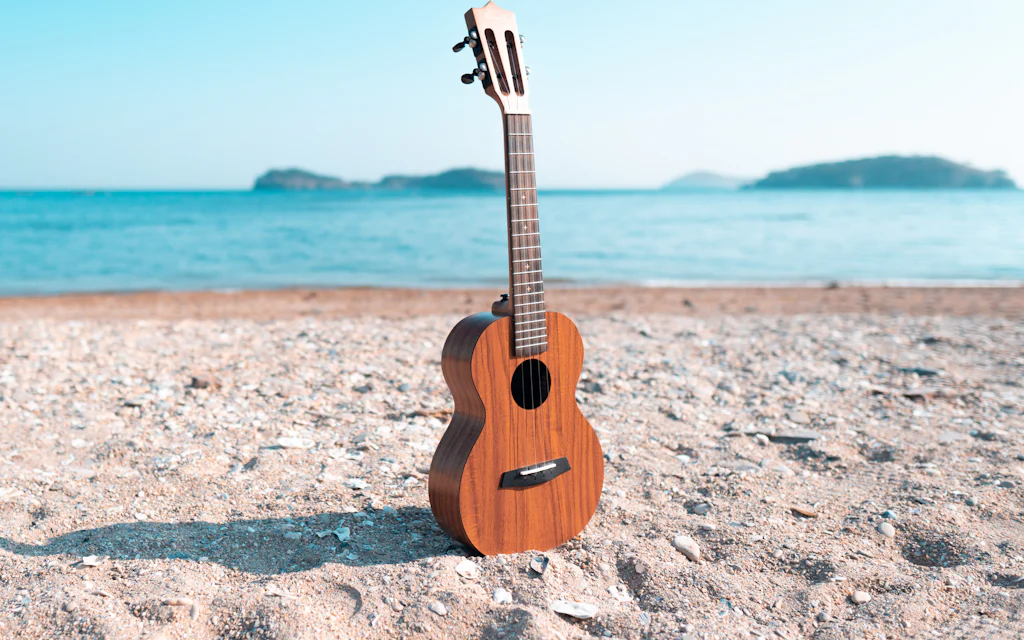
Hawaiian Ukulele: The Story Behind Hawaii's Beloved Instrument
17 min readYndira W. Tonin
The ukulele is the small, four stringed instrument at the heart of Hawaiian music, that bright, cheerful, instantly recognizable voice of the islands. The Hawaiian ukulele has a surprising backstory, it is not originally Hawaiian at all, but an instrument that Portuguese immigrants brought across the ocean in 1879, and that Hawaii adopted, transformed, and made its own, until it became a symbol of the Hawaiian islands worldwide.
This guide is current as of 2026.
Easy to pick up, easy to love, and impossible to play sadly, the uke went from an immigrant's keepsake to the heartbeat of the local songbook, the centerpiece of countless luau, and, through one famous recording, known in every corner of the globe.
This guide tells the whole story, the instrument's journey from Madeira, what its name means, its place in Hawaiian culture, the four sizes you will see, how hard it is to start, and how to choose and buy your first one.
Table of contents
01
What is a Hawaiian ukulele?
A ukulele is a small, guitar like four string instrument, traditionally made of wood and played by strumming or plucking with the fingers.
It is the small size and the four nylon strings that give the uke its character, a bright, warm, jangly tone quite unlike a six string guitar. Standard ukuleles are tuned G C E A, and here is the quirk that defines the voice, the top G string is usually tuned "re entrant," meaning it is a high note rather than the lowest, so your strums ring out bright and chiming rather than building from a deep bass. That cheerful, slightly toy like brightness is the ukulele's signature.
Ukulele vs guitar for a total beginner
UkuleleOur pick
The friendly one
- 4 soft nylon strings, tuned G C E A
- Re entrant high G, strums ring bright and chiming
- Small body, short neck, easy chord shapes
- First song, a day or two
Guitar
The bigger commitment
- 6 strings, often steel, tuned E A D G B E
- Low to high strings, fuller, bassier voice
- Bigger stretches and tougher barre chords
- First song, weeks of sore fingertips
Because it has only four strings and a short neck, the uke is far more approachable than a guitar, small hands, short fingers, and total beginners all find it friendlier. It is light, portable, and forgiving, which is a big part of why it spread so far and why it remains one of the easiest musical instruments in the world to pick up.
A quick anatomy, since the parts have names you will hear, the hollow wooden body projects the sound. The neck carries the fretboard with its metal frets. The strings run from the bridge on the body up to the tuning pegs on the headstock. Traditional Hawaiian ukuleles are prized when built from koa, a beautiful native Hawaiian hardwood that gives a warm, resonant tone (and a gorgeous grain), though good beginner ukes are made from mahogany, spruce, and other woods too. The strings, once gut and now usually nylon or fluorocarbon, are what keep this littlest of the stringed instruments gentle on beginner fingers.
In Hawaii, though, the ukulele is more than an easy instrument, it is woven into Hawaiian culture, hula, and identity, as instantly recognizable as the shaka. To understand how that happened, you have to go back to 1879.
02
Ukulele history: from Madeira to Hawaii in 1879
The story begins not in Hawaii but on Madeira, a small island belonging to Portugal, out in the Atlantic, and it begins with hardship. By the 1870s a series of natural disasters had hit Madeira, vine disease wrecked the island's wine industry, crops failed, and work disappeared. When Hawaii's booming sugar industry came recruiting contract workers, thousands of Madeirans signed on and crossed half the planet to the middle of the Pacific Ocean.
More than 400 of those Portuguese immigrants, recruited for the sugar plantations, arrived in Honolulu **aboard the British ship Ravenscrag on August 23, 1879, and among them were craftsmen carrying a small instrument called the braguinha** (a form of the machete de braga, cousin to the five string rajão). As the story goes, a passenger named João Fernandes borrowed one and started playing right there on the wharf, and the Hawaiians who'd gathered were captivated by the bright little voice and his flying fingers. In September 1879, the Hawaiian Gazette reported that the "Madeira islanders recently arrived here" had been "delighting the people with nightly street concerts." The instrument was a hit within two weeks of its arrival.
The ukulele's journey, in six stops
- 1Aug 23, 1879
The Ravenscrag docks in Honolulu
More than 400 Madeiran immigrants arrive to work the sugar plantations. Joao Fernandes plays a borrowed braguinha on the wharf.
- 21880s
Three woodworkers set up shop
Nunes, Dias, and Espirito Santo start building, Dias in Chinatown from 1884, all three selling by 1888.
- 31880s-90s
Royal approval
King Kalakaua features the uke at court and in hula. By the 1890s the name ukulele is settled.
- 41915
San Francisco falls for it
The Panama-Pacific International Exposition sets off the first mainland craze. Martin and Harmony start mass production.
- 51916
Kamaka opens
Nunes apprentice Samuel Kamaka starts the one man Honolulu shop that is still building ukuleles today.
- 61990
IZ records the medley
"Somewhere Over the Rainbow / What a Wonderful World" carries the ukulele to every corner of the world.
Three of those Madeiran woodworkers, Manuel Nunes, Augusto Dias, and José do Espirito Santo, soon set up shop building the little guitars for local musicians, Dias opened his shop in 1884 in the city's Chinatown district, and by the late 1800s all three men were selling in earnest. Ukulele makers adapted the instrument to local tastes and tunings, blending features of the braguinha and the rajão, and in doing so created something new, Nunes later advertised himself, with no false modesty, as "Inventor of the Hawaiian Ukulele". His legacy ran further than his ads, another apprentice from his shop, Samuel Kamaka, opened his own one man operation in 1916, and Kamaka is still building ukuleles in Honolulu today.
The defining Hawaiian touch was the wood. Builders began crafting ukuleles from native koa, giving them a distinctive look and a warmer voice than the European originals, and over time the body shape and tuning settled into the Hawaiian form we know today. What began as a Portuguese folk instrument had become, within a decade, distinctly Hawaiian, a small wooden emblem of the kingdom's whole multicultural plantation history, Portuguese here as Japanese, Chinese, and Filipino elsewhere.
03
What does "ukulele" mean? The jumping flea story
The word "ukulele" translates literally as "jumping flea", uku meaning flea and lele meaning to jump or fly. But why would Hawaiians give the name ukulele, of all things, to a charming little instrument? Three stories compete,
Why "jumping flea"?
The flying fingersThe classic
A good player's left hand darts around the fretboard like a flea hopping, the explanation most people hear first.
Edward Purvis's nicknameThe courtier
A small, quick English officer in King Kalakaua's court, nicknamed "jumping flea", loved the instrument, and the name may have jumped from him.
The gift that came hereThe queen's version
Queen Liliuokalani's gentler reading, uku as "gift or reward," lele as "to come", the gift that came here.
The queen's version deserves its own paragraph. Queen Liliuokalani, Hawaii's last monarch, and the composer of "Aloha Oe," the most famous song the kingdom ever produced, reportedly disliked the pest explanation and preferred a gentler etymology, uku as "gift or reward," lele as "to come." The gift that came here. Given where the instrument came from and what Hawaii did with it, the queen's reading might be the truest of the three, whatever the dictionaries say.
There is a small but meaningful note on spelling and pronunciation, too. In Hawaiian it is written with an okina at the front (ʻukulele, that little reversed apostrophe marks a glottal stop), and traditionally pronounced "oo-koo-LEH-leh" rather than the mainland "yoo-kuh-LAY-lee." Neither is wrong in everyday English, but using the Hawaiian pronunciation is a nice nod to the instrument's home, the kind of small respect that locals notice and appreciate.
Whichever origin is true (and they may all have a hand in it), the name was settled by the 1890s, and it captures something essential, that quick, hopping, joyful quality that makes the uke so hard to play gloomily.
04
The ukulele in Hawaiian culture and music
The ukulele did not just arrive in Hawaii, it was embraced at the very top, and that royal endorsement cemented its place in Hawaiian culture.
The People Who Made the Ukulele Famous
King David KalakauaRoyal patron
Hawaii's last king, remembered as the Merrie Monarch who revived hula, loved the uke and featured it at royal gatherings, giving hula a livelier rhythm.
1915 Panama-Pacific ExpositionSan Francisco
Hawaii's pavilion charmed millions of fairgoers with live ukulele performances, sparking a mainland craze and mass production by Martin and Harmony.
Israel KamakawiwooleWorldwide
His tender 1990 medley of Somewhere Over the Rainbow and What a Wonderful World became a global phenomenon and one of the most beloved recordings ever made.
Jake ShimabukuroModern virtuoso
Pushes the instrument into dazzling new territory, proving the ukulele is far more than a novelty.
King David Kalakaua, Hawaii's last king and a passionate patron of the arts (he is remembered as the "Merrie Monarch" who revived hula), loved the uke and featured it at royal gatherings and performances, where it gave hula a livelier rhythm than the older accompaniment. With King Kalakaua's support, its popularity spread fast through song and dance, and it soon became inseparable from island identity.
The next chapter was global. A craze swept the US mainland after Hawaii's pavilion at the 1915 Panama-Pacific International Exposition in San Francisco, where live ukulele performances charmed millions of fairgoers, mainland manufacturers like Martin and Harmony rushed into mass production, and the craze returned in the 1950s with TV star Arthur Godfrey. But the uke's most powerful modern ambassador was Israel "IZ" Kamakawiwoole (Kamakawiwoʻole), whose tender 1990 medley of "Somewhere Over the Rainbow / What a Wonderful World" became a worldwide phenomenon, one of the most beloved recordings ever made, and the track that introduced millions to its emotional power. Today, virtuosos like Jake Shimabukuro push it into dazzling new territory, proving it is far more than a novelty.
It is worth pausing on what the uke means in Hawaiian music specifically. It is not a solo show off instrument so much as the warm, rhythmic heartbeat behind a song, the gentle strum that carries a singer's voice and a dancer's hula, a symbol of how Hawaii makes music. In the hands of local musicians it accompanies everything from sacred and traditional mele (songs) to the sweet, swaying hapa haole tunes of the 20th century. That supportive, communal role, played together on a porch or a beach, rather than performed at people, is the legacy the Madeirans never could have planned.
05
The four ukulele sizes
If you go shopping for a ukulele, the first thing you will notice is that they come in different sizes, and the size changes both the sound and the feel.
Which ukulele size is right for you?
Soprano (~21")Our pick
- Best for
- The classic, smallest uke and the quintessential bright, jangly 'Hawaiian' sound — and the cheapest to start on
- The catch
- Tight fret spacing can feel cramped for big adult hands
Concert (~23")
- Best for
- A touch bigger, with a fuller tone and roomier frets — the comfortable all-rounder most adult beginners prefer
- The catch
- Slightly less of that tiny, traditional soprano twang
Tenor (~26")
- Best for
- Bigger, richer, and louder — the choice of many pros and serious players (it's what Bruddah IZ played)
- The catch
- Larger and pricier; less of the toy-like classic charm
Baritone (~30")
- Best for
- The largest, with a deep, mellow, guitar-like voice — easy for guitarists, who can use familiar chord shapes
- The catch
- Tuned lower (DGBE), so it loses the signature high-G uke sound
There are four standard sizes, from smallest to largest, soprano, concert, tenor, and baritone. The soprano (around 21 inches) is the original and smallest, with the classic bright, plinky, quintessentially "ukulele" sound. The concert (around 23 inches) is a little bigger, with a fuller tone and more comfortable spacing, a popular choice for adult beginners. The tenor (around 26 inches) is bigger and richer still, favored by many professionals (it is the size IZ played). And the baritone (around 30 inches) is the largest, with a deep, mellow, almost guitar like voice.
One key difference, soprano, concert, and tenor are all tuned the same (G C E A), so you can switch between them easily, while the baritone is tuned lower (D G B E), like the top four strings of a guitar, which gives it a different, deeper character and makes it especially easy for guitarists. For that classic Hawaiian sound, a soprano or concert is the way to go.
So which should you pick? For most adult beginners chasing the traditional sound, a concert hits the sweet spot, that classic brightness, but with frets roomy enough for grown up fingers. Choose a soprano if you want the smallest, most portable, most quintessentially Hawaiian option (and the lowest price). A tenor if you have larger hands or think you will get serious. And a baritone mainly if you already play guitar and want the easiest crossover. You will also see a few less common sizes (sopranino, bass), but the four above cover nearly everyone.
06
How hard is it to learn?
Here is the good news that draws so many people in, the ukulele is one of the easiest instruments in the world to start, and you can be playing real songs within a day or two.
With only four strings (versus a guitar's six) and soft nylon strings that are gentle on the fingers, the ukulele is genuinely beginner friendly. Many popular songs use just three or four simple chords, and the small neck means even short fingers can form them without strain. Kids take to it easily, it is commonly taught in Hawaiian schools, and adults who "have no musical talent" are often strumming along to a song by the end of their first sitting.
That low barrier to entry is the ukulele's superpower. You will not master it overnight, real fluency and the fancy fingerpicking of a Jake Shimabukuro take years, but the distance from zero to "playing a song and having fun" is shorter than with almost anything else you could pick up. It is the rare instrument that rewards you almost immediately.
The hardest parts for beginners are usually small and quickly overcome, building a little finger strength for clean chords, getting a smooth strumming rhythm, and switching between chords without pausing. None of these take long, and there is a vast, friendly world of free online lessons, chord charts, and play along videos to guide you. Because the uke is so social and so forgiving, many people who "failed" at guitar or piano as kids find they actually stick with this one, and enjoy it.
07
Buying your first ukulele
If a trip to Hawaii has you wanting to take the music home, a ukulele makes a wonderful, portable souvenir, but choose it with a little care.
Here is the one strong opinion in this guide, do not buy the $20 toy ukulele. The cheapest novelty ukes, often sold as beach souvenirs, will not hold their tuning and sound poor, and nothing makes a beginner quit faster than one that is frustrating to play. A decent beginner ukulele costs roughly $50 to $100, and that modest step up buys one that actually stays in tune and sounds good, worth every cent.
What buying smart looks like
For a starter, a soprano or concert size in that price range is ideal, from trusted beginner brands like Kala, Cordoba, and Lanikai. At the other end of the market sit the homegrown ukulele makers, collectors talk about "the 4 K's", Kamaka, Kanile'a, KoAloha, and Ko'olau, luthiers hand building koa ukes on the islands, with Hawaiian made models starting around $1,000 and master grade koa running several thousand. Nobody needs one to start. Plenty of players save up for one later as the trip souvenir to life hobby pipeline completes itself. If you can, buy in person so you can feel the size in your hands and hear the tone, and have the shop tune it and show you how to keep it that way.
A few extras are worth grabbing with your first uke, a clip on tuner (the single most useful accessory, keeping it in tune is half the battle), a soft gig bag to protect it, and maybe a spare set of strings. If you are buying a koa or solid wood instrument as a special Hawaii keepsake, ask about caring for it in a drier mainland climate, since the wood can react to big humidity changes. And remember that a ukulele travels beautifully, it fits in a carry on, making it one of the most practical musical souvenirs you can bring home from the islands.
08
Where to hear live Hawaiian music (and buy a ukulele)
Part of the joy of Hawaii is hearing live ukulele in its natural setting, and the islands are full of chances to do exactly that.
You will hear ukulele at nearly every luau, where it accompanies the hula and Hawaiian songs, as well as at hotel lounges, farmers' markets, and street performances. A luau on Oahu is a reliable place to hear it live alongside a feast and a show, and many resorts offer free Hawaiian music and even beginner ukulele lessons.
★4.9(3,583)
Toa Luau at Waimea Valley, Oahu
3 hours
Free cancellation
from
$133
To buy, skip the cheap souvenir stalls and seek out a real music shop. On Oahu, the historic Kamaka Ukulele factory in Honolulu offers tours where visitors can watch heirloom instruments being made by hand, and dedicated ukulele stores across the islands carry everything from $60 starters to the 4 K's. Some shops even offer a quick free lesson when you buy, so you leave knowing a chord or two.
Keep an eye out, too, for live ukulele events, the International Ukulele Festival of Hawaii, the long running free festival in Waikiki's Kapiolani Park, going since 1971, draws top players and huge crowds each year to celebrate the instrument, and smaller community jams, hula shows, and hotel performances happen year round. Many shopping centers and resorts also host free Hawaiian music sets where the uke takes center stage, so you rarely have to look hard or pay anything to hear it live. Hearing it played well, in the place it was born, is the best possible inspiration. For more of the culture the ukulele belongs to, our guides to Hawaiian food and the language spoken in Hawaii make great companions.
09
Tips for beginners
If you catch the ukulele bug, a few tips will get you off to a strong, fun start.
Your first week with a uke
- 1Day 1
Tune it, then learn C
Clip on the tuner, get to G C E A, and park your ring finger on the third fret of the bottom string. That is the C chord, strum it until it rings clean.
- 2Day 2 to 3
Add G, Am, and F
The big four. Practice switching between pairs slowly. Speed shows up on its own.
- 3Day 4 to 5
First song
Pick a four chord song you actually like and play along with a video. Badly. That is the system working.
- 4Day 7
Play it for someone
A song played for another human counts triple. This is a porch instrument. Treat it like one.
- Start with a soprano or concert in the $50 to 100 range, playable, affordable, and the classic sound.
- Get it in tune first (G C E A) with a clip on tuner or an app. A ukulele that will not stay in tune is the number one reason beginners give up.
- Master four chords first, C, G, Am, and F carry you through a huge number of songs.
- Use online lessons and song sites, the ukulele has a massive, friendly online community.
- Play every day, even five minutes. Short, frequent practice beats rare long sessions, and the uke is small enough to keep on the couch.
- Pick up an easy Hawaiian song to connect with the instrument's roots, even a simple version of IZ's "Over the Rainbow" is within reach.
It also helps to play with others. The ukulele was born as a communal, around the campfire kind of instrument, and it is far more fun (and motivating) in company, a friend, a local jam, or an online play along group. Do not wait until you are "good" to play with people. Strumming a simple song together badly is exactly the point.
Most of all, keep it light and have fun, the ukulele is, more than almost any instrument, made for joy rather than perfection.
A small, on brand note, we run beach picnics on Oahu (from $349 for two), and few things suit a Hawaiian sunset on the sand like someone gently strumming a ukulele. That is the only pitch, the music, happily, is everywhere in Hawaii, and often free.
FAQ
Who makes the best Hawaiian ukuleles?
The "4 K's", Kamaka, Kanile'a, KoAloha, and Ko'olau, the famous luthier families of Hawaii, all hand building on the islands, most famously in koa. Kamaka is the oldest (Honolulu, since 1916). Each of the four has its own tone and following, and players argue the rankings the way surfers argue breaks.
How much does a real Hawaiian made ukulele cost?
From about $1,000, up to several thousand for master grade koa. That is the price of island labor and aged Hawaiian hardwood, not a tourist markup, these are heirloom instruments that hold value. For comparison, a perfectly good imported starter runs $50 to $100. The Hawaiian made uke is the reward you buy later, not the one you learn on.
What is kanikapila?
A Hawaiian jam session. Kanikapila (from kani ka pila, roughly "make the music") is the local, everyone welcome style of playing, ukuleles, guitars, and voices trading songs at a backyard party, a beach, or a park. If you are invited to one, go. It is the instrument in its natural habitat, and nobody cares if you only know four chords.
Can you take a ukulele on a plane as a carry on?
Yes. A ukulele fits in the overhead bin (even a baritone), and US airlines are required to accept instruments as carry on when they fit, so your Hawaii souvenir flies home in the cabin with you, not in checked baggage. A padded gig bag is still a smart $20 of insurance against an enthusiastic seatmate.
What is the best ukulele for a child?
A soprano, around $50. It is the smallest size, so little hands can reach the chords, and the classic bright tone is what kids want anyway. Skip the $20 toy version for kids especially, a child cannot tell that the instrument is the problem, and an out of tune uke teaches them they "cannot play." Hawaiian schools commonly start kids on sopranos for exactly these reasons.
More island culture → what is poi · things to do on Oahu.
Disclosure: Some links on this page are affiliate links. If you book or buy through them we may earn a small commission, at no extra cost to you. As an Amazon Associate, we earn from qualifying purchases.


