Hawaii State Fish: The Humuhumunukunukuapua'a (Reef Triggerfish)
17 min readYndira W. Tonin
The Hawaii state fish is the humuhumunukunukuapua'a, the reef triggerfish, a small fish with a name longer than most people's commute and roughly the syllable count of a short prayer.
Say it out loud, humu-humu-nuku-nuku-apua-'a. You will not get it on the first try. Neither did anyone, including, on some mornings, the people who live here.
Here is the short version before we have fun with it, the official Hawaii state fish is the reef (or rectangular) triggerfish, a palm sized, brightly patterned reef dweller that grunts like a pig and behaves like it owns the coral. The name roughly means "triggerfish with a snout like a pig," which is both accurate and the best thing about it.
This is the whole story, how to say it without spraining your tongue, what the name actually means, the genuinely strange tale of how it got, lost, and got its title back, and where you can meet one with a snorkel and a little patience.
Table of Contents
01
How to say humuhumunukunukuapua'a
Let us get the hard part over with, because you came here for it.
It breaks into friendly little chunks, HOO-moo-HOO-moo-NOO-koo-NOO-koo-AH-poo-AH-ah. Each piece is simple. The trouble is stacking eleven of them in a row without your brain filing for a break.
A few tips that genuinely help. Hawaiian is wildly consistent, so every vowel is pronounced and always the same way, a is "ah," e is "eh," i is "ee," o is "oh," u is "oo." There are no silent letters lurking to ambush you.
That little mark before the last "a" is an okina, a glottal stop, a tiny catch in your throat, like the pause in the middle of "uh oh." It is a real consonant in Hawaiian, not decoration.
Say it slowly four times, then a little faster, and somewhere around the fifth attempt it stops being a tongue twister and starts being a song. That is the secret, it has a rhythm, and once you find the beat you have got it. Tap it out like a drum line, "hoo moo, hoo moo, noo koo, noo koo, ah poo, ah ah."
And if you never quite nail it, you are in excellent company. Plenty of locals just say "humuhumu" and get on with their day, which is the linguistic equivalent of calling your friend Alexander "Alex." Nobody is grading you. The fish certainly is not.
Bonus party facts, the name runs 21 letters, nine of them U's and three of them A's, and it is often cited as one of the longest words in the Hawaiian language. A fish, with a name that long, beating out entire towns. Respect the humuhumu.
02
What the name actually means
This is where the fish earns its reputation, because the translation is not poetry, it is a description, and a funny one.
Break it down, humuhumu is the triggerfish part (literally something like "to stitch" or "fit pieces together," for the way it wedges itself into coral). Nukunuku is snout or nose, just nuku, snout, said twice, which is how Hawaiian does emphasis. Apua'a comes from pua'a, the word for pig.
Put it together and you get, more or less, "the triggerfish that wedges itself into the reef and has a snout like a pig."
Which is both a literal description of its little face and a reference to the grunting, pig like noise it makes, more on that absurd detail later.
So the name is not some lofty ancient title bestowed on a sacred creature. It is essentially "pig nosed wedge fish," which the old Hawaiians looked at, considered, and decided was perfect. Honestly, they were right.
It is worth sitting with how good that is. While other places named their official animals after kings and eagles and noble ideals, Hawaii looked at a grumpy little reef fish that snorts and called it the snout pig stitcher. That is a culture with a sense of humor, and it is one of the reasons the humuhumu is so beloved here.
A small note on spelling, since you will see it written a dozen ways, humuhumunukunukuapua'a is the common form, sometimes written humuhumu-nukunuku-apua'a to make the pieces obvious. They are all the same gloriously long fish.
One more wrinkle worth knowing. There are actually two reef triggerfish that share the humuhumu name in everyday speech, the rectangular one, which holds the official title, and its near twin the Picasso triggerfish. Scientists care about the difference. The rest of us do not.
To most people, any small, grumpy, brightly patterned triggerfish wedged into the coral is a humuhumu, full stop. It is a bit like how every tissue is a Kleenex and every soda is a Coke, depending on where you grew up.
Triggerfish with a pig like snout
humuhumuthe fish
Triggerfish, the fish family it belongs to.
nukunukuthe nose
Snout, that short, pointed nose.
alike
Like, 'resembling'.
pua'athe pig
Pig, for the pig like grunt it makes.
03
The reef triggerfish: what the fish actually is
The humuhumu at a glance
Underneath the comedy name is a genuinely cool little animal.
The Hawaii state fish is the reef triggerfish, also called the Hawaiian triggerfish, specifically the wedge tail or rectangular triggerfish, Rhinecanthus rectangulus. For size, it tops out around nine or ten inches, so it is palm to hand sized, not some leviathan.
It is unmistakable once you know the pattern, a blue and black mask across the eyes, a dark brown back fading to white underneath, a bold black wedge running back from the gill, yellow and orange accents, and a snout that does, in fact, look faintly piggy. It is one of the more painted looking fish on the reef.
Rectangular vs Picasso triggerfish
Rectangular triggerfishOur pick
Rhinecanthus rectangulus, the state fish
- Holds the official title
- Bold dark wedge toward the tail
- Blue lipped, masked face
- The one on the gift shop magnets
Picasso triggerfish
Rhinecanthus aculeatus, the near twin
- Shares the humuhumu nickname
- Lighter body, painted on lines
- Works the same shallow flats
- Locals shrug, still a humuhumu
The "trigger" in triggerfish is a real mechanism. It has a dorsal spine it can lock upright, then bolt in place with a second smaller spine, like a trigger. When threatened, it darts into one of the reef's cracks and crevices, raises the spine, and wedges itself in so tightly that nothing can pull it out. Try, and you mostly get a very annoyed fish and sore fingers.
It is a daytime fish that potters around the shallow reef flats and lagoons, usually in water less than 15 feet deep, hunting small invertebrates, algae, and the occasional unlucky crustacean. It even blows jets of water at the sand to uncover buried snacks, which is the marine equivalent of using a leaf blower to find your keys.
And it has a personality. Triggerfish are famously territorial and not remotely shy, which is exactly why snorkelers love them. Where many reef fish flee, the humuhumu tends to give you a flat, unimpressed look and carry on, secure in the knowledge that it is, after all, the state fish.
One more piece of trivia for the road, Hawaii's state fish is not actually exclusive to Hawaii. The species patrols shallow reefs across the entire Indo-Pacific, from the Red Sea to Polynesia. Plenty of places have the fish. Only one gave it a government job.
04
How the humuhumu became Hawaii's official state fish
Here is the part nobody expects, and it is genuinely one of the funniest pieces of state trivia going.
The hunt began in 1984, when the state went looking for a candidate and put it to a public vote, which the humuhumu won. So Hawaii named the humuhumunukunukuapua'a its official state fish in 1985, but only on a five year trial basis. The designation came with an expiration date, like a carton of milk.
So in 1990, the law quietly lapsed. And for years afterward, the State of Hawaii technically had no official fish at all. The most famous fish in the islands, the one on every gift shop magnet, was running around with no legal standing whatsoever.
This bureaucratic limbo dragged on until 2006, when the legislature finally made the humuhumu Hawaii's state fish permanently, no expiration, no trial period, title secured for good.
Picture it, for roughly sixteen years, one of the most beloved symbols of Hawaii was, on paper, just a fish with a great name and excellent PR. It kept doing its job the entire time, grunting, wedging into coral, posing for snorkelers, completely unbothered by its lapsed paperwork.
There is something very Hawaii about that story. The fish never needed the title to be the state fish. Everyone already knew. The 2006 law just made official what every kid with a snorkel had understood for decades.
So when you spot one on the reef now, you are looking at a creature that outlasted its own legal status through sheer popularity. That is a fish with tenure.
It also makes for an unbeatable piece of trivia. Drop "Hawaii had no official state fish for sixteen years because the law quietly expired" at a dinner party and watch someone insist you are making it up.
You are not. The paperwork really did lapse, the state really did spend the better part of two decades fishless on a technicality, and the humuhumu really did not notice or care. It just kept being everyone's favorite anyway, which is the only kind of mandate that has ever actually mattered.
How it (twice) became state fish
- 11985
Named state fish
But the designation came with a 5-year clock on it.
- 21990
The title expired
The clock ran out and Hawaii had no official state fish.
- 31990 to 2006
16 years in limbo
The humuhumu swam in bureaucratic no-man's-land.
- 42006
Made permanent
The legislature finally locked it in for good.
05
Where to see one
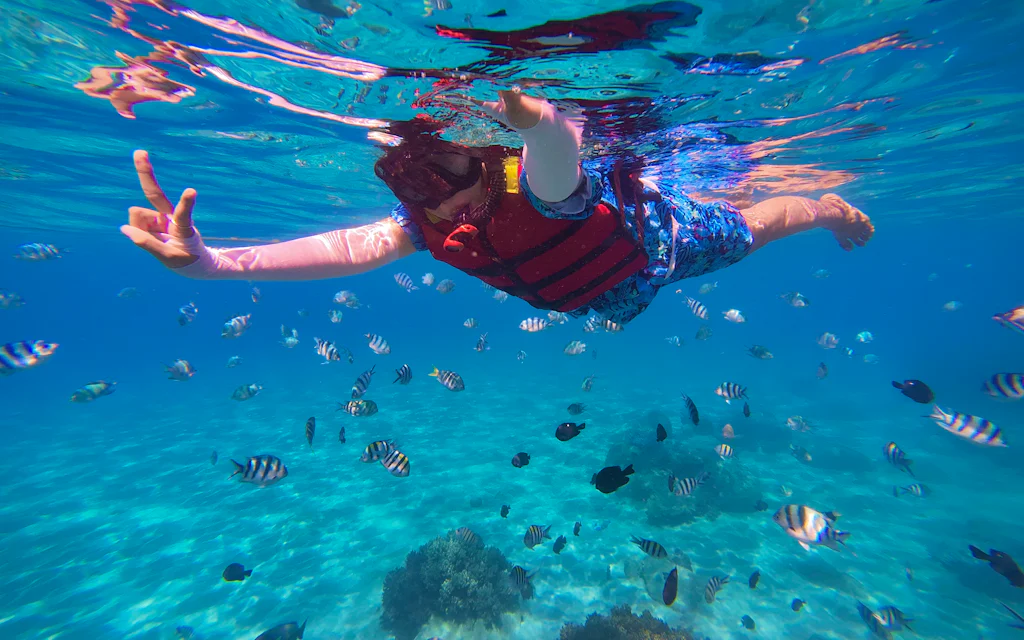
Good news, you do not need a research submarine. The humuhumu lives in shallow, sunny reef flats across all the Hawaiian islands, in calm ocean only a few fin kicks from shore, which is exactly where snorkelers hang out.
Where to meet the humuhumu
Hanauma BayOahu
A protected marine reserve in an old volcanic crater where the fish are abundant and used to people. As of 2026 it still needs an advance reservation and an entry fee, but it is the closest thing to a guaranteed sighting.
Molokini and WaileaMaui
Molokini Crater and the calm reefs off Wailea and Kaanapali are just as reliable for spotting one. The boats leave at dawn for the clearest water.
Kahalu'u Beach ParkBig Island
Just south of Kailua-Kona, this is the easy one, waist deep and ringed by lava rock and busy with humuhumu, which is why half the snorkel tours out of Kona work these waters.
Poipu Beach ParkKauai
The reliable pick on the south shore, with Tunnels (Makua) up on the north coast a calm summer only classic.
On Oahu, the single best bet is Hanauma Bay, a protected marine reserve in an old volcanic crater where the fish are abundant and used to people. As of 2026 it still needs an advance reservation and an entry fee, our Hanauma Bay guide walks through the booking dance, but it is the closest thing to a guaranteed humuhumu sighting. On Maui, Molokini Crater and the calm reefs off Wailea and Kaanapali are just as reliable for spotting one.
The other islands hold up their end too. Over on the Big Island's west coast, Kahalu'u Beach Park just south of Kailua-Kona is the easy one, waist deep, ringed by lava rock, and busy with humuhumu, which is why half the snorkel tours out of Kona work these waters. On Kauai, Poipu Beach Park on the south shore is the reliable pick, with Tunnels (Makua) up on the north coast a calm summer only classic. Every island keeps a front row seat for its state fish. Our best snorkeling in Hawaii guide ranks the reefs island by island.
Honestly, though, almost any calm, rocky reef will do. Many of the spots in our best beaches in Oahu guide hold triggerfish in the shallows, you just need clear water, a mask, and the patience to float and watch.
If you would rather not sort out gear and logistics, guided snorkeling tours take you to the good reefs with equipment included, which is the low effort way to tick the state fish off your list. It is also a fine call if you are a nervous swimmer and want a guide and a boat nearby.
★4.9(3,571)
Waikiki: Turtle Canyon Snorkel Adventure on Oahu
2 hours
Free cancellation
from
$85
Timing matters a little. Calm, clear summer mornings (roughly May through September) give you the best visibility on most Oahu reefs, it is why the Molokini boats on Maui leave at dawn. Our best time to visit Hawaii guide breaks down the seasons. Wind picks up by afternoon, the water clouds, and the fish get harder to see.
One honest aside, since this is what we do, plenty of our beach picnics on Oahu end with guests wandering into the shallows to snorkel before sunset, and the humuhumu is a regular guest star. We set the table. The fish provides the entertainment. If you want to see how a picnic day works, you can take a look here.
06
Why it grunts like a pig
Yes, the pig thing is real, and it is the detail that makes everyone fall in love with this fish.
When a triggerfish is caught or feels genuinely threatened, it makes a grunting, snorting sound, produced by grinding its teeth and vibrating its swim bladder. To the old Hawaiian fishermen who heard it, the noise was unmistakably pig like, which is precisely how the "apua'a" (pig) part of the name got there. In Hawaiian tradition the humuhumu is even tied to Kamapua'a, the pig demigod whose stories run through these islands, so the pig connection runs deeper than the snout alone.
So the name is doubly earned. The fish has a snout that looks like a pig's, and it makes a noise like a pig when you bother it. The naming committee, such as it was, simply reported the facts.
It is a strange thing to consider while watching one calmly graze the reef, this serene little painted fish has, in its back pocket, the ability to snort at you like a barnyard animal if you push your luck. Do not push your luck. Just enjoy the look on its face.
This is also a tidy reminder that Hawaiian names tend to be observational and earned, not arbitrary. The language watched closely and named honestly, the snorting pig fish, the rain bringing blossom, the wedge that stitches itself into stone.
If you are very quiet and very lucky, you might catch a faint version of the grunt while snorkeling, though the fish mostly saves the full barnyard performance for moments of genuine outrage, a hook in the lip, a hand reaching into its crack in the coral.
Consider it a privilege you did not earn and a sound you will not forget, a serene, painted little reef fish, snorting at the universe like it has had enough of your nonsense. Which, to be fair, it has.
Other reef fish you will meet
Yellow tangYellow
The bright yellow crowd pleaser, in shoals over the coral.
ParrotfishSand maker
Munches coral and, yes, turns it into the white sand you stand on.
Moorish idolShowy
Tall white dorsal streamer, black and yellow bands.
WrassesCleaners
Busy little cleaners working the reef's cleaning stations.
07
Other reef fish you will meet
Spend ten minutes face down in an Oahu reef and the humuhumu introduces you to its neighbors, and there are plenty, Hawaii's reefs hold over 500 fish species, roughly a quarter of which live nowhere else on Earth. A quick field guide so you can name the headliners as they drift by,
- Yellow tang, a flat, electric yellow disc that looks like a swimming highlighter. Impossible to miss, impossible not to smile at.
- Moorish idol, the elegant black, white, and yellow one with a long trailing fin. If you have seen "Finding Nemo," this is Gill, and yes, it is real.
- Parrotfish, the big blue green one crunching audibly on coral. On a quiet day you can hear it from 20 feet away. That sound is it eating the reef and, eventually, producing sand. A good chunk of that white beach was once parrotfish lunch. You are welcome.
- Convict tang, silver with black vertical stripes, traveling in schools like a tiny chain gang.
- Saddle wrasse, slim, common, with a reddish band. One of the most abundant fish you will see.
- Raccoon butterflyfish, pale gold with a black bandit mask, usually drifting in pairs like a tiny couple inspecting real estate.
- Green sea turtle (honu), not a fish, but a frequent reef guest. Beloved, protected, and to be admired from a respectful distance, never touched.
The humuhumu is the celebrity, but the supporting cast is half the fun. Learn five of these names and an Oahu snorkel turns from "pretty fish" into a reef you can actually read.
It is genuinely worth the ten minutes it takes to memorize a handful before you get in the water. There is a real difference between floating over a blur of color and recognizing the cast, the highlighter, the bandit, the coral cruncher, and the grumpy little state fish holding court in the middle of it all.
08
How to spot one (without wrecking the reef)
How to spot the humuhumu
A few practical tips, because meeting the state fish humuhumunukunukuapua'a should not cost the reef anything.
First, the spotting,
- Float, do not chase. Triggerfish hold territory, so if you hover quietly one will often come to you. Thrashing toward it just sends it into a crack in the coral.
- Look near the reef floor and ledges, not the open water. The humuhumu works the bottom, poking around rock and coral.
- Go in the morning for the calmest, clearest water and the best light.
- Bring a cheap underwater case or camera. Nobody back home believes the fish has that name until they see the little pig snout face for themselves.
Float still for a few minutes when you first get in, before you decide a reef is quiet. The fish do not perform on arrival. They reappear once you stop thrashing and become, in their eyes, just another slow moving piece of the scenery.
Now the part that matters more,
- Use reef safe sunscreen. Oxybenzone and octinoxate bleach coral. Hawaii has restricted them for a reason. Mineral (zinc) sunscreen protects you without poisoning the reef.
- Never touch or stand on the coral. It is a living animal that grows about an inch a year. A single careless fin kick can undo a decade.
- Keep your distance from turtles and never feed the fish. Fed reefs get aggressive and unbalanced, and it is illegal with the protected species anyway.
The reef gives you the humuhumu, the turtles, the whole painted show for free. The only fair trade is leaving it exactly as you found it, so the next snorkeler, and the next grumpy little pig nosed fish, gets the same welcome.
FAQ: the Hawaii state fish
What is the Hawaii state fish?
The humuhumunukunukuapua'a, the reef (rectangular) triggerfish, Rhinecanthus rectangulus. It is a small, brightly patterned reef fish known for wedging itself into coral and making a pig like grunting sound.
How do you pronounce humuhumunukunukuapua'a?
HOO-moo-HOO-moo-NOO-koo-NOO-koo-AH-poo-AH-ah. Every vowel is pronounced (a = "ah," e = "eh," i = "ee," o = "oh," u = "oo"), and the okina before the final "a" is a short glottal stop, like the catch in "uh oh."
What does humuhumunukunukuapua'a mean?
"Triggerfish with a snout like a pig." Humuhumu means triggerfish, nukunuku means snout or nose, and apua'a refers to a pig, a nod to both its piggy looking face and the grunting noise it makes.
Is the Hawaii state fish humuhumunukunukuapua'a permanent now?
Yes, permanently since 2006. It was first designated in 1985 but only for a five year trial, which lapsed in 1990, leaving Hawaii with no official fish until the legislature made the humuhumu permanent in 2006.
Where can you see the Hawaii state fish?
Shallow reefs on every island. On Oahu, Hanauma Bay is the most reliable spot. Kahalu'u in Kona and Poipu on Kauai do the same job on their islands. Snorkel on a clear summer morning for the best chance, or join a guided snorkeling tour.
Why does the Hawaii state fish grunt like a pig?
Teeth grinding plus a vibrating swim bladder. When threatened or caught, the reef triggerfish produces a grunting, pig like sound. That noise is part of how it earned the "pig" (apua'a) portion of its Hawaiian name.
Can you eat the humuhumunukunukuapua'a?
Legal, but nobody bothers. It is not a protected species, yet it has never been prized eating, older Hawaiian accounts describe dried humuhumu being burned as cooking fuel more often than served as dinner. Its modern job is posing for snorkelers, and the islands seem content to keep it that way.
What song mentions the humuhumunukunukuapua'a?
Two famous ones. The 1933 hapa haole classic "My Little Grass Shack in Kealakekua, Hawaii," where the humuhumu "go swimming by," and, for a different generation entirely, the song literally titled "Humuhumunukunukuapua'a" from High School Musical 2.
Disclosure: Some links on this page are affiliate links. If you book or buy through them we may earn a small commission, at no extra cost to you. As an Amazon Associate, we earn from qualifying purchases.


