Black Sand Beach Big Island: 7 Best to Visit (2026 Guide)
28 min readYndira W. Tonin
The best black sand beach on the Big Island is Punaluu (Punaluʻu), on the southern Kau (Kaʻū) coast, it is the famous one, the easy one, the one with sea turtles sunbathing on jet black sand like they pay rent there. But it is not the only one, and depending on what you want out of a beach day, it might not even be your favorite. The Big Island has more black sand beaches than the rest of Hawaii combined, ranging from a roadside postcard you can walk to in ninety seconds to a valley beach that demands a thigh burning hike and a serious talk with the ocean.
The guide was reviewed and updated for 2026.
This is the honest field guide to all of them. Which ones are worth the drive, which ones you should only look at, where the turtles actually hang out, and why you should absolutely, under no circumstances, put a souvenir handful of that gorgeous sand in your suitcase.
Quick orientation, because the Big Island is enormous and the beaches are scattered around its edges like buttons that fell off a coat, most of the black sand is on the wetter, younger east and south sides, Kau, Puna, and the Hilo coast. That is where the lava is freshest. We will go beach by beach, then sort out how to actually pull this off without spending your whole vacation in a rental car (though, fair warning, you will spend a good chunk of it in a rental car).
Getting to the Black Sand Beach
Tap to open Google Maps with turn-by-turn directions.
Table of contents
- Why the Big Island has black sand and the other islands mostly do not
- Punaluu, the famous one, and the one to start with
- The honu rules, how to share a beach with a sea turtle
- Do not take the sand home, Pele's curse and the science
- Pohoiki, the newest black sand beach on Earth
- Kehena, the locals' beach with the Sunday drum circle
- Kaimu, the beach that lava ate, and is slowly rebuilding
- Pololu and Waipio, the valley black sand beaches
- Near Hilo, Richardson and Honolii
- The bonus round, Papakolea, the green sand beach
- How to actually do this, Kona vs. Hilo, the drive, what to bring
- Big Island black sand beach FAQ
01
Why the Big Island has black sand and the other islands mostly do not
Black sand is not a fancier version of regular sand. It is a completely different substance with a completely different life story, and the Big Island is the only Hawaiian island actively cranking it out at scale.
Most beach sand, the soft tan stuff on Waikiki or Kaanapali (Kaʻanapali), is ground up coral and shell, manufactured slowly over thousands of years by parrotfish, waves, and time. Black sand skips all of that. It is basalt, molten lava that hit cold seawater, flash cooled, and shattered into millions of tiny glassy fragments in a single violent afternoon. No parrotfish required. Just a volcano with a deadline.
That is why the Big Island wins this category by a landslide. It is the youngest island in the chain, it has two active volcanoes, and Kilauea (Kīlauea) has spent decades pouring fresh lava into the sea. Every time that happened, a new batch of black sand got made. The older islands, Oahu, Kauai, Maui, stopped erupting long enough ago that their black sand has mostly washed away or never formed in volume. Maui has a famous one at Waianapanapa (Waiʻānapanapa) on the Road to Hana, and that is about it for the neighbors. The Big Island has so many it can afford to lose a few and not throw a parade.
There is a second flavor worth knowing about, because it confuses people. Some black sand forms the slow way too, basalt cliffs and boulders eroding into dark grains over centuries, rather than the dramatic lava meets ocean explosion. Both end up jet black. One just took its time. The instant kind is what makes beaches appear overnight, and it is the reason this island's coastline has a habit of rearranging itself between guidebook editions.
Here is the catch that matters for your visit, because black sand is born in one event and not constantly replenished, each beach is essentially a fixed, finite amount of sand. A coral beach regenerates. A black sand beach does not. Take a cupful home and, multiplied by a few hundred thousand tourists a year, the beach literally disappears. We will come back to that, because it is the single most important rule on this entire page and it comes with a folklore enforcement department.
One more practical note before we start the tour, black sand is darker, which means it absorbs heat like a cast iron pan left on a porch in July. On a sunny afternoon it can get hot enough to make a barefoot walk a genuinely regrettable decision. Sandals are not optional. Neither, frankly, is a sense of humor about the noise you will make hopping back to your towel.
Which Big Island black sand beach is yours?
PunaluuOur pick
- Best for
- First-timers, basking turtles, easy roadside access
- The catch
- Often too cold and rippy to swim — a look-don't-swim beach
Richardson's (Hilo)
- Best for
- Actually getting in the water — calm, snorkel-friendly, lifeguarded
- The catch
- Small and popular; less dramatic scenery
Pohoiki / Kehena (Puna)
- Best for
- Novelty and local color — the newest beach, the drum-circle one
- The catch
- Rough water, changeable access, rocky scrambles down
Pololu / Waipio
- Best for
- Jaw-dropping cliff-backed valley scenery and a real hike
- The catch
- Steep trails, dangerous surf, restricted access at Waipio

Photo by Aaron Lee on Unsplash
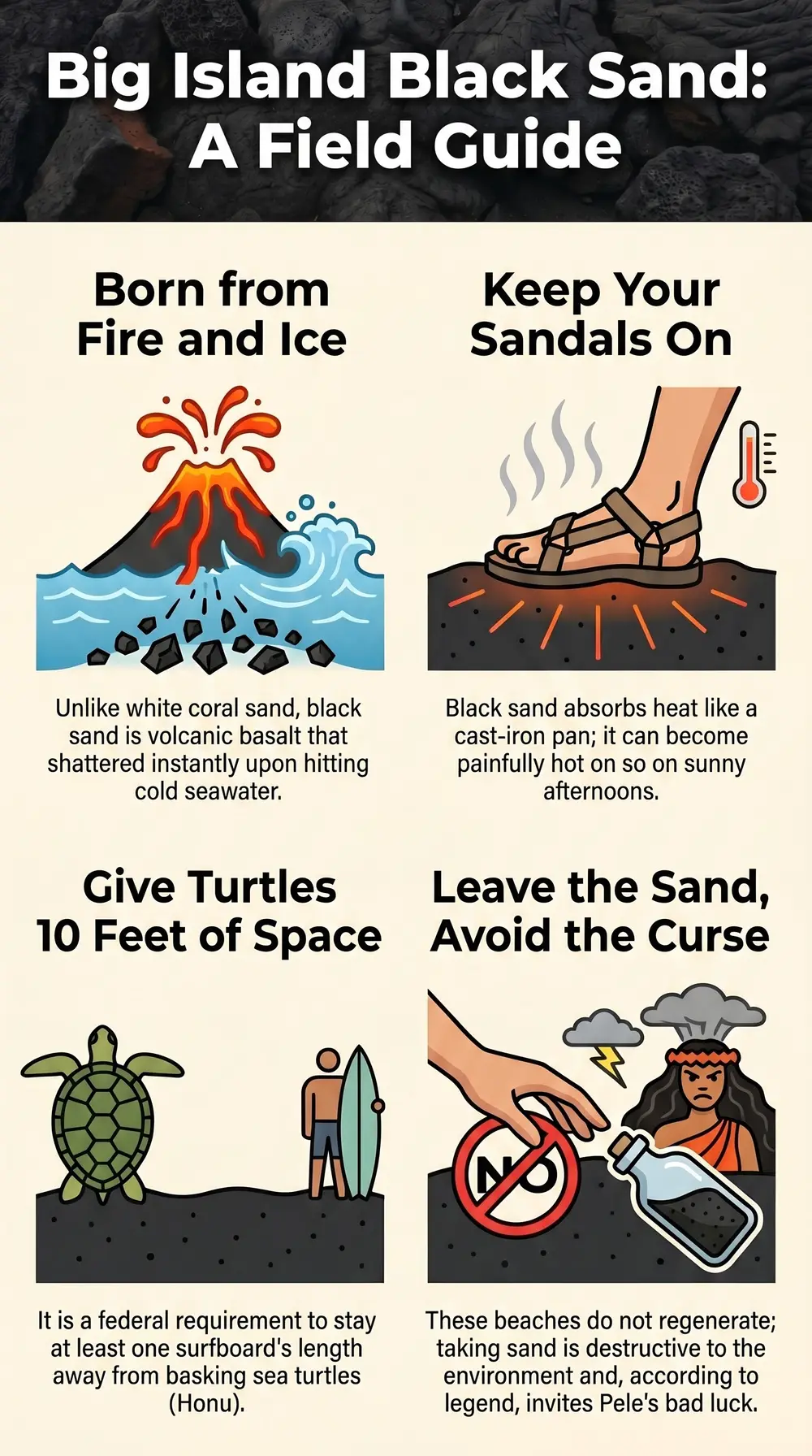
Big Island black sand, decoded, how it forms, why it burns, and the rules that matter.
02
Punaluu: the famous one, and the one to start with
If you only have time for one black sand beach on the Big Island, make it Punaluu. It is the beach on every postcard, every "Big Island bucket list" pin, and every parent's phone after they finally got the kid to look at the camera and not the turtle.
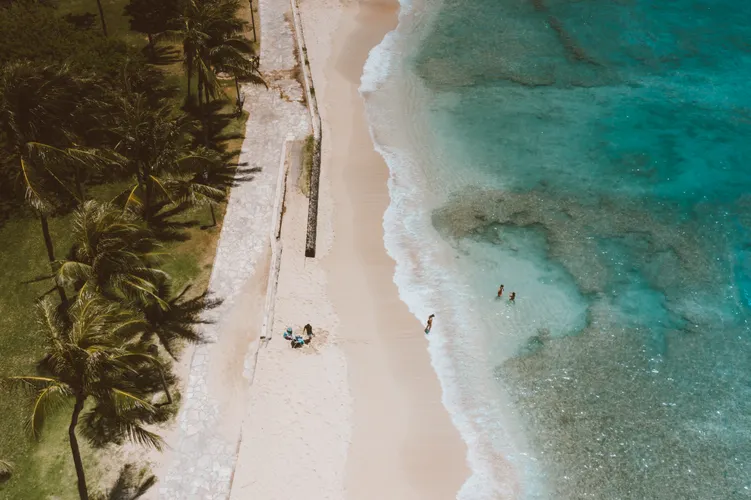
You will find it on the Kau coast, on the south end of the island, right off Highway 11 between mile markers 55 and 56, roughly halfway between the Volcanoes National Park area and the town of Naalehu (Naʻalehu). There is a paved parking lot, real restrooms, picnic pavilions, and shade from coconut palms, the Punaluu Beach overview lists it among Kau's signature stops. By Big Island black sand standards, this is the Four Seasons of accessibility, you park, you walk maybe ninety seconds, and there it is, a crescent of jet black sand backed by green so bright it looks color graded.
The headliners here are the honu, Hawaiian green sea turtles, and the occasional hawksbill. They haul out onto the warm black sand to bask, sometimes several at a time, lined up like they are waiting for a bus. It is genuinely one of the most reliable places in Hawaii to see a wild sea turtle do absolutely nothing at extremely close range. (More on the etiquette in a second, because there are rules and they are not suggestions.)
Now the honest part. Punaluu is gorgeous to look at and frequently terrible to swim in. The water is often cold (freshwater springs feed in from below), there are rocks, and there is a real rip current that has caught people off guard. On a calm day, locals and confident swimmers get in near the boat ramp. On a day with any surf, the smart move is to keep your feet on the sand, take the photo, and admire the ocean from a respectful distance, the same distance you would keep from a large dog you have not been formally introduced to.
If you would rather not white knuckle the south coast drive yourself, or you want a guide who knows which mile marker the good photo is at, a small group day tour that bundles Punaluu with the volcano is the painless way to do it.
That same loop usually folds in Hawaii Volcanoes National Park, which is right up the road and absolutely worth pairing with your beach day, our full guide to the park covers what to see once you are there. If you are piecing together a longer itinerary, our guide to things to do on the Big Island maps out how the south and east circuit fits together.
03
The honu rules: how to share a beach with a sea turtle
Let us talk about the turtles, because this is where well meaning tourists get themselves into trouble, and occasionally into a conversation with a very unimpressed enforcement officer.
Hawaiian green sea turtles are protected under both federal and state law, NOAA Fisheries lists them as a threatened species. The widely posted guidance is to stay at least 10 feet away, about the length of a surfboard, and to never touch, feed, chase, or "just gently" reposition a turtle for a better shot. They are wild animals having a nap, not a petting zoo exhibit, and the law treats harassment seriously, with fines that will ruin your month far more thoroughly than missing the photo would.
Here is the thing nobody tells you, the turtles do not care about your ten feet. They will haul out wherever they please, occasionally directly between you and the only path back to your towel, creating what I can only describe as a honu traffic jam. The rule still applies. You go around. You give the animal the right of way. You are a guest in its living room and it has been doing this for thirty million years longer than you have.
A few field notes that keep everyone out of trouble,
- Give them a wide arc, not a tight squeeze. If getting your shot means crowding the turtle, your shot is too close. Zoom with your feet planted, or zoom with your phone.
- No flash, no drone hovering, no "herding" for a group photo. Sudden movement and noise stress basking turtles.
- Watch the kids and watch the water. Turtles in the shallows are feeding, not performing. Let them be.
- If a turtle is roped off or has a volunteer nearby, that is a sign it is resting in a marked zone, keep extra distance.
Do this right and you get the best version of the experience anyway, a wild turtle, completely relaxed, three steps closer than you ever expected, doing the thing it came to do. That is the souvenir. The other kind of souvenir is next, and it is a trap.
04
Do not take the sand home: Pele's curse and the science
I will say this plainly because it matters more than anything else on this page, do not take the black sand. Not a handful, not a film canister, not a "just a little for the memory jar." Leave it.
There are two reasons, and they stack neatly. The first is the boring but real one from earlier, black sand is finite. It was made in a volcanic event and is not being replenished by reef fish the way coral sand is. Multiply one tourist's harmless cup by the crowds that visit, and you are watching a beach get carried off in carry on luggage, grain by grain. Several of these beaches are noticeably smaller than they were a few decades ago.
The second reason is folklore with a remarkable enforcement record, Pele's curse. The legend says that anyone who takes lava rock or black sand from the islands will suffer bad luck until they send it back. Skeptical? So is everyone, right up until the parking ticket, the lost luggage, the inexplicable head cold on day three. The national park and post offices across Hawaii receive a steady stream of mailed back rocks and sand every year, often with apologetic letters describing a run of misfortune that the sender would very much like to end.
Now, the killjoy footnote, archaeologists generally trace the "curse" to a twentieth century park ranger story rather than ancient Hawaiian belief, possibly invented to stop visitors from looting the place. But honestly? Whether you fear the goddess of volcanoes or simply respect that taking sand is both illegal in places and genuinely destructive, the outcome is the same. The sand stays. You take photos. Everybody wins, especially the beach.
Think of it this way, the black sand is the one souvenir that is worth infinitely more left exactly where it is. Buy a magnet.

05
Pohoiki: the newest black sand beach on Earth
Here is a sentence you cannot say about almost any beach anywhere, this one is younger than your car. Pohoiki, officially Isaac Hale Beach Park, in the Puna district, got its black sand beach in the summer of 2018, when the Kilauea lower Puna eruption reshaped the entire coastline. Lava poured into the ocean, shattered into fresh black sand, and the currents stacked it up against the boat ramp at Pohoiki. A beach appeared, more or less overnight, where there had not been one.
That alone makes it worth the detour. You are looking at brand new land. The black sand here is coarse and dramatic, the setting is wild and a little raw, and the whole place has the feel of a coastline still deciding what it wants to be.
The eruption also created or supercharged a series of warm geothermal ponds nearby, pockets of water heated from below by the same volcanic plumbing, which, when conditions and access allow, are a genuinely surreal soak. Imagine a tide pool that someone left the kettle on under, and you are close. Conditions at Pohoiki change, access roads and amenities have been rebuilt in stages since 2018, and the ocean itself is often rough, so this is a check locally first kind of stop rather than a guaranteed swim.
Pohoiki was a working boat ramp and a beloved local surf spot long before 2018, and the eruption nearly took it for good, lava came within a few hundred feet and choked the bay with new sand. The ramp has since been dredged back into use, and the surf break still draws east side locals on the right swell. It is a place that very nearly disappeared and is stubbornly, slowly coming back, which is the recurring theme of this entire coastline.
But for the sheer novelty of standing on a beach that did not exist during the last World Cup, Pohoiki is hard to beat. It is the closest thing Hawaii has to watching the island grow in real time. The Big Island is the only place you get to say that and mean it geologically, not just emotionally, everywhere else in the world, "this beach is brand new" is a real estate exaggeration. Here it is a measurement.
06
Kehena: the locals' beach with the Sunday drum circle
Kehena is the one your guidebook mentions nervously and your most interesting friend swears by. It is a small black sand beach down a short, steep, genuinely rocky scramble off Highway 137 in Puna, and it has a personality the size of a mid sized planet.
Two things define Kehena. First, the vibe, it is clothing optional, unofficially and enthusiastically, and on Sundays it hosts a long running drum circle where a wonderfully eclectic crowd shows up to bang on things, dance, and generally remind you that the 1970s never fully ended in lower Puna. If that sounds delightful, you will love it. If it sounds like a lot, consider yourself warned and pack accordingly (or do not pack, as the local custom goes).
Second, and far more importantly, the water at Kehena is no joke. There is a strong current and a steep drop-off, and the surf can come up fast. People have gotten into serious trouble here. Dolphins are sometimes seen offshore, which is magical and also not an invitation to swim out after them. Treat Kehena as a place to sit on warm black sand, soak up an unrepeatable scene, and stay out of the water unless you genuinely know what you are doing and the ocean is genuinely cooperating.
The path down is short but unforgiving on flip flops, closed toe shoes earn their keep here. The trail was damaged by a 1975 earthquake that dropped the beach several feet, which tells you something about how geologically restless this stretch of coast is, even the footpath has a seismic backstory. Take it slow on the way down and slower on the way up, especially if you have spent the afternoon, as one does, becoming one with the drum circle.
So does showing up with the right expectations. Kehena is not a resort beach and has zero interest in becoming one. There are no facilities, no lifeguard, and no one coming to rescue your cooler if the tide decides it wants it. Park legally up on the road, carry everything in and out, and read the room, this is a community's beach that happens to welcome respectful visitors, not an attraction built for them. That distinction is the entire point of it, and the reason it is still worth going.
07
Kaimu: the beach that lava ate, and is slowly rebuilding
Kaimu (Kaimū) might be the most quietly moving stop on this whole list, because it is a story about loss and slow regrowth that you can walk across with your own feet.
The original Kaimu black sand beach, near Kalapana in Puna, was for generations one of the most famous and beautiful beaches in all of Hawaii, palm fringed, jet black, postcard perfect. Then, in 1990, a Kilauea lava flow buried the entire village of Kalapana and the beach with it under many feet of hardened lava. The old Kaimu is simply gone, entombed somewhere beneath the black rock you will park on.
But the island, being the island, started over. A new black sand beach has been forming at the edge of that 1990 flow, and to reach it you walk a short path across the lava field, a strange, lunar, surprisingly beautiful stroll over the very rock that did the burying. Along the way you will pass coconut palms that locals and visitors have planted in the cracks, a slow community project to bring the green back. You are encouraged to bring a sprouted coconut and plant one yourself.
Swimming is generally a hard no here, the new beach is raw and the water is rough, so this is a place you come for the walk, the perspective, and the genuine sense of geological time happening on a human scale. It is the rare beach that doubles as a meditation on impermanence. Also, you get to step over an entire buried town, which is the kind of thing that recalibrates a person's relationship with a parking complaint.
A practical note, the lava field walk is short, maybe ten minutes each way, but it is exposed black rock with no shade, and on a clear afternoon it radiates heat like a stovetop. Go in the morning or late day, wear real shoes, and bring water. The planted coconut palms make handy mile markers and even handier shade once they have grown, which is exactly the long game the people tending them are playing, replanting a beach one sprouted coconut at a time, for a version of Kalapana that none of them will get to lounge on. That is the kind of patience a place like this teaches whether you wanted the lesson or not.

Photo by Corey Simoneau on Unsplash
08
Pololu and Waipio: the valley black sand beaches
The two valley beaches are the dramatic, earn it ones, the beaches you hike down to, the ones that show up in the wide angle drone shots with cliffs plunging into the sea. They are spectacular. They are also the two where people most often get hurt, so this section comes with extra fine print.
Pololu (Pololū) Valley sits at the very north tip of the island, at the end of the road through North Kohala (Highway 270). You park at the lookout, which is a jaw dropper on its own, then hike a steep, often muddy trail down to the black sand beach at the bottom. It is not a long hike, but it is a real one, and the climb back up will remind you of every leg day you skipped. The reward is a wild, cliff backed black sand beach with a grove of ironwood trees and almost no amenities. Bring water. Bring shoes with grip. (Our full Pololu Valley guide covers the lookout, the hike, parking, and whether to bother with the climb down.)
Waipio (Waipiʻo) Valley is the deeper, more sacred, more complicated one. The Valley of the Kings, on the Hamakua coast, has one of the most photographed lookouts in Hawaii and a black sand beach far below. The catch, access to the valley floor has been restricted, and the rules have changed repeatedly in recent years, at various points limited to residents and permitted tour operators, with private vehicles and many hikers turned away. Before you plan anything beyond the lookout, check the current access status, because it genuinely changes.
At both valleys, the same warning applies and it is not boilerplate, the surf is powerful, the currents are strong, there are no lifeguards, and the water has taken visitors who underestimated it. The view is the point. The swim is a gamble you do not need to take. If you are building a wider beach itinerary, our roundup of the best beaches in Hawaii covers the gentler, swimmable picks across the islands for the days you just want to float.
09
Near Hilo: Richardson and Honolii
Not every black sand beach requires a pilgrimage. On the east side, just outside Hilo, two of them are practically suburban, and that accessibility makes them some of the best for actually getting in the water.
Richardson Ocean Park (locals call it Richardson's) is the rare black sand beach that is also a solid snorkeling spot. It is small, it is protected by an offshore rock barrier that calms the water, and turtles cruise through to feed on the algae along the rocks. There are facilities and lifeguards on duty, which on this island makes it feel positively civilized. For families and first time snorkelers, Richardson's is arguably the most forgiving black sand beach on the Big Island.
Honolii (Honoliʻi) Beach Park is the surfers' one. Just north of Hilo, it is the most popular surf spot on the east side, with a black sand and rock beach at the mouth of a stream. It is a fantastic place to watch local surfers do their thing, and there is a lifeguard and easy access. Swimming is better left to strong swimmers when the surf is up, but as a place to sit, watch, and soak in real east side Hilo life, it is a gem that most visitors blow right past on their way to somewhere more famous. The stream mouth also means the water here is often brackish and a little cooler than you would expect, so it is more of a watch the waves with a plate lunch beach than a swim laps one.
If you want a third easy option nearby, Carlsmith Beach Park (Four Mile) is not pure black sand, but it sits on the same Hilo coast, has calm protected pools, lifeguards, and reliably good turtle sightings, a fine pairing with Richardson's for a low effort, high reward east side morning. The point of the Hilo cluster is that you can string together two or three of these before lunch without ever driving more than fifteen minutes, which on this island counts as a miracle of efficiency.
The Hilo side rewards exactly this kind of low key beach day. It rains more here, the towns are old and unpolished, and the beaches feel like they belong to the people who live there, because they do. Show up, be respectful, and you get a window into the Big Island that the Kona resort strip never shows you.
10
The bonus round: Papakolea, the green sand beach
Black sand is the headliner, but the Big Island has a closing act so absurd it sounds made up, a green sand beach. There are only a handful on the entire planet, and one of them is here, at Papakolea (Papakōlea) near South Point, the southernmost tip of the United States, a fact worth a moment of patriotic vertigo. For the island's other worldly flip side, Mauna Kea stargazing from near the summit is the bucket list clear night outing.
The green comes from olivine, a heavy volcanic mineral that erodes out of an old cinder cone called Puu (Puʻu) Mahana and collects in the bay while the lighter, lesser minerals wash away. Olivine is dense, so the waves do the sorting for free, hauling off the light stuff and leaving the green behind, like a bouncer who only lets one color in. The result is a beach the color of a faded army jacket, cupped inside a half collapsed crater, with bright blue water in front and rolling golden grassland behind. It is one of the strangest, most beautiful places in Hawaii, and it photographs like a special effect.
A word on swimming, since people ask, it is usually a no. The bay sits in a pocket that funnels surf and current, the entry is rocky, and there are no lifeguards within several miles. Most people climb down, stand in the green sand long enough to confirm it is real, take the photo, and climb back out. That is a completely legitimate way to "do" Papakolea.
It is also a commitment. From the parking area at the end of the road past South Point, the beach is roughly 2.5 miles each way over open, windy, shadeless terrain, a 5-mile round trip hike with zero facilities and no water once you start. The wind out here is relentless and the sun is brutal.
Now, the part where I tell you something you did not ask to hear, you will be offered a ride. Locals run unofficial truck "shuttles" bouncing visitors across the rutted trail for cash. They are not permitted, the route tears up protected land, and the trucks are exactly as safety regulated as you would expect a cash only desert taxi to be. My honest opinion, and the one strong opinion I will spend on this entire post, skip the shuttle. Either hike it under your own power, with real water and sun protection, or look at the photos and feel completely fine about your choice. A green sand beach is a wonderful thing. It is not worth a sketchy ride or a heatstroke.

Photo by Corey Simoneau on Unsplash
11
How to actually do this: Kona vs. Hilo, the drive, what to bring
Here is the logistical truth that the dreamy drone footage leaves out, the Big Island is huge, bigger than all the other Hawaiian islands combined, and the black sand beaches are spread along its southern and eastern edges, far from the Kona resorts where most visitors stay. Seeing them is as much a road trip plan as a beach plan.
The single biggest decision is where you base yourself. Kona, on the dry west side, has the resorts, the sunshine, and most of the rental fleet, but it is a 2-to-3-hour drive to the black sand country. Hilo, on the wet east side, is older, rainier, and far less polished, but it puts you within easy reach of Richardson's, Honolii, Pohoiki, Kehena, Kaimu, and an easy run to Punaluu and the volcano.
If black sand is your priority, a couple of nights based on the Hilo side changes the whole trip from a series of marathon drives into a string of easy mornings (compare Big Island hotels on Expedia (also on Booking.com) for Hilo and Kona options). (The Big Island lodging picture is a real "it depends," so weigh the Kona vs Hilo split against what else you want to see. For the bigger picture, our where to go primer on the best island to visit in Hawaii frames the trade offs.)
You will need a rental car. There is no version of this trip on a bus, and rideshare evaporates the moment you leave Kona or Hilo. Budget for the gas, too, those distances are real.
What to actually throw in the bag, learned the hard way,
- Reef safe sunscreen. It is the law in Hawaii, and the south coast sun is no joke. Reef safe mineral sunscreen is worth packing before you fly.
- Water shoes or sturdy sandals. Black sand gets scorching, the valley trails are rocky, and fresh lava rock beaches are sharp. A pair of water shoes saves both your feet and your dignity.
- A dry bag. For the surf spray beaches and the valley hikes, a dry bag keeps your phone and keys from a salty death.
- Way more water than feels reasonable, especially for Papakolea and the valleys. There is nowhere to buy it once you are out there.
One honest aside, since you will notice we know our way around a beach setup, we run beach picnics on Oahu, not the Big Island, so we cannot style a turtle side spread for you at Punaluu. If your trip also touches Oahu, our Sunset Picnic for Two starts at $349 and handles the table, the food, and the teardown so you do not have to. On the Big Island, your move is simpler, a cooler, a beach mat, and the good sense to keep both off the turtles.
12
Big Island black sand beach FAQ
Which is the best black sand beach on the Big Island?
Punaluu, for most people. It is the easiest to reach, it has a real parking lot and restrooms, and it is the most reliable spot to see basking green sea turtles. If you want to actually swim, Richardson's near Hilo is calmer and friendlier. If you want raw novelty, Pohoiki is the newest. "Best" depends on whether you are chasing turtles, swimming, or scenery.
Can you swim at Punaluu Black Sand Beach?
Sometimes, carefully. The water is often cold from freshwater springs, there are rocks, and there is a real rip current. On calm days, confident swimmers get in near the boat ramp. On any day with surf, treat it as a look do not swim beach. There are no guarantees and conditions change quickly, so read the ocean before you commit.
Why cannot you take black sand home from Hawaii?
Two reasons. Practically, black sand is finite, it is made in volcanic events and is not replenished like coral sand, so removing it shrinks the beach permanently. Culturally, legend holds that taking lava rock or sand brings bad luck (Pele's curse) until it is returned. Removing sand is also prohibited in places. Leave it where it is and take photos instead.
Are there sea turtles at the black sand beaches?
Yes, especially at Punaluu and Richardson Ocean Park, where green sea turtles (honu) bask on the sand and feed in the shallows. They are protected by law, stay at least 10 feet away, never touch or feed them, and give them room to move. Sightings are common but never guaranteed. They are wild animals on their own schedule.
How many black sand beaches are on the Big Island?
There are roughly a dozen worth knowing, ranging from easy roadside stops to hike in valley beaches. The main ones are Punaluu, Pohoiki (Isaac Hale), Kehena, Kaimu, Pololu, Waipio, Richardson Ocean Park, and Honolii. New ones can form whenever fresh lava reaches the sea, which is part of what makes the Big Island unique.
Do I need a car to see the black sand beaches?
Yes. The black sand beaches are spread across the south and east coasts, far from the Kona resort strip, with no practical public transport between them. A rental car is essential. If you would rather not drive the south coast route yourself, a guided day tour that pairs Punaluu with Hawaii Volcanoes National Park is the easiest hands off option.
Is the green sand beach worth it?
If you are up for a 5-mile round trip hike across hot, windy, shadeless terrain with no facilities, yes, Papakolea is one of only a handful of green sand beaches on Earth and genuinely surreal. If that hike does not appeal, it is fine to skip it. Avoid the unofficial cash "shuttle" trucks. They are unpermitted and damage protected land. Bring serious water and sun protection either way.
Disclosure: Some links on this page are affiliate links. If you book or buy through them we may earn a small commission, at no extra cost to you. As an Amazon Associate, we earn from qualifying purchases.