Mauna Kea Stargazing: Summit Tours and DIY Guide for 2026
17 min readYndira W. Tonin
Mauna Kea, the Big Island's tallest volcano at 13,800 feet, is one of the best places on the planet to look at the stars. The air at the summit is thin, dry, and far above the clouds and city lights, which is exactly why the world's leading observatories are perched up there, and why a clear night on Mauna Kea delivers a star field most people never see in their lives.
This guide is current as of 2026.
But visiting takes some planning, and there is one crucial thing most first timers get wrong, you cannot stargaze at the summit at night. The summit is open for sunset, then closes after dark, so the actual night sky viewing happens lower down at the visitor station or on a guided tour. Get that distinction right and the rest falls into place.
This guide covers how to do Mauna Kea properly, sunset at the summit, where to stargaze at night, the 4WD and altitude rules that genuinely matter, whether to take a tour or drive yourself, and what to wear up a mountain that can be near freezing while the beaches below are balmy.
Table of contents
01
Why Mauna Kea is a stargazing wonder
Mauna Kea is not just a good place to stargaze, it is one of the very best on Earth, and the reasons are baked into its geography.
At 13,800 feet, the summit sits above roughly 40% of the atmosphere and almost all of the water vapor that blurs and dims the night sky. The air is exceptionally dry, dark, and stable, the Big Island's isolation means almost no light pollution, and the weather is clear a remarkable share of the year. That rare combination is why a dozen nations have built major research observatories at the top, it is among the most important astronomy sites on the planet.
How should you do Mauna Kea?
Guided tourOur pick
- Best for
- The easy, safe choice — they handle the 4WD drive, parkas, dinner, acclimatization, and telescopes, with summit sunset plus stargazing after
- The catch
- Pricey (~$250+) and on a fixed schedule
DIY summit at sunset
- Best for
- Driving yourself to the 13,800-ft summit for an unforgettable sunset above the clouds and observatories
- The catch
- Requires a real 4WD/AWD; the summit closes 30 min after sunset
Stargazing at the Visitor Station
- Best for
- Night-sky viewing at 9,200 ft — no 4WD needed, far easier on the body, and where public stargazing actually happens
- The catch
- Lower (still dark) than the summit; check current program status
From the saddle / below
- Best for
- A 2WD-friendly option — the dark Saddle Road area still delivers a jaw-dropping star field on a clear night
- The catch
- No telescopes or guides; just you, a blanket, and the sky
For visitors, that translates into a night sky of staggering depth, the Milky Way as a bright, textured band, thousands of stars, planets, and shooting stars, all with a clarity that genuinely stops people in their tracks. Whether you catch sunset above the clouds at the summit or lie back under the stars lower down, Mauna Kea is one of the most awe inspiring experiences on the Big Island, and it pairs naturally with the rest of things to do on the Big Island.
There is a nice symmetry to the Big Island, too, it is home to both the most active volcano (Kilauea) and the best stargazing on Earth, fire and sky on one island. And a quirky bragging right, measured from its base on the ocean floor, Mauna Kea is the tallest mountain on the planet, taller than Everest, with more than half its height hidden underwater. Standing at the summit at sunset, above the clouds with telescopes the size of buildings around you, you genuinely feel like you have left Hawaii for somewhere closer to space.

Photo by Patrick Hendry on Unsplash
02
Sunset at the summit
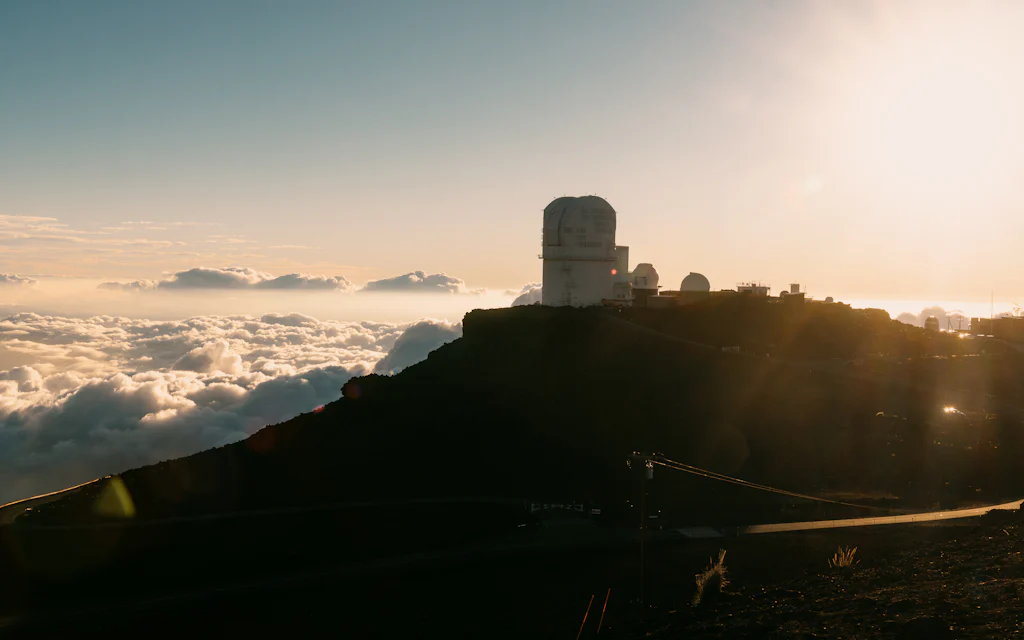
Watching the sun set from the summit of Mauna Kea, above a sea of clouds with the observatory domes glowing gold, is unforgettable, but it comes with firm rules.
The big one, you need a real four wheel drive (or AWD) vehicle to go above the Visitor Information Station (VIS) at 9,200 feet. The summit road climbs another ~8 miles and nearly 5,000 feet, with steep, unpaved, single lane sections. 2WD vehicles are not permitted past the VIS, and most rental car contracts forbid driving up regardless. The summit is open to visitors only from about 30 minutes before sunrise to 30 minutes after sunset, so it is a sunset (or sunrise) destination, not a place you can linger after dark.
The plan, arrive at the VIS 1.5 to 2 hours before sunset to acclimatize, then make the drive up so you are in place as the sun drops. Bundle up (it is genuinely cold), watch the sunset and the alpenglow on the domes, and then head back down before the road closes for the night. It is the most spectacular part of a Mauna Kea visit you can do during daylight.
The sunset itself is the show, from 13,800 feet you are looking down on a flat ocean of cloud, the sky stacking from gold to orange to deep blue, and as the sun drops you can often see the curved shadow of the mountain thrown onto the clouds to the east, with the silver observatory domes catching the last light. It is cinematic in a way photos undersell. Then, as the color fades and the first stars appear, it is time to descend, which feels abrupt, but the night sky half of the experience is waiting for you lower down.
03
Where to stargaze at night
Here is the distinction that trips people up, since the summit closes after dark, night stargazing does not happen at the top. It happens lower down, and that is still spectacular.
The main spot is around the Visitor Information Station at 9,200 feet, which is open in the evening and sits well above the clouds and light pollution. Historically the VIS ran free nightly stargazing programs with telescopes. Those programs have changed over the years and can be paused or reservation only, so check the official status before counting on one. Even without a program, the sky from the VIS area (and the dark stretches of Saddle Road below it) is jaw dropping on a clear, moonless night.
The catch is that to stargaze at night you are either at the VIS level on your own, or you book a guided tour that takes you up for sunset at the summit and then back down to a dark spot for telescope stargazing, the best of both worlds, since the tour legally cannot (and will not) keep you at the summit after dark either. However you do it, the night sky here is the payoff. The summit is for the sunset.
A budget friendly note for DIYers without a 4WD, the Saddle Road area and the VIS parking lot are genuinely dark, high, and above most of the haze, so even a regular car parked at a safe pullout on a clear, moonless night gives you a star field that will ruin ordinary skies for you forever. Bring a blanket, let your eyes adjust for 20 minutes (no phone screens), and look up. You will miss the summit sunset and the big telescopes, but the free version of Mauna Kea stargazing is still one of the best night skies most people will ever stand under.

Photo by Sultonbek Ikromov on Unsplash
04
Tour vs driving yourself
Here is the one strong opinion in this guide, for most visitors, a guided tour is genuinely the smart way to do Mauna Kea, not just the easy way.
A tour solves the three real obstacles at once, the 4WD requirement (you do not need to rent and drive a 4WD up an unpaved mountain road in the dark), the altitude (guides manage acclimatization and carry oxygen), and the gear (they provide heavy parkas, hot drinks, dinner, and telescopes with an expert to run them). They handle the summit sunset and the after dark stargazing as one well run evening. It runs around $250+ per person, but for a once in a lifetime night sky, it is money well spent.
Drive yourself only if you have a genuine 4WD/AWD (and permission to take it up), you are confident on a steep unpaved road, and you will respect the sunset and down timing. DIY works well for the summit sunset specifically. But for the night stargazing, even DIYers often end up at the VIS or a turnout, so unless you have your own telescope and mountain experience, the tour earns its price. Either way, never push the altitude or the road. This is not the place to wing it.
One more practical angle, most rental car companies explicitly prohibit driving to the Mauna Kea summit, and some track it, so "I will just take the rental up" can void your insurance or land you with a hefty bill if anything goes wrong on that unpaved road. The handful of agencies that do allow it (and rent true 4WDs for it) charge a premium. Factor that into the math, once you add a specialty 4WD rental to the cost and hassle, a guided tour often comes out comparable in price and far ahead in ease, which is a big part of why the tours are so popular here.
05
Altitude and safety
Mauna Kea's altitude is not a formality, 13,800 feet is high enough to make people genuinely sick, and the mountain should be treated with respect.
The rules exist for good reason, acclimatize at the VIS (9,200 ft) for at least 30 minutes before going higher, and know that altitude sickness (headache, nausea, dizziness, shortness of breath) can hit anyone. Officials advise that pregnant women, people in poor health, and children under 13 should not go above the VIS, and that you should not go up within 24 hours of scuba diving. Drive slowly, stay hydrated, skip alcohol, and turn back if you feel unwell, there is no shame in stargazing from the VIS instead.
Beyond altitude, the summit road is genuinely demanding (use low gear, watch for poor visibility and changing weather), there are no services or gas up top, and conditions can flip from clear to whiteout fast. Tours exist precisely because professionals manage all of this. If you DIY, go prepared, go early, and do not let the once in a lifetime feeling override good judgment about your body or the road.
It is worth knowing the early signs of altitude sickness so you can act on them, a dull headache, nausea, unusual fatigue, dizziness, or feeling breathless and "off." The fix is simple and effective, descend. Even dropping back to the VIS at 9,200 feet, or further to the Saddle Road, usually resolves symptoms quickly, and you can still stargaze beautifully from there. The mountain is not going anywhere. Pushing through real altitude symptoms to stand at the summit is never worth it. Going up gradually, hydrating, and skipping that celebratory beforehand drink all stack the odds in your favor.

Photo by Joshua Earle on Unsplash
06
What to wear and bring
The single most common Mauna Kea mistake is dressing for Hawaii. The summit can be near or below freezing, often 30 to 40°F colder than the coast, with biting wind, while you were on a warm beach hours earlier.
Pack like you are going somewhere genuinely cold,
- A warm, windproof jacket or parka, the heaviest layer you brought to Hawaii, plus more if you have it. (Tours supply parkas.)
- Layers underneath, thermal base, fleece, long pants.
- A hat, gloves, and warm socks with closed shoes.
- Water and snacks, altitude dehydrates you, and there is no food up top.
- A red filtered flashlight or headlamp (white light ruins everyone's night vision) and a full tank of gas (there are no services on the mountain).
Also useful, motion-/altitude-sickness remedies if you are prone, a blanket, and a camera that can do long exposures for the stars. Dress right and a freezing summit becomes magical. Dress wrong and you will spend the sunset shivering in the car wishing you would packed a coat.
For star photography specifically, a few things make the difference between a blurry phone snap and a keeper, a tripod (essential for the long exposures the dark sky needs), a camera or phone with a night/long-exposure mode, and that red flashlight so you can adjust settings without blinding yourself or fellow stargazers. But do not spend the whole night behind a lens, the Milky Way arching overhead at 9,000-plus feet is the kind of thing best burned into memory first, photographed second.
07
The best time to go
You can visit Mauna Kea year round, but a few timing choices make a big difference to what you will see.
For the stars, aim for a night around the new moon, a bright full moon washes out the fainter stars and the Milky Way, while a moonless sky is at its most spectacular. Check the weather and summit conditions, too, the mountain is clear much of the year, but winter can bring snow, ice, and road closures up top (yes, it snows in Hawaii), so conditions matter more than season. Clear, dry, moonless nights are the jackpot.
For timing within the day, plan around sunset, arrive at the VIS in the late afternoon to acclimatize, catch sunset at the summit (or the VIS), and stay into full dark for the stars. Summer offers milder summit conditions and the Milky Way's core riding high. Winter is colder and snowier but can be crystal clear. Whenever you go, build in flexibility, Mauna Kea rewards the patient and the prepared.
A couple of planning specifics help. Apps and sites that show the moon phase, sunset time, and a Mauna Kea summit weather/road forecast are worth checking the day before, the mountain runs its own weather, and a clear coast does not guarantee a clear summit. If you are set on the Milky Way's bright core, it is highest in the sky from roughly spring through early fall. In deep winter it sits low or below the horizon, though the winter constellations (Orion and friends) more than compensate. And if a tour or your one free night gets clouded out, the consolation is that the Big Island has plenty else, the volcano, the beaches, the manta dive, to fill the evening instead.
08
Respecting Mauna Kea
One thing matters more than any logistics, Mauna Kea is a deeply sacred place to Native Hawaiians, and visitors should treat it accordingly.
In Hawaiian tradition, Mauna Kea is the firstborn child of the gods Wakea (Wākea) and Papa, and a realm of deities, the most sacred mountain in the islands, a place of worship, burial, and profound cultural significance. That reverence is real and living, and it sits at the heart of the ongoing discussions about development on the summit. As a visitor, the right posture is humility, stay on roads and marked areas, do not build or disturb rock structures (ahu), take all your trash, keep noise down, and treat the mountain as the temple it is to the people whose home you are visiting.
It is also worth understanding why you might see signs of that reverence in person, cultural practitioners, offerings, or ahu near the access road. These are not tourist features. They are active expressions of a living relationship with the mountain. Photograph the landscape, by all means, but be respectful around people who are clearly there to worship or care for the place, and never treat ceremony as a backdrop. A little awareness goes a long way, and it is the difference between visiting Mauna Kea and intruding on it.
Approached that way, with awe for both the science and the sacredness, a night on Mauna Kea becomes something deeper than a photo op. You are standing on one of the most revered and most studied places on Earth at once, which is a rare and humbling thing.
09
Getting there and where to stay
Mauna Kea's access road meets the Daniel K. Inouye Highway (Saddle Road) that crosses the middle of the Big Island, roughly between Hilo and the Kona/Kohala side, so it is a drive from anywhere, made at the end of the day.
From Hilo or Waimea it is the shortest haul (roughly an hour to the VIS). From the Kona/Kohala resorts, budget about two hours each way, which is why many west side visitors book an evening tour that includes the round trip drive. Whichever base you choose, our where to stay on the Big Island guide weighs Kona, Hilo, and Waimea, you can compare Big Island hotels on Expedia (also on Booking.com) across Kona, Hilo, and Waimea, and our Big Island map lays out the drive times.
The drive home is its own consideration, it is long, dark, and you will be tired after the altitude and the cold, so going on a guided tour means you can doze on the way back instead of navigating Saddle Road at midnight. If you DIY, gas up beforehand, keep snacks and water in the car, and do not plan an early start the next morning. Mauna Kea is genuinely a whole evening, sometimes a whole day once you count acclimatizing and the drive, so treat it as the headliner of that day rather than one stop among several, and pair it with a relaxed afternoon (or the volcano on the way) rather than a packed schedule.
A guided Mauna Kea summit and stars tour is the most popular way to do it from either side.
★4.8(1,592)
Big Island: Mauna Kea Summit and Stars Small-Group Adventure Tour
8 hours
Free cancellation
from
$330
A last, on brand note, we run beach picnics on Oahu, not the Big Island, so we have no stake in your Big Island plans, but if your trip also touches Oahu, our picnic packages (from $349 for two) are there for a sunset on that island. On the Big Island, point yourself up Mauna Kea on a clear night and let the universe do the rest.
FAQ
Can you stargaze at the summit of Mauna Kea?
Not at night, the summit is open to visitors only from about 30 minutes before sunrise to 30 minutes after sunset, so it closes after dark. You can watch sunset from the summit (with a 4WD), but night stargazing happens lower down at the Visitor Information Station (9,200 ft) or on a guided tour.
Do you need a 4WD to drive up Mauna Kea?
Yes, to go above the Visitor Information Station at 9,200 feet. The summit road is steep, unpaved in sections, and single lane. 2WD vehicles are not permitted past the VIS, and most rental contracts prohibit the drive anyway. You can reach the VIS itself in a regular car, and guided tours provide the 4WD for the summit.
Is Mauna Kea stargazing worth it?
For clear night stargazers, absolutely, Mauna Kea offers one of the darkest, clearest skies on Earth, with the Milky Way and thousands of stars in stunning detail, plus a summit sunset above the clouds. Just plan around the moon phase and weather, dress for genuine cold, and respect the altitude, and it is a Big Island highlight.
How cold is it on top of Mauna Kea?
Very cold by Hawaii standards, summit temperatures often run 30 to 40°F colder than the coast and can drop near or below freezing, with strong wind, and it occasionally snows. Dress in real winter layers, a warm windproof jacket or parka, hat, gloves, and warm closed shoes, even though you were at the beach earlier that day.
Is Mauna Kea safe to visit?
Yes, with care. The main risks are altitude sickness (13,800 ft) and the demanding summit road. Acclimatize at the VIS for 30+ minutes, skip the summit if you are pregnant, in poor health, under 13, or scuba dived in the last 24 hours, drive slowly with a 4WD, and turn back if you feel unwell. Guided tours manage all of this for you.
How much does a Mauna Kea tour cost?
Guided Mauna Kea summit and stars tours typically start around $250 per person. That usually includes hotel pickup, the 4WD drive up for sunset, warm parkas, dinner or snacks, and telescope stargazing with a guide afterward, covering the 4WD, altitude, gear, and expertise that make DIY tricky.
What time should you arrive at Mauna Kea?
Plan to reach the Visitor Information Station about 1.5 to 2 hours before sunset. That gives you the recommended 30-plus minutes to acclimatize to the altitude, time to drive the summit road, and a place in time for sunset, after which you head back down to stargaze, since the summit closes 30 minutes after sunset.
Disclosure: Some links on this page are affiliate links. If you book or buy through them we may earn a small commission, at no extra cost to you. As an Amazon Associate, we earn from qualifying purchases.

