Waimea Canyon Kauai: Best Views, Hikes, and What to See
17 min readYndira W. Tonin
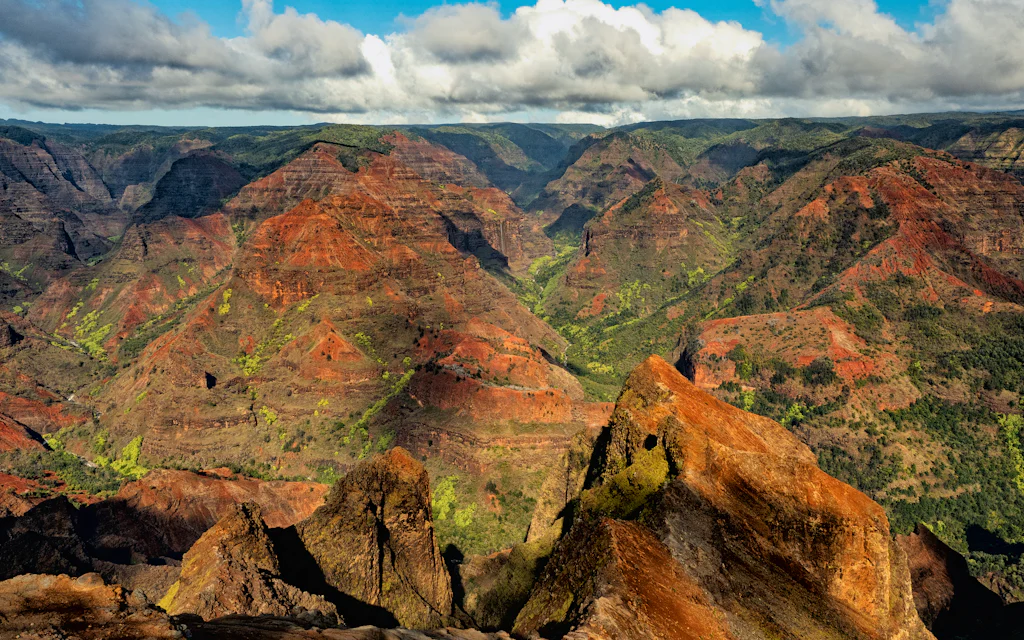
Waimea Canyon is the dramatic, mile deep gorge that splits the west side of Kauai, a 10-mile-long canyon of rust red cliffs, emerald green ridges, and silver waterfalls that has earned the nickname "the Grand Canyon of the Pacific." It is one of the most jaw dropping sights in all of Hawaii, and the easiest way to see it is simply to drive the scenic road to its lookouts.
These details were last verified in 2026.
But there is more to Waimea Canyon than a roadside photo. You can hike down into it to a waterfall, drive on up to where the canyon meets the cliffs of the Na Pali Coast, or fly over the whole thing by helicopter, and one simple timing rule makes the difference between a clear, glowing canyon and a wall of fog.
This guide covers how to visit Waimea Canyon, the scenic drive and the best lookouts, the Waipoo Falls hike, the Kalalau Lookout up in Kokee (Kokeʻe), the fees and the drive time, when to go, and how to see it from the air.
Table of contents
01
What is Waimea Canyon?
Waimea Canyon is a vast erosional gorge on the west side of Kauai, the oldest of the main Hawaiian Islands, and millions of years of erosion show.
Roughly 10 miles long and about 3,000 feet deep, the canyon was carved by the Waimea River and by a catastrophic ancient collapse of the volcano that built Kauai. The result is a riot of color, deep reds and oranges from iron rich volcanic soil, vivid greens where vegetation clings to the slopes, and ribbons of waterfall after a rain. The light shifts it constantly through the day.
How should you experience Waimea Canyon?
Scenic drive + lookoutsOur pick
- Best for
- The easy classic — drive the canyon road and stop at the big overlooks; jaw-dropping views with minimal walking
- The catch
- Clouds roll in by midday; go early or you'll photograph fog
Hike to Waipoo Falls
- Best for
- Getting into the canyon itself — a ~3.5-mile trail to a waterfall and pool, with views the road can't give
- The catch
- Muddy, steep in spots, and a real half-day hike
Kokee & Kalalau Lookout
- Best for
- Driving to the very top, where the canyon gives way to a stunning view over the Na Pali Coast
- The catch
- Even more cloud-prone up high; bring a layer, it's cooler
Helicopter flight
- Best for
- The aerial wow — the only way to see the canyon's full scale and the Na Pali Coast in one go
- The catch
- Expensive, and weather can cancel it
The "Grand Canyon of the Pacific" nickname is famous, and while it is smaller than Arizona's, the comparison captures the scale and the drama, and Waimea has something the Grand Canyon does not, tropical green draping the red rock, and the Na Pali Coast waiting just beyond its upper rim.
There is real cultural and ecological depth here, too. The name Waimea means "reddish water" in Hawaiian, for the iron rich runoff that tints the river, and Kauai's high, wet interior above the canyon, including Mount Waialeale (Waiʻaleʻale), one of the rainiest spots on Earth, feeds the waterfalls that streak the walls. The forests up in Kokee shelter native birds and plants found nowhere else, which is part of why the whole area is protected.
It sits within Waimea Canyon State Park, which runs straight into Kokee State Park higher up, so a visit to one is a visit to both. For most travelers, the canyon is the single best reason to spend a day on Kauai's quieter, sunnier west side, and it pairs naturally with the rest of things to do on Kauai.

Photo by Jason Weingardt on Unsplash
02
Getting there: the scenic drive
The drive is half the experience, a winding climb from the coast up to the canyon rim, with the views getting better at every turn.
There are two roads up, and they merge a few miles in. Waimea Canyon Drive (Highway 550) starts from Waimea town and is the more scenic, easier climb. Kokee Road (Highway 552) branches up from Kekaha to the west. The classic first timer move is to go up Highway 550 for the canyon views and come back down 552 for a different perspective.
From Waimea town, it is about 45 minutes of driving to the top lookout without stops, climbing a narrow, curving road, so take it slow, watch for oncoming cars on the bends, and pull over only at the marked lookouts. Plan to spend at least 1.5 to 2 hours for the drive and the main stops, more if you hike.
There is a state park entrance fee for nonresidents, roughly $5 per person plus $10 per vehicle, and the good news is it covers Kokee State Park too, so you pay once for the whole day. Map the route into a wider Kauai road trip and the west side becomes an easy, rewarding day.
A note on the drive itself, the road is paved and accessible to any rental car, you do not need four wheel drive, but it is narrow and winding with sheer drop-offs in places, so it is not the road to be racing or distracted on. Use the marked pullouts to take in views rather than slowing on the road, give cyclists and the occasional wild chicken room, and on the way down, use a lower gear to spare your brakes on the long descent. Treat it as part of the scenery, not a transfer to it.
03
The best lookouts
The lookouts are the heart of a Waimea Canyon visit, and a few stand out. They are all right off the road with short walks from the parking areas.
Waimea Canyon Lookout (around mile marker 10) is the main event, the big, full on view into the heart of the canyon, with its red walls, green ridges, and, after rain, the distant thread of Waipoo Falls. If you stop at only one, stop here.
Puu (Puʻu) Hinahina Lookout (around mile 13) gives a different angle down the canyon toward the coast, and on a clear day you can see the forbidden island of Niihau (Niʻihau) out in the ocean. Between and beyond these, smaller pullouts offer their own framings, the canyon looks different from every one, so it rewards a few stops rather than a single photo.
After rain, keep an eye out for Waipoo Falls itself, a roughly 800-foot waterfall that streaks down the canyon wall and is visible (and audible) from the main lookout and the trail, it is fullest in the wetter months and can shrink to a trickle in a dry spell. You may also be greeted by Kauai's famous wild roosters and hens, which strut the lookout parking lots looking for handouts (do not feed them, however charming).
A practical note, the official lookouts have parking and restrooms, but the canyon's edges are steep and often unfenced, so keep well back from the rim and keep an eye on kids. The views are worth lingering over, bring patience for the cloud to clear and you will often be rewarded with a sudden, glowing reveal.
04
Beyond the canyon: Kokee and the Kalalau Lookout
Here is the one strong opinion in this guide, and it is the mistake most visitors make, do not stop at the canyon lookouts and turn around. Keep driving up.
Past the canyon, the road climbs into Kokee State Park, a cool, misty highland of forest and trails, and to the two lookouts that are, for many people, the real highlight of the whole drive. The Kalalau Lookout and, a little higher, Puu o Kila Lookout (around 4,000 feet) deliver a staggering view down the Kalalau Valley to the Na Pali Coast, the soaring, fluted green cliffs you cannot reach by car anywhere else on Kauai. Standing here, looking down a valley to the sea, is one of the great views in Hawaii.
The catch is the same one that governs the whole canyon, clouds. These high lookouts cloud over even faster than the canyon below, so the earlier you arrive, the better your odds of a clear Na Pali view. Many a visitor has driven all the way up to find a wall of white, and many who came at dawn have had it all to themselves in perfect light.
Kokee is also a hiking hub in its own right, with a network of trails through the highland forest, from short rim walks to the long, demanding Pihea and Awaawapuhi (Awaʻawapuhi) trails that lead to even more dramatic Na Pali overlooks. If you have the time and legs for it, an hour or two on a Kokee trail is a completely different, greener counterpart to the red canyon below.
Near the Kalalau Lookout, Kokee Lodge has a small restaurant, restrooms, and a gift shop, plus a natural history museum nearby, a welcome warm up stop in the cooler highland air before you head back down.

Photo by Jakob Owens on Unsplash
05
Hiking Waimea Canyon: Waipoo Falls
To really feel the canyon rather than just photograph it, take a hike, and the classic is the trail to Waipoo Falls.
The Waipoo Falls hike drops from the rim down into the canyon to a waterfall and a pool you can dip in, with knockout canyon views along the way. The full loop runs a little under four miles (roughly 1.5 miles each way to the falls), and while it is family doable, it is a real hike, the trail is often muddy and slippery, with steep, root tangled sections and a climb back out at the end. Wear proper shoes, not flip flops.
It is worth the effort. Being down inside the canyon, with the red walls rising around you and the falls ahead, gives you a sense of scale the lookouts simply cannot. Go in the morning while it is cooler and clearer, bring water and a light rain layer (the area gets sudden showers), and give yourself two to four hours depending on your pace.
A safety word that genuinely matters here, the flash flood risk is real in the canyon's streams and pools, so do not enter the water or cross streams if rain is falling or threatening up above, even if it is sunny where you stand, the watershed is enormous and water can rise fast and far downstream. Check the forecast, turn back if the weather turns, and treat the upper trails (which can be long and remote) with the respect a high, wet, wild place deserves.
If you would rather not navigate the trail alone, guided hiking and kayak outfitters on Kauai run trips into the canyon and Kokee, which take the route finding and the mud management off your plate. For the canyon's other trails, Awaawapuhi, Kukui, the Alakai Swamp, and where they rank among Kauai's best hikes, our island roundup sorts them all. Either way, one hike turns Waimea from a scenic drive into a genuine adventure.
06
Seeing it from the air
If your budget allows one splurge on Kauai, a helicopter flight over Waimea Canyon is the one to consider, because the island guards its best scenery from the roads.
A huge share of Kauai, the full Na Pali Coast, the interior waterfalls, the depths of Waimea Canyon, is simply unreachable by car. A helicopter tour sweeps over all of it, down the canyon, along the fluted Na Pali cliffs, past Manawaiopuna ("Jurassic") Falls, and over Mount Waialeale's dripping crater. It is expensive and weather dependent, but for sheer wow per minute, nothing on the island beats it.
A Kauai helicopter tour shows you the canyon's true scale and the Na Pali Coast in one unforgettable hour, the canyon from above looks nothing like the view from the rim.
★4.8(932)
Kauai Deluxe Waterfall Safari: Helicopter Tour
55 minutes
Free cancellation
from
$309
A few helicopter tips if you go that route, book a morning flight (calmer air, clearer skies), choose a "doors off" flight only if you are comfortable with it, take motion sickness precautions if you are prone to it, and know that flights genuinely do cancel or reschedule for weather, so book it early in your trip to leave room for a backup day. The cost stings, but the consensus among repeat Kauai visitors is that it is the one splurge most worth making.
If a flight is not in the cards, the other way to see Na Pali up close is from the water, a Na Pali Coast boat tour sails the base of the cliffs you glimpse from the Kalalau Lookout. Between the rim, the trail, the air, and the sea, Kauai gives you four completely different ways to take in the same astonishing landscape.
07
The best time to visit
Timing is everything at Waimea Canyon, and one rule matters more than all the others, go early.
Arrive before 9 a.m. This is the single most important tip in this guide. The canyon and especially the high Kokee lookouts cloud over as the day warms, and by midday you can easily find the views swallowed by fog. Early morning brings the clearest air, the best light on the red walls, the fewest people, and the best odds of a clean Na Pali view from the top. It is worth setting an alarm.
Season matters less, since the west side is the driest, sunniest part of Kauai year round, but the canyon is greenest and the waterfalls fullest after the wetter winter months (roughly November to March). Even in the dry season, expect quick passing showers up in Kokee, that is what keeps it green.
A nice strategy if your schedule allows, do the lookouts first thing for the clearest views, then hike or explore Kokee as the morning goes on, rather than the reverse, that way you bank the long distance views while the air is clear and save the up close trail time for when the clouds would not matter anyway. And if you only get one shot and it is cloudy, give it twenty minutes. The canyon's weather is fickle, and a patient wait is often rewarded with a sudden, dramatic clearing.
Whenever you go, build in flexibility and patience, clouds come and go, and a lookout that is socked in when you arrive can clear in ten minutes. Linger, and let the canyon reveal itself.

Photo by Roberto Nickson on Unsplash
08
What to bring and know
A few practicalities make a Waimea Canyon day smoother, since you are heading somewhere remote and changeable.
- Layers. The coast is hot, but up in Kokee at 4,000 feet it is cool and often misty, bring a light jacket or fleece, especially in the morning.
- A rain layer. Passing showers are part of the highland's charm and its weather. A packable rain shell keeps a sudden squall from ending your hike.
- Gas and snacks. Fuel up in Waimea or Kekaha before you head up, services are limited beyond Kokee Lodge, and there are no big stores at the top.
- Good shoes if you plan to hike, the trails are genuinely muddy.
- Water and sun protection, the lookouts are exposed, and the altitude sun is strong.
- Bug spray if you plan to hike, the damp forest trails of Kokee have mosquitoes, especially after rain.
- Snacks and a picnic. Beyond Kokee Lodge there is nowhere to buy food, and a sandwich at a lookout with that view beats anything else. Just pack out your trash and do not feed the chickens.
- A real camera or charged phone. The canyon is a photographer's dream and the light changes constantly, a dead battery at the rim is a genuine shame.
It is also a long drive from the main resort areas, so top off the tank, use the restrooms at the lookouts when you see them, and do not count on cell signal up in the park. A little preparation turns a remote canyon day into a smooth, glorious one.
09
Getting there and where to stay
Waimea Canyon is on Kauai's west side, the island's sunniest and least developed coast, reached via the town of Waimea on Highway 550.
From the main visitor bases the drive is real, figure about 45 minutes to an hour from Poipu on the south shore, longer from the north shore areas like Princeville and Hanalei. Because of that distance and the go early rule, some visitors who want a dawn start choose to stay a night on the west or south side (Waimea or Poipu) to shorten the pre clouds morning drive. You can compare Kauai hotels on Expedia (also on Booking.com) to base on the sunny south side near the canyon.
A full disclosure, since we are an Oahu company, we run beach picnics on Oahu, not Kauai, so we have no stake in the where to stay on Kauai question, but our guides to the best of Kauai, the Kauai map, and where Kauai fits among the islands help you plan the trip. If your travels also touch Oahu, our picnic packages (from $349 for two) are there for a sunset on that island.
The town of Waimea at the base is worth a quick look on the way through, it is a sleepy, historic west side town (with a statue of Captain Cook, who first landed in the islands here) and a few local eateries to grab breakfast or a plate lunch before the climb. Stocking up there, rather than counting on the top, is the smart move. The west side is also home to Polihale, the long, remote beach at the end of the road, if you want to pair the canyon with a wild stretch of sand.
However you reach it, Waimea Canyon is one of Hawaii's truly unmissable sights, go early, drive all the way to the top, and let one of the most beautiful canyons on Earth do the rest. Few places in the islands deliver this much grandeur for the price of a scenic drive and a state park fee.
FAQ
How do you get to Waimea Canyon?
Waimea Canyon is on Kauai's west side, reached by driving up Waimea Canyon Drive (Highway 550) from the town of Waimea, or Kokee Road (Highway 552) from Kekaha. The two merge a few miles in. From the south shore Poipu area it is about a 45-minute to one hour drive, longer from the north shore.
Is there a fee for Waimea Canyon?
Yes. Nonresidents pay a state park fee of roughly $5 per person plus $10 per vehicle, and it covers Kokee State Park higher up the road as well, so you only pay once for the whole day. Hawaii residents enter free with ID.
What is the best lookout at Waimea Canyon?
The Waimea Canyon Lookout (around mile marker 10) is the main, must see overlook into the heart of the canyon. But do not stop there, keep driving up to the Kalalau Lookout and Puu o Kila Lookout in Kokee State Park, which offer staggering views over the Kalalau Valley and the Na Pali Coast.
How long do you need at Waimea Canyon?
Plan at least 1.5 to 2 hours for the drive up and the main lookouts, and add 2 to 4 hours if you hike, such as the Waipoo Falls trail. Many visitors make it a half day or full day trip, especially when combined with the Kokee lookouts and a hike.
What is the best time to visit Waimea Canyon?
Early morning, arrive before 9 a.m. The canyon and the higher Kokee lookouts cloud over as the day warms, often hiding the views by midday. Early means the clearest air, best light, fewest crowds, and the best chance of a clear Na Pali view from the top.
Can you hike in Waimea Canyon?
Yes. The classic is the Waipoo Falls hike, a roughly 3.5-to-4-mile round trip down into the canyon to a waterfall and pool, with great views along the way. It is often muddy and steep in places, so wear proper shoes. Kokee State Park above the canyon has many more trails, including ones to Na Pali viewpoints.
Is Waimea Canyon worth visiting?
Absolutely, it is one of the most spectacular natural sights in Hawaii and the highlight of Kauai's west side. The 10-mile, 3,000-foot-deep canyon of red and green cliffs, plus the Na Pali views from Kokee just above, make it well worth the scenic drive, especially if you go early before the clouds arrive.
Disclosure: Some links on this page are affiliate links. If you book or buy through them we may earn a small commission, at no extra cost to you. As an Amazon Associate, we earn from qualifying purchases.

