Makapuu Lighthouse Trail: Everything You Need to Know
22 min readYndira W. Tonin
The Makapuu Point Lighthouse Trail is the easiest big view hike on Oahu, a fully paved two mile round trip to a clifftop lookout with a red roofed lighthouse, two offshore islands, and, from roughly December through May, humpback whales breaching close enough to make a grown adult squeal.
All of this was last checked in 2026.
That is the whole pitch. Famous view, almost no suffering.
If you have read our other Oahu trail posts, you know the usual deal, drive an hour, find no parking, climb a muddy ridge, sign a metaphorical waiver, question your life choices near the top. The Makapuu lookout on Oahu is the opposite of all that. It is paved. It is stroller friendly. Your grandmother could do it, and honestly she would probably lap you while filming whales on her phone.
So here is the honest guide, where it is, the parking situation (there is always a parking situation), what the trail's actually like, the whales, the tide pools you should mostly admire from above, and how to time it so you are not melting on a shadeless cliff at noon.
Getting to the Makapuu Lighthouse Trail
Tap to open Google Maps with turn-by-turn directions.
Table of contents
- What (and where) is the Makapuu Lighthouse Trail?
- How to get there, and the parking reality
- The trail, distance, difficulty, and what it is actually like
- The view from the top
- Whale watching at Makapuu
- The Makapuu tide pools (the honest version)
- Sunrise, seasons, and gate hours, when to go
- What to bring
- Is the Makapuu Lighthouse Trail worth it?
- What else is nearby on the southeast coast
- Where to stay near Makapuu
- FAQ
01
What (and where) is the Makapuu Lighthouse Trail?
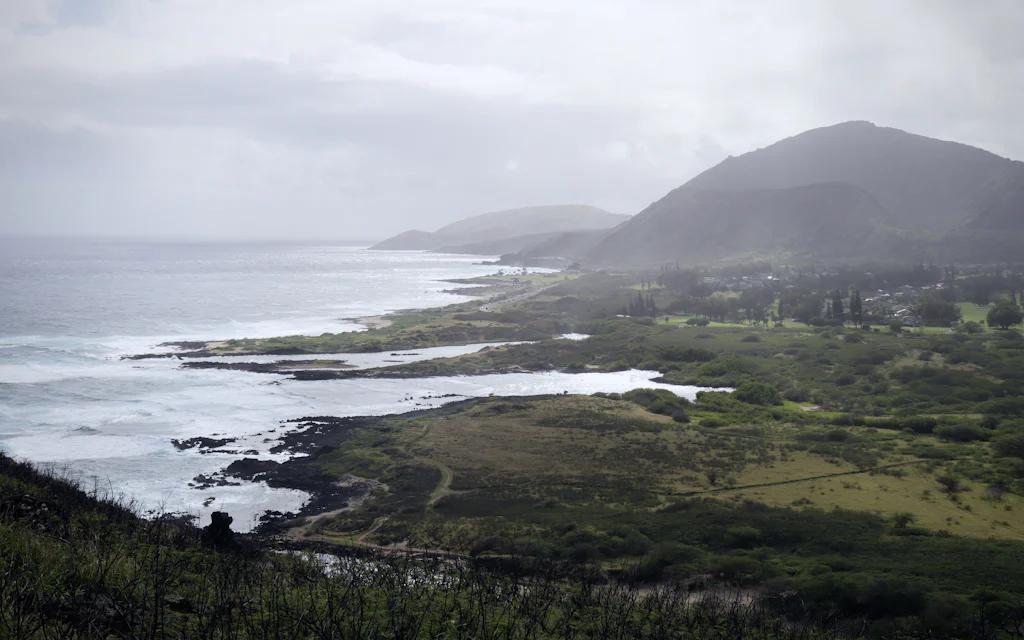
The Makapuu Point Lighthouse Trail is a paved coastal path on the far southeastern tip of Oahu, inside the Kaiwi State Scenic Shoreline. It climbs a gentle, exposed headland to a series of railed lookouts that stare straight down at the 1909 Makapuu Lighthouse and out across the Kaiwi Channel toward Molokai and Lanai.
It is run by Hawaii's Division of State Parks, which is your first clue that this is a legitimate, maintained, you will not get a citation kind of hike. No permit, no reservation, no sketchy "is this even allowed" energy. Refreshing, frankly.
The lighthouse itself is the star. It is small, white, with that postcard red roof, perched on the cliff below the trail's end. You cannot walk down to it, the lighthouse grounds are closed to the public, but the view of it from the upper lookout is the shot everyone comes for. It also houses one of the largest Fresnel lenses in the United States, which is a sentence that means more to lighthouse people than it does to you, and that is fine.
The setting does the heavy lifting. You are on a dry, golden headland with the deep blue channel on three sides, Rabbit Island (Manana) and Kaohikaipu sitting just offshore, and the Koolau cliffs marching up the coast behind you. It feels remote and dramatic for a place you can reach in flip flops.
This is also the southeastern corner most visitors never bother with, which is their loss and your gain. Quieter than Diamond Head, prettier than you would expect for the effort, and the kind of spot locals bring out of town guests when they want an easy win.
02
How to get there, and the parking reality
Makapuu Point sits at the southeastern tip of Oahu, about 30 to 35 minutes east of Waikiki along Kalanianaole Highway (Route 72). The drive itself is half the fun, you will roll past Hanauma Bay, the Halona Blowhole, and Sandy Beach, with the ocean throwing itself at the lava the whole way.
Punch Makapuu Lighthouse Trail or Kaiwi State Scenic Shoreline into your maps app, not just "Makapuu," which can dump you at the beach park across the highway instead of the trailhead. You want the gated lot on the makai (ocean) side of the road, just past the top of the hill.
Now, the parking. There is always a parking situation, and here is this one, the lot is free, which is wonderful, and small, which is not. It holds a few dozen cars and fills up fast on weekends and during whale season. By midmorning on a Saturday it can be a slow motion vulture circle of cars waiting for someone to leave.
There is a gate, too, and it matters. Vehicles can only enter when the gate is open, roughly 7 a.m. to early evening, with the exact closing time shifting by season (think around 6 to 6:45 p.m.). Get locked in behind it and your car spends the night on a cliff. Do not be that person.
A few honest parking tips, come early (before 9 a.m. is gold), or come late afternoon when the sunrise crowd has cleared out. People do park along the highway shoulder when the lot's full, but it is tighter and less safe with traffic flying past, so the lot is the better play. And as always on Oahu, leave nothing visible in the car, a smash and grab takes ten seconds and ruins a great day.
If the drive and park puzzle is not your idea of a vacation, totally fair, a circle island day tour swings by the southeast lookouts and the big name stops without you ever touching a steering wheel or a parking app.
★4.8(4,263)
Oahu Circle Island Tour with Waimea Valley Waterfall
8 hours
Free cancellation
from
$154
03
The trail: distance, difficulty, and what it is actually like
Here is the part that makes Makapuu the people pleaser of Oahu hikes, it is about two miles round trip (some signs and apps say 2.5), it is paved the entire way, and it climbs only around 500 feet on a steady, gentle grade. No scrambling, no roots, no "is this even the trail" moments. It is a wide old service road that tilts uphill, and that is it.
Plan on 45 minutes to an hour and a half depending on how often you stop to take photos and lose your mind over whales. Most people are up and back in under two hours, including a good long stand and stare at the top.
Because it is paved and railed, it is genuinely friendly for kids, strollers (the determined kind, it is a real uphill), and anyone who wants a Hawaii view without a Hawaii workout. It is also a popular morning fitness lap for locals, so do not be surprised when someone power walks past you pushing a jogging stroller and chatting on the phone like the hill is not there.
The one thing the trail is not, shady. This is a hot, dry, exposed headland covered in low kiawe and the occasional defiant cactus. There is essentially zero shade from the lot to the lookout. On a sunny afternoon the pavement radiates heat back up at you like a pizza stone, and the trade winds at the top, while a blessing, will absolutely audition your hat for a one way flight to Molokai.
Footwear is forgiving here, regular sneakers or even sturdy sandals are plenty, since you are on smooth pavement the whole way. Save the trail runners for the muddy ridges. The only real demands are sun, wind, and water, in that order.

Photo by little plant on Unsplash
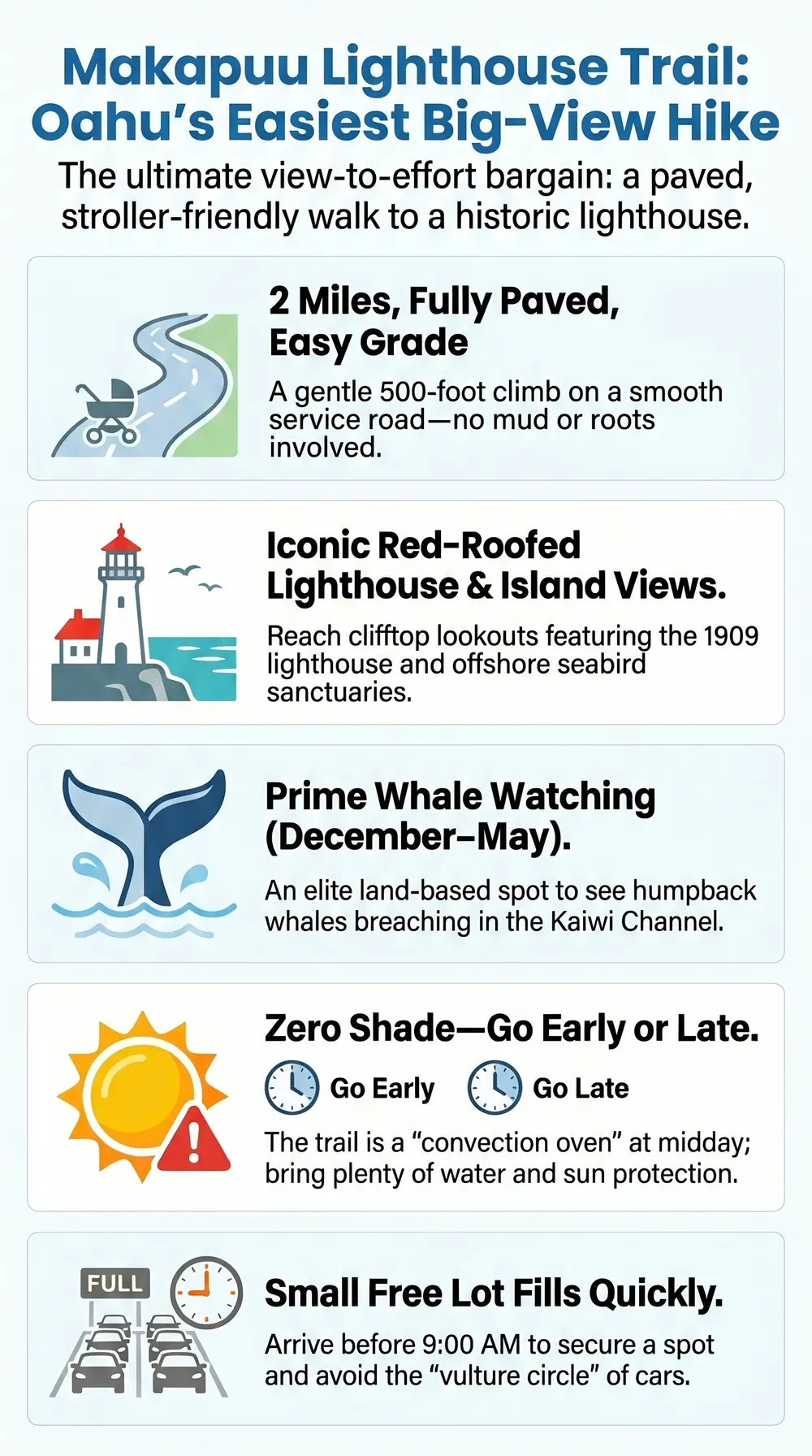
The Makapuu Lighthouse Trail at a glance, the easiest big view hike on Oahu.
04
The view from the top
The payoff arrives in stages, which is part of the charm. About halfway up, the lookouts start, and each one is better than the last.
From the upper platforms you get the full sweep, the little white lighthouse with its red roof directly below, the Kaiwi Channel stretching toward Molokai and Lanai on a clear day, and Rabbit Island and Kaohikaipu sitting offshore like two sleeping sea creatures (Rabbit Island, Manana, is a seabird sanctuary, those are not actual rabbits, despite the shape). Turn around and the windward coast unspools north toward Waimanalo's impossibly long beach.
There are a couple of WWII-era pillboxes near the top, too, squat concrete bunkers that now serve mainly as wind shelters and photo perches. They are a quiet reminder that this dramatic lookout was once a strategic military observation point, watching the same channel for very different reasons. Poke your head inside one and you will usually find someone hiding from the wind, eating a granola bar, looking smug.
The lookouts are staged, which is the underrated part. You do not grind to a single summit and hope it was worth it, the view opens up gradually, with railed platforms at a few points along the upper stretch, each angling at a slightly different slice of coast. The lower ones frame the lighthouse. The top one gives you the whole 270-degree channel and islands panorama. It means even if you run out of steam before the very top, you have already banked a great view.
The light is best early and late. Morning gives you the sun rising out of the channel and softer crowds. Late afternoon backlights the whole coast in gold. Midday is harsh, hot, and flat, still pretty, but you will be squinting and sweating through the magic. On a clear winter day with the islands sharp on the horizon and a whale spout going off below, it is one of those views that makes the whole flight to Hawaii feel like a bargain.
One photographer's note, a wide shot captures the lighthouse and islands scene, but the whales and distant islands really want a little reach. Even a cheap pair of compact binoculars turns "is that a whale or a wave" into an actual show.

Photo by Abigail Lynn on Unsplash
05
Whale watching at Makapuu
This is Makapuu's secret weapon. From roughly December through May, Pacific humpback whales migrate to Hawaii to breed and calve, and the Makapuu headland is one of the best land based whale watching spots on Oahu. You are up high, you are staring at deep channel water, and the whales come through close.
On a good winter morning you will see spouts, tails, and, if the ocean's feeling generous, full breaches, where a 40-ton animal throws itself out of the water for reasons marine biologists still politely describe as "not fully understood" (the whales know. They are just not telling). The whole lookout goes quiet, then erupts, every single time.
It is worth understanding what you are watching. These are North Pacific humpbacks, and the waters around the islands are protected as the Hawaiian Islands Humpback Whale National Marine Sanctuary precisely because so many of them gather here each winter. Makapuu's elevation and its position over the channel make it a front row seat that costs nothing but a short uphill walk.
Bring patience and something to look through. Whales do not perform on schedule, so give it time, find a railed spot, settle in, and scan the horizon between the islands. Spouts are usually the first thing you will catch, little puffs of mist that do not behave like whitecaps. Once your eye learns the difference between a whale and a whitecap, you start seeing them everywhere, and the whole channel turns into a slow, scattered show.
A word on whale etiquette, even from a cliff, these are protected animals, and approaching them by boat or drone is regulated for good reason. From the lookout you are doing it the perfect way, far away, up high, leaving them entirely alone. Resist the urge to "help" anyone get closer, and just enjoy being a polite, distant fan.
If you would rather get out on the water and meet them closer than a cliff allows, a whale watching cruise runs all season and gets you out into the channel where the action is, a great pairing with the land view. For more on shore versus boat strategy and timing, our full Oahu whale watching guide breaks down both.
06
The Makapuu tide pools (the honest version)
Below the main lookout, on the ocean side, sit the Makapuu tide pools, a cluster of natural rock pools that people scramble down to swim in. They look magical in photos. They are also where I get to play the role of the friend who tells you the unfun truth.
Getting to the Makapuu tide pools on Oahu means leaving the nice paved trail and taking a steep, unofficial, unmaintained side path down the cliff face. It is loose, rocky, and a real descent, not a casual detour. And the pools sit right at the edge of open ocean with no lifeguard, no railing, and no one coming quickly if it goes wrong.
On a genuinely calm, low surf day, the lower pools can be a gorgeous, sheltered soak. On any other day, they are a hazard. The ocean here can surge over the rocks without warning, and people have been swept off this shelf. The exact same water that makes the pools pretty is the water that makes them dangerous.
So here is the green light / red light version, the same one we use for every rock shelf spot on this island,
Is today a tide pool day at Makapuu?
Green light, goOur pick
- Best for
- A calm, low-surf morning with a flat forecast, you're a confident ocean swimmer, and you've checked the surf yourself
- The catch
- Still never go alone, and still watch the water the whole time you're down there
Yellow light, look from above
- Best for
- Small but lingering swell, gusty trades, or a forecast you can't quite read
- The catch
- Stay on the lookout, get the photo from the rim, skip the scramble down
Red light, do not climb down
- Best for
- Any real swell, a high-surf advisory, rain, or fading light
- The catch
- The same surge that makes the pools pretty sweeps people off this shelf — the lighthouse view is the point anyway
My honest take, and the one strong opinion I will spend on this post, skip the tide pool scramble unless conditions are obviously calm and you are a confident ocean person, the lighthouse lookout is the actual highlight, and it delivers the entire reason you came without ever leaving the pavement. The pools are a bonus for the right day, not the point. If the surf's up at all, photograph them from above and feel smug about your excellent judgment.
If you want guaranteed calm water to actually swim and snorkel in, you have got far better, lifeguarded options nearby. Our guide to the best snorkeling on Oahu covers spots with easy entries and someone actually watching the water.
07
Sunrise, seasons, and gate hours: when to go
Two timing questions decide your Makapuu experience, what time of day, and what time of year.
Time of day. Sunrise is the cult favorite, and for good reason, you are facing east over the channel, the light is unreal, the air is cool, and the shadeless trail has not turned into a frying pan yet. The catch, the vehicle gate opens around 7 a.m., which in winter is after sunrise, so dedicated sunrise hikers sometimes park outside and walk in. Check the gate hours and the day's sunrise time before you commit to that plan.
If sunrise is not happening, early morning is the next best thing, cooler, quieter, easier parking. Late afternoon works too, with golden light and the sunrise crowd long gone. The one window to avoid is midday in summer, full sun, no shade, hot pavement, and a headland that turns into a convection oven.
Time of year. For whales, you want December through May, peak roughly January to March. For comfort, the cooler, less humid months (late fall through spring) make the shadeless climb far more pleasant. Summer is still doable, just go early, hydrate like it is your job, and respect the heat.
Day of week matters for parking more than anything. Weekends and holidays pull big local crowds. A weekday morning is dramatically calmer on both the trail and the lot. And always glance at the surf and wind forecast, the National Weather Service in Honolulu posts the day's marine and surf outlook, which tells you whether the tide pools are even a conversation.
08
What to bring
Makapuu has a small restroom near the trailhead and, crucially, no shade and no water once you start walking. Pack for a hot, exposed, breezy cliff, because that is exactly what you are getting.
- Water, more than you think. There is no water on the trail and nowhere to buy any once you are parked. An insulated water bottle keeps it cold against the heat radiating off the pavement.
- Reef safe sunscreen. Zero shade plus reflected glare off the water is a sunburn factory. Hawaii law restricts certain sunscreen chemicals anyway, so reef safe is the move.
- A packable sun hat. The trades at the top are strong, so pick one that actually stays on your head and does not emigrate to Molokai.
- Compact binoculars. In whale season, this is the difference between "I think I saw something" and an actual show.
- Sturdy footwear. Sneakers or solid sandals are plenty for the pavement. You only need real shoes if you are (carefully, on a calm day) heading down to the tide pools.
- A camera or a charged phone. The lighthouse and islands shot is one of the most reliable photos on the island. Do not show up at 3% battery.
What to skip, hiking poles (it is paved), and any expectation of a snack bar, a gift shop, or a vending machine. This is a state shoreline, not a theme park. Bring what you need and carry your trash back out, there is limited rubbish service up here, and this coastline stays beautiful because people pack it out.
09
Is the Makapuu Lighthouse Trail worth it?
Yes, and it is one of the few Oahu hikes I would recommend to literally anyone, regardless of fitness, age, or appetite for suffering.
Here is the math. Most of Oahu's jaw dropping views charge a steep entry fee in effort, the Koko Crater stairs will end your quads, the windward ridge hikes are long and muddy, and the truly famous ones come with legal and safety baggage. Makapuu hands you a top tier coastal panorama, a storybook lighthouse, and front row whales for a flat, paved, hour ish walk. That is the best view to effort ratio on the island, full stop.
Who it is perfect for, families with kids, anyone hiking with grandparents, travelers on a jet lagged first morning who want a win without a workout, and photographers who'd rather spend their energy on the shot than the climb. Who might find it underwhelming, hardcore hikers chasing a burn and solitude, since it is paved, popular, and over fairly quickly. If you want lungs on fire and an empty trail, Makapuu is not your hike, and that is exactly why everyone else loves it.
The one caveat worth repeating is the sun. The thing that makes Makapuu easy (open, exposed, paved) is the same thing that can make it miserable at the wrong hour. Treat it as a morning or late afternoon outing rather than a midday one, and the "worth it" question answers itself.
It pairs beautifully with the other easy win lookout on this coast. If you liked the low effort, high reward formula here, the paved crater rim at Diamond Head is the same idea on the south shore, and our best hikes on Oahu roundup ranks where Makapuu sits among the rest.
One honest aside, since sunset on a blanket is our actual day job, Makapuu is a clifftop lookout, not a picnic spot, it is shadeless, windy, and there is nowhere to lay out a spread, nor would you want to up there. But Waimanalo Bay, just down the hill, is some of the prettiest sand on the island and squarely our home turf. If you want the view day followed by a proper beach evening, we set up sunset picnics on Oahu's real beaches from $349. Makapuu for the lookout, Waimanalo for the blanket, two different tools, both excellent.

Photo by Drew Farwell on Unsplash
10
What else is nearby on the southeast coast
Makapuu is a 90-minute stop, not a full day, and it sits in the middle of Oahu's best stretch of coastal road. String a few of these together and you have got a proper southeast loop.
- Makapuu Beach Park, right across the highway from the trailhead, a powerful bodyboarding and shorebreak beach. Gorgeous to look at, serious for swimming. Respect the lifeguards and the flags.
- Halona Blowhole Lookout, a few minutes west, where the ocean shoots up through a lava tube, plus tiny "Eternity Beach" (Halona Cove) tucked below.
- Sandy Beach, the famous (and famously punishing) shorebreak just west of Makapuu. Incredible for experienced bodyboarders, a quick way to meet the sand wrong for everyone else. Great for watching.
- Lanai Lookout, a quick roadside pull off with layered lava cliffs and, in winter, another solid whale spotting perch.
- Koko Crater Railway Trail, if your legs are spoiling for a fight, this brutal stairway up an old railbed is back toward Hawaii Kai. The polar opposite of Makapuu's gentle grade, and the view's a worthy reward.
- China Walls, keep going west to Portlock for the south shore's best sunset off a lava shelf. Our China Walls guide covers that one in full.
Do Makapuu early, hit a lookout or two, and finish with a beach or a sunset, that is a southeast Oahu day done right. For the bigger picture of how the island fits together, our best hikes on Oahu guide maps it out.
11
Where to stay near Makapuu
There is no lodging at Makapuu itself, this is protected shoreline and quiet windward suburb, not hotel country. So the real question is where to base yourself so the drive out is short and the rest of your trip still works.
Most visitors stay in Waikiki, about 30 to 35 minutes west, and drive out for the morning. Waikiki gives you the most hotels at every price point, walkable food and beaches, and a straight shot east along the coast to Makapuu, Hanauma Bay, and the rest of the southeast lookouts. Browse Waikiki hotels (also on Booking.com) and you will have the whole southeast corner within a half hour drive. If you would rather wake up closer, the quieter, upscale Kahala and Hawaii Kai side (also on Booking.com) of the southeast shore cuts the Makapuu run to about fifteen minutes.
If you want to split the difference, Kahala and Hawaii Kai sit between Waikiki and the southeast tip, leafier, calmer, and ten to fifteen minutes closer to Makapuu. You trade the nightlife and walkable Waikiki strip for a quieter base that is still a short drive from town when you want it, and an even shorter one to the trailhead at sunrise.
If you would rather wake up closer to the windward side, look at vacation rentals in Kailua or Waimanalo, just over the hill, quieter, beachy, and a short hop to the trailhead, at the cost of nightlife and walkable restaurants. Waimanalo in particular puts you minutes from both the lighthouse trail and one of the longest, softest beaches on the island. It is the move if your trip leans toward sunrises and sand over city buzz.
Whichever base you pick, Makapuu works best as a morning stop before the heat and crowds build, so factor the drive time into your alarm rather than your afternoon. For a full breakdown of every base on the island and who each one suits, our guide to where to stay on Oahu walks through the trade offs region by region.
FAQ
How long is the Makapuu Lighthouse Trail?
It is about two miles round trip (some signs and apps list 2.5), fully paved, with roughly 500 feet of gentle elevation gain. Most people complete it in 45 minutes to an hour and a half, including time at the lookouts.
Is the Makapuu Lighthouse Trail hard?
No, it is one of the easiest view hikes on Oahu. The whole route is paved at a steady, moderate grade with no scrambling, making it friendly for kids, beginners, and determined strollers. The only real challenge is the heat and sun, since there is almost no shade.
Can you see whales from the Makapuu lookout?
Yes. From roughly December through May, the Makapuu headland is one of the best land based humpback whale watching spots on Oahu. You are elevated over deep channel water, so spouts, tails, and breaches are common on a good winter morning. Bring binoculars.
Is there parking at the Makapuu Lighthouse Trail?
Yes, there is a free lot at the trailhead, but it is small and fills up fast on weekends and during whale season. The gate opens around 7 a.m. and closes in the early evening, so do not get locked in. Arrive early or late afternoon for the best shot at a space.
Are the Makapuu tide pools safe?
Only on calm, low surf days, and only for confident ocean goers. Reaching them means a steep, unofficial scramble down the cliff to an unguarded shelf where the ocean can surge over the rocks. When surf is up, admire them from the lookout above rather than climbing down.
What is the best time to hike Makapuu?
Sunrise or early morning for cool air, soft light, and easy parking, or late afternoon for golden light and thin crowds. Avoid midday in summer, when the shadeless trail gets brutally hot. For whales, come December through May.
Do you need a permit or reservation for the Makapuu Lighthouse Trail?
No. It is a free state park trail with no permit and no reservation required, just mind the gate hours for the parking lot. That makes it one of the most hassle free big view hikes on the island.
Disclosure: Some links on this page are affiliate links. If you book or buy through them we may earn a small commission, at no extra cost to you. As an Amazon Associate, we earn from qualifying purchases.


